
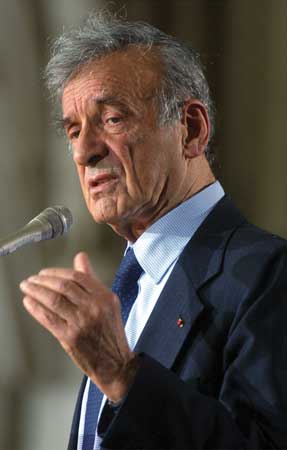


Elie Wiesel
(Dove, 1997)
Born- September 30, 1928
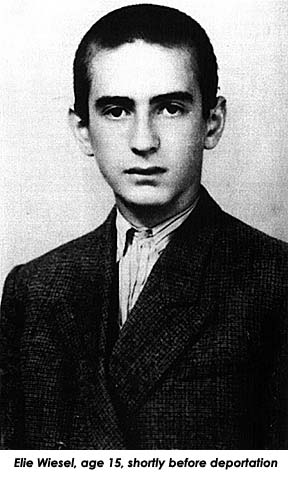
1928--born in Sighet,
Romania
1944--deported to
Auschwitz
Jan.1945--father
dies in Buchenwald
Apr.1945--liberated
from concentration
camp
1948--moved to
Paris to study at
the Sorbonne
1948--work in
journalism begins
1954--decides to write
about the Holocaust
1956--hit by a car
in New York
1958--Night is
published
1963--receives U.S.
citizenship
1964--returned to
Sighet
1965--first trip to
Russia
1966--publishes
Jews of Silence
1969--married Marion
Rose
1972--son is born
1978--appointed chair
of Presidential
Commission on
the Holocaust
1980--Commission
renamed U.S.
Holocaust Memorial
Council
1983--given keys to
National Holocaust Memorial
in D.C.
1985--awarded
Congressional
Gold Medal of
Achievement
1986--awarded
Nobel Peace
Prize
1995--publishes
memoirs
(Dove, 1997)
and hope. Elie is a Jewish holocaust survivor and currently an author. He has published 36 books and still feels as if he has done nothing to change the world. Wiesel's most recognized work of all of 36 pieces, is Night, a memoir of his days of Awschwitz. He goes into detailed reminiscence of hangings, death, sickness, cruelty, insanity, and darkness that was night. Night was the first installment in a trilogy.
Wiesel married in 1969 and his son was born in '72. He was appointed chair of the Presidental Commission on the Holocaust in '78, two years later the was renamed the U.S. Holocaust Memorial Council. In '83 the National Holocaust Memorial Museum in Washington, D.C..
Elie has done a Night special on Oprah, in which they walked along the ruins of Auschwitz and Wiesel shared his nightmares that he lived there. He told of how he lost his sisters and mother on the first day, and at the latter end of the nightmare his father had left him also. He tells of how much he'd lost, but how much he gained. People have said to him 'it is a miracle that you survived, it must have been a miracle.' He replies ' why would God choose me to survive rather than any of the others? There were plenty of others better than me. Why did he choose me?'
Night (Hill and Wang, 1958; 2006)
(Dove, 1997)