A number of years ago, I envisioned a process wherein nuclear fusion energy might be converted to electricity without the energy losses normally associated with the heat cycle.
At that time, the general view was that soon a hot plasma reactor system (that heated a fluid to drive turbines) would be perfected, and man would have all the energy he would ever want.
For this reason, I filed away my concepts and waited for the promised thermodynamic system. However, the path toward a random plasma system has been followed for nearly 40 years without useful success.
More recently, "cold fusion" made a debut and seems to have fizzled out as well.
Perhaps unlimited energy will be a long time coming for humanity, and I should contribute this vision while I'm still around to do so.
Two nucleons approach each other. As yet at a considerable distance, only the weak forces (coulombic) are in play. At some point, the strong nuclear attractive force starts to pull them together, overcoming the weaker repulsive forces. The nucleons now free-fall toward each other, crashing to the lower energy state of proximity. The energy released during this process is converted to thermal energy (the high kinetic energy of motion of the resulting particles). It would seem that any system that allows this crashing to take place, is doomed to the inefficiency of the heat cycle. The conversion of energy has taken place uncontrolled, and the best that can be done thereafter, is to gather up a fraction of the energy.
The key seems to be, how to prevent the last minute free-fall of the nucleons. If we could hold each of the nucleons, restrain the nuclear force, as the nucleons approached each other, and eased them down to their final positions of proximity; we could use that force, that we applied, to do useful work on the external system. This would be a "reversible" process, that is, at any point in the approach, the external force and the nuclear force would be in equilibrium. The energy would be transferred to the external system as the approach was taking place. Hence, at the final position, there would be no energy left to be expressed as thermal (kinetic) energy.
Which of the known forces would be sufficient to counter the nuclear binding force at the moment of collapse? The only one I know of, is another nuclear binding force on the other side of the nucleon.
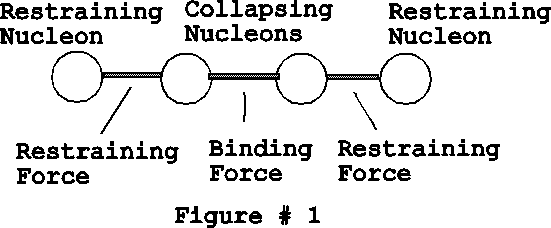
The physical object that could manifest this restraining force would be another nucleon. The following figure shows this next step, wherein two "external" nucleons are exerting nuclear binding force to restrain the collapse of the two nucleons under study. (Figure # 1)
We still can't hold these restraining nucleons with a force linked to an external system. The only hold we could apply would be yet another binding force from another nucleon, and another, and another, as shown in Figure # 2.
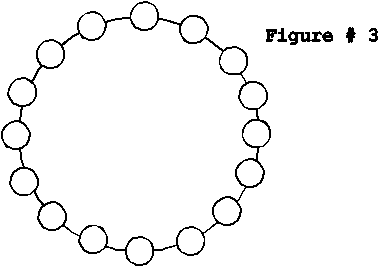
This chain of nucleons would seem to have to extend forever in a straight line. Theoreticians, of the past, were uncomfortable with space extending forever in a straight line, so they curved it back around on to itself. We shall do the same. Curve the line of nucleons around and bind the ends together with the last binding force required. (See Figure # 3. )
A limp "necklace" of nucleons would be of no use. It must therefore be given a tangential velocity of considerable magnitude. At great speed, a taut hoop would result. At speed, centrifugal forces would be generated from the masses of the particles being constrained to follow a circular path. At greater speeds, the hoop would be inclined to expand or even fly apart. The only forces that would counteract these forces of expansion would be the tangential forces of the nuclear binding force. There would be some speed at which the centrifugal force of the masses would be exactly equal to the centripetal force of the nuclear binding force. The rotating ring could then be said to be in equilibrium.
This is part of the condition that was being sought. That is, two nucleons in the process of collapse being restrained from doing so; being restrained from crashing to the lowest energy state of proximity.
A preliminary calculation shows that the tangential velocity during equilibrium would be around 25% of the speed of light, regardless of the radius of the ring, (taking into account, the relativistic increase of mass at moderate fractions of the speed of light.)
This counterbalancing of forces is however all internal. No link as yet exists to the surrounding system. It seems reasonable to assume that a rotating ring as described, would exhibit magnetic properties.
A coil of wire, for example, will exhibit a magnetic field if a current of electrons is passing through it. The magnetic field of the wire points out along the axis of the coil. It seems reasonable to assume that a field will point out along the axis of rotation of a nucleonic ring.
Moreover, the strength of this field would be related to the radius of the ring and the velocity of the nucleons. It is this magnetic property that would be one way that a link could be established to an external field. (A coulombic link is also feasible but will be passed over for the purposes of brevity).
Returning to the analogy of the loop of electric wire, not only does a current exhibit a magnetic field, but a change in the strength of an externally applied magnetic field will cause a change in the current in the wire. This reversible conversion would be essential. As a change in the physical property causes a change in the magnetic field, so a change in the externally applied field will cause a change in the physical property of the nucleonic ring. In short, a change in the external magnetic field will tend to pull the nucleons apart (in a tangential direction) or the opposite change will tend to allow the nucleons to come together.
Now comes a most interesting insight; when the nucleonic ring is in equilibrium (due to its high speed), the strength of the controlling external magnetic field can be extremely small. To envision the change of the inter-nucleonic distance (normally under the control of the raging force of the nuclear bond) with only a modest magnetic field would be the quintessence of leverage.
If we allow the ring to contract reversibly (i.e. the external field is easing the nucleons together), the magnetic field exhibited by the ring will change, inducing electromotive force in the coils that generate the controlling field. This induced electromotive force could be stored as electrical energy or used immediately as useful work by a device that converts electric potential to mechanical work.
Draining off this energy of the nuclear bond as the collapse takes place, means that, at the final proximity of the nucleons, they are "cold". That is, that there will be no high thermal (or kinetic) energy to dissipate, as in a thermodynamic cycle, because the energy has already been converted by the linked external magnetic field.
We need now to lay aside the image of the nucleonic ring, to perform a different thought experiment. Consider a string of nucleons of finite length, Figure # 4. A number of nucleons are in a line, each bonded one to the next by the nuclear binding force. If we could create such a structure in a void of space, free of external influence, and leave it be; what would it do?
It would seem to have three options, Only one , of course, would obey the mathematics of the situation. The first scenario is that the combined coulombic forces along the axis of the structure would overcome the single nuclear force at the center of the structure and the structure would explode.
In the second and third scenario, the nuclear bond would be stronger and the structure would not explode. In the second scenario, the structure would be seen to be stabile, and it would simply stay in that configuration. The repulsive coulombic forces would cause the string to be taut and the nucleons would tend to remain coaxial. The nucleons not in immediate juxtaposition would be at a distance such that the nuclear force would not be sufficient to overcome the repulsive force and the nucleons would not be pulled together.
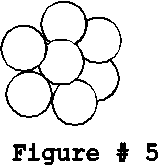
In the third scenario, the nuclear forces would be sufficient and the structure would collapse to the familiar nuclear cluster (with an attendant release of energy of course), as shown in Figure # 5.
Determining which of the three scenarios is in harmony with the laws of nature would seem to be only a modest project in quantum theory. I however will assume that scenario three would happen; for if either of the other two scenarios were the correct one, the discussion would be ended.
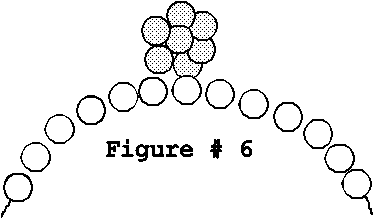
We now need to return to the vision of the nucleonic ring. As the external controlling magnetic field is changed such that the nucleonic ring is allowed to collapse somewhat; we see that in accordance with scenario three, a cluster of nucleons will form on the ring as shown in Figure # 6. This collapse to a cluster has taken place reversibly, in that the external magnetic force has eased the ring down and absorbed the energy in the external system. The ring remains "cold".
As the cluster grows larger and larger, the centrifugal force of the clusters' mass would start to outweigh the few remaining bonds to the ring that act in the centripetal direction. Ultimately, the bonds to the ring would break and the cluster would be released from the ring. This released cluster (herafter referred to as a macro-particle) is therefore the exhaust of the process.
The intake of the process would be particles more elementary (having less nucleons) and will be hereafter referred to as micro-particles. (The count of nucleons per particle at intake and exhaust is open to debate as long as the exhaust particles have more nucleons per particle than the intake.)
An implicit assumption of the previous paragraph is that the release of the macro-particle would not disconnect the ring. It would be essential that a ring structure remain intact for succeeding power cycles to take place. This seems reasonable in that the nucleons within the macro-particle would become saturated, being in proximity to many bonded neighbors (relative to the nucleon down in the ring) and those bonds linking the macro-particle to the ring would therefore be weaker than those bonds along the ring and they would break first, allowing the particle to exit while leaving the ring intact.
The preceding paragraph referred to a power cycle and this needs to be elaborated on. If one has a nucleonic ring and allows it to collapse and extracts the nuclear bonding energy, there is some energy gain but not very much.
It is necessary therefore to repeat this process over and over again. The vision is that the controlling magnetic field would be applied to encourage expansion of the ring while micro-particles are entered into the ring. This would continue until the ring was at its largest diameter in the cycle. At this point, the ring would be controlled to shrink, energy extracted, macro-particles released, and the ring would reach its smallest diameter in the cycle.
This then is the power cycle; the ring expanding, taking on particles, then contracting, releasing particles, and producing electrical energy in the external system. Generators, of more and more power, would require, more and more rings, operating in parallel.
© 1989 William Day (email:[email protected])