|
Biography |
||
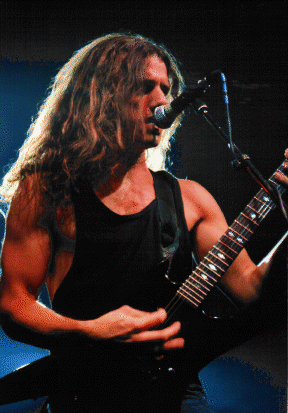
Around the 70's Black Sabbath, led by the riffs of Toni Iommi, had successfully laid down the foundations of what would become metal. It would not be wrong to call them the godfathers of all metal. Along with early 80's acts of the likes of Venom, Judas Priest, Iron Maiden and others from the British wave of heavy metal, they led way to a next generation of speed/thrash metal bands. 1983 saw the release of Metallica's "Kill 'Em All", an album that certainly brought out thrash to a wider audience. Others included Slayer and Exodus. Meanwhile in Florida in 1983, Mantas took birth as the brain-child of the fifteen year old Chuck Schuldiner. The band consisted of a three school boys line up that featured: Kam Lee as the drummer and vocalist, Rick Rozz and Chuck Schuldiner as guitarists. Mantas recorded a four track demo "Death By Metal" in 1983. About the same time four high-schoolers in San Francisco formed Possessed. With their Swiss counterparts HellHammer(later to become Celtic Frost) and Venom , these four bands were among the pioneers of the heaviest, fastest music that had yet been played. Some time after their first demo Mantas changed names to Death. By 1984, Possessed, Celtic Frost and some others had all put out demo's and death metal was growing strong on the underground. Death metal, initially however failed to win any large audiences or attract much attention from any labels. As Chuck Schuldiner stated, music and musicians were too ... bad to be taken seriously. A demo tape by Possessed made its way to Brian Slagel who then got the band featured on "Metal Massacre vol. 6" with their song "Swing Of The Axe". This eventually led Possessed to sign up with Combat. Sadly, however, Death remained unsigned for quite some years. In 1984 Possessed released "Seven Churches" their historical debut on Combat . An album that was truly the first of its kind to have been released, and became an influence to many. With fast aggressive guitars and outrageous vocals this record was the crude creation of a new kind of metal ,a precursor form that was later perfected by Chuck Schuldiner on "Scream Bloody Gore" and deservingly categorized into a separate, established genre, now called death metal. Years later ,in an interview Chuck Schuldiner cited "Seven Churches" as a major influence for the Death's debut album. Even though musically tuned out, death metal still, had a not so good reputation. A consequence of the dark morbid public images and morbid lyrics of the earlier acts Venom, Possessed, HellHammer and others. Death metal immediately became notorious for Satanism. Most of what was happening in Scandinavia had nothing to do with the music, rather music was being used by cults promote Satanism and anti-Christianism. On the Florida scene things were quite different and the two scenes moved apart as years progressed. There were still bands in Florida whose lyrics were about Satanism but not in the form of preaching or promoting it, rather in the form of entertainment. Anyway, returning to Death, the three piece outfit released another demo "Reign Of Terror" in October '84, this time the vocals being handled by Chuck Schuldiner. Another came in March '85 under the title "Infernal Death". The same year Possessed returned with their second full length album, and the Brazilian band Sepultura debuted with their EP "Bestial Devastation". Among the earliest, yet unfortunately, Sepultura were never exactly a big influence to death metal in the evolution years, however, except maybe for the local Brazil scene. Death metal was really beginning to grow, yet Death had no label. There were a few more demo's by Death in '85, following which Chuck Schuldiner moved away to San Francisco, California. He wished to shift the band there but the other two members opted to stay in Florida. Kam Lee and Rick Rozz then teamed up with Terry Butler and Bill Andrews to form Massacre. Meanwhile in California, Chuck Schuldiner found new band members in Chris Reifert and John Hand. With Chris on the drums, John as rhythm guitarist, Chuck Schuldiner handled the vocals and guitars. The band was lacking a bassist, which was in jamming sessions often made up for by Steve DiGiorgio (from Sadus, who later eventually worked on two Death records). However, Chuck Schuldiner ended up doing the bass himself for the debut recording. Death recorded a few demo's in 86. The last one of which "Mutilation", helped Death finally land a deal with Combat records. Death forever changed the death metal world with the release of "Scream Bloody Gore" in '87. The first album by Death that simply blasted its way through with unseen aggression. Although a bit poor on production and technicality compared to later works, this album made up for all with its shear brutality. Chuck Schuldiner's cut-throat growls alternated with guttural screams set a top notch standard of intense death metal vocals, that in a certain perspective , was never again achieved, not by any other band, not by Chuck Schuldiner himself. (It would be unfair however, not to mention Obituary's John Tardy and Asphyx's Martin Van Drunen, both of whom have certainly made a mark of their own too). The lyrics on the album however, much lacked depth and intelligence. Most of the songs seem to have been inspired by stories from horror movies. It must however be realized that Chuck Schuldiner was about 18 years old when Death's debut was made. And it was, musically, an achievement strong enough coming from someone of such age (in such an era when death metal was still taking birth) to prove his genius purely on musical grounds, even totally disregarding the lyrics. In the words of Gene Hoglan a few years later: "I know Chuck wrote super gory lyrics for "Scream Bloody Gore". He grew up on horror flicks, and that was considered heavy at the time. After all, when you're 18, you say 'what can I say to shock people'." This three piece line-up was soon disbanded. Chuck Schuldiner,
writing new material for the next record, was joined by Massacre (that
had also recently split) band members: Terry Butler (bass), Bill Andrews
(drums) and Rick Rozz, the former guitarist of Death. A year after their
first release, Death shook the world again with the phenomenal
"Leprosy" in '88. The music had vastly improved, the riffs
were more faster and richer. The arrangements on the songs were more
striking. The drumming is just what an album like it should have had.
Long runs of non-stop double bass drumming teamed up with the same tempo
of crunchy riffs makes this album a forty minute ride through
headbanger's heaven. And the lyrics were already beginning to improve.
The title song intelligently uses the disease leprosy as a metaphoric
reference to the dying sense of grace and kindness among the human race, This line-up again did not last long, as Rick Rozz left the band
sometime after the release of "Leprosy". Rick was replaced by
James Murphy, an accomplished guitarist (who later also worked with
Obituary and Testament), who helped in writing the music for Death's new
LP to come in 1990. The result was "Spiritual Healing", a
powerful sound that pushed the guitar work one step further than the
previous Death stuff. With this album the solos got a lot more melodious
than the previous album. The riffs from the title song, "Defensive
Personalities", and "Low Life" are fast and really
catchy. The general richness of the music had proven Chuck Schuldiner's
skill to expand and grow while remaining intense as ever. The music
explored rapid alterations between slow paced grinding riffs and fast
intricate ones, exemplified most strikingly on the title song, and
"Low Life". At the same time Chuck's power of expressing of
anger and sarcasm in the lyrics, and the topics themselves were getting
as deep and upto reality as ever. The title song condemns narrow-minded
fanatics and the exploitation of blind-faithed people by them in the
name of religion.
"Spiritual Healing" in many ways marked the turning point in the career of Chuck Schuldiner and Death. From this album on Death proved themselves to be simply the best, not just one of the earliest. With each successive release from then on, Death pushed death metal one step further into a technical progressive realm that left other bands light-years behind. The technical prowess of Chuck Schuldiner's compositions has grown exponentially with each next released, as the limits to death metal have been stretched wide. He has brought out more melody and emotion into a powerful expression. The music has turned more and more complex, as the number of riffs per song has increased to a level where each album encompasses so much amount of music. Making a progressive cut while maintaining the ferocity all the while. At the same time Chuck Schuldiner suffered one of the lowest moments of his life. At their European tour, things were turning sour in the Death camp. Soon after returning from tour, Terry Butler and Bill Andrews decided to break up with Death and join up Rozz with their original band Massacre. James Murphy went on to join Obituary for the recording of their second LP "Cause Of Death". Chuck Schuldiner abondoned, was yet surrounded by vicious rumors from the media, that were cheaply raising questions on Chuck Schuldiner, the man; To this end that Chuck almost, at one time, was about to scrap up the band, Death, altogether. Eventually, however, Chuck Schuldiner's strength shined through and he opted to carry the Death legacy on, as his words later vented it out on the "Human" CD sleeve, "Also, thanks to those people that support my music and not the rumors. This is much more than a record to me; it is a statement, it is revenge ". He managed to coerce band members from Miami based Cynic, and Sadus to work with him for the new Death album. The new line-up being Sean Reinert (drums), Paul Masvidal (guitar), Steve DiGiorgio (bass) and of-course Schuldiner himself. This did not, however mean that this line-up was going to be the future ingredients of Death, rather, they were just working on one record together. Paul and Sean were able to help Chuck with the writing by giving him input, something which had been lacking on the previous Death records. Meanwhile Combat's contract with Relativity went out, and the label Combat came to an end, so Death were now on Relativity. 1991 saw the release of Death's fourth record, philosophically titled
"Human". This is the most brutal music by Death yet, marked by
heavy, fast and intricate riffs. The guitar sound has a thicker,
heavier, more solid, pounding touch to it. Backed up by powerful bass
and fast, complex packed drums that sound like a thunderous gallop. All
this makes "Human" a very aggressive recording indeed.
Although the album is riddled all over with great rhythm and lead guitar
works, most mentionable the riffs from the choruses of "Together As
One" and "Suicide Machine", and from the pre-choruses of
"Lack Of Comprehension" and "Vacant Planets" are
what exemplify the powerful, fast guitar accent of "Human". It
soon had critics admitting that Death is the definition of technical
guitar playing. The opening to "Lack Of Comprehension" and
Death's first instrumental "Cosmic Sea" both showed the band's
growing progressive sense. Among the lyrics "Suicide Machine"
addresses the same topic that Chuck had earlier covered on "Pull
The Plug", only with more acidic sarcasm this time, By this time death metal had grown into a quite a big scene. "Human", along with one of the greatest technical death metal recording ever, Sepultura's "Arise", helped death metal reach out to more listeners around the world, including Asia, where previously thrash acts like Metallica and Slayer were the heaviest stuff available. "Human" helped break out Death to a much wider audience, while "Lack Of Comprehension" became the first video by Death, that was aired on MTV's Headbanger's Ball all over the globe. The same year "Human" came out, Cynic were planning to make their debut on RoadRunner, and then after that go touring with Chuck Schuldiner for Death. For some reason though they went straight on to the European tour after "Human". Sometime in '92 Cynic were scheduled to go to the studios, but unfortunately a hurricane destroyed the house of Jason, a band member of Cynic, and with it the band's rehearsing facilities that were placed there. This interrupted Chuck Schuldiner's plan for the next Death LP for, which Sean was his first choice for the drummer. Meanwhile, the band Dark Angel had split after the vocalist Ron Rineheart called it quits. Their drummer, Gene Hoglan, disappointed and reluctant to have to start all over again also opted out. He coaxed one of the guitarist with him and formed his own band, but nothing much came out of it. A month later Chuck Schuldiner called up Gene, and he agreed to handle the drums for Death. Steve DiGiorgio from Sadus returned for bass duties. And this highly potent outfit was perfected with the joining up of King Diamond's guitarist Andy LaRocque. With the whole band's line-up filled with excellent musicians in each slot, the stage was set for something apocalyptic. "Individual Thought Patterns" was unleashed in '93, and
with it a whole new dimension to death metal was opened. As if death metal
wasn't different enough already, this was a different kind of death metal
in itself. Arguably Death's most complex album to date, it rose above
all reference standards and created its very own criteria of what great
music should be like. Expectations abolished, and all rules lays aside
"Individual Thought Patterns" makes its cut in a very special
way. Some parts on the album are so progressive that they simply
transcend generic death metal to a point where deservingly another genre
name should be coined for it. Complex and diverse drumming, accompanied
by phenomenal bass playing that at lot of instances is very much in the
foreground and breaking away from the main rhythm with mini solo-like
flicks. Toned done with lesser of the open-E chords, yet, the rhythm guitars are one step ahead of "Human" in complexity, examples
are the riffs on "Overactive Imagination" , "Mentally
Blind" and the title song. And there are also quite a number of
riffs arranged up per song. This time out the lead guitar work is
stronger than ever, the solos more melodic and emotional compared to any
previous work by Death. Steve DiGiorgio and Andy went on to pursue work with their own bands. Meanwhile Chuck Schuldiner and Gene stuck along for further writing on Death. Following the negligence by Relativity, Chuck Schuldiner pushed on to transfer Death to the Roadrunner label. And while the record companies were busy with paper-work, Chuck and Gene were left with ages of time to rehearse for the new material. A lot of the writing had been done by mid '94, and the two of them rehearsed for about nine months before entering the studio. Infact, the last three months were spent rehearsing tirelessly, five days a week. One month before the recording Kelly Conlon (bass) and Bobby Koelble (guitar) joined in. On March 21st, the world witnessed the personification of musical
perfection as Death's sixth full-length record "Symbolic"
blessed the world with it's divinity. And with it, were shattered any
remaining concepts of comparison. "Symbolic" to a lot of us,
not only became the best Death record, but the best death metal album
ever. It is best described by an adjective that is rarely ever used for
music so aggressive: 'beautiful'. They get very progressive on this
album, yet without losing their identity. The sound is still
unmistakably "Death". What has changed vastly is the
atmosphere, thanks to excellent production and studio work. There is a
definite hum to it. The tone of the rhythm guitar is more soulful,
melodic and 'filled', yet without losing Schuldiner's signature buzz-saw
crunch. The music itself is rich in emotional solos. The whole is album
filled with excellent riffs all over. Here each and every riff, chord,
and note is perfectly composed and arranged to form unblemished musical
beauty. The emotion in the compositions follows natural flow of emotion
as human nature would need it to. Soon after the tour for "Symbolic", Death suffered another
break-up. Too much disappointed Chuck Schuldiner Schuldiner was diagnosed with pontine giloma, a rare type of brain
tumor, in 1999 and struggled to afford treatment. The guitarist
eventually underwent surgery for the tumor in January of 2000, and
appeared to be recovering well in the months following the operation.
Earlier this year, however, Schuldiner's condition worsened as his tumor
continued to grow and proved inoperable.
|


 opted
to put aside Death, and join up a new band called Control Denied. In the
opinion of many, the legacy of Death had come to an end. By the mid of
'96 Control Denied had their first demo tape out, which featured Chuck
as the vocalist. Chuck wished to get Warrel Dane (Nevermore) or James
Rivera (Helstar) to do the vocals for Control Denied, however eventually
Tim Aymar (PsychoScream) was to replace Chuck in the vocals department.
Control Denied had non-death vocals. Although sounding a bit like the European
styled metal, Control Denied was quite technical. The band
debuted with "A Moment Of Clarity" in early '97. The band
however came to end, when Chuck Schuldiner decided to terminate the
project and return to Death because he felt that songs written for
Control Denied sounded too much like Death. He wanted a different
sound.
opted
to put aside Death, and join up a new band called Control Denied. In the
opinion of many, the legacy of Death had come to an end. By the mid of
'96 Control Denied had their first demo tape out, which featured Chuck
as the vocalist. Chuck wished to get Warrel Dane (Nevermore) or James
Rivera (Helstar) to do the vocals for Control Denied, however eventually
Tim Aymar (PsychoScream) was to replace Chuck in the vocals department.
Control Denied had non-death vocals. Although sounding a bit like the European
styled metal, Control Denied was quite technical. The band
debuted with "A Moment Of Clarity" in early '97. The band
however came to end, when Chuck Schuldiner decided to terminate the
project and return to Death because he felt that songs written for
Control Denied sounded too much like Death. He wanted a different
sound.  RIP
Chuck Schuldiner May 13, 1967 - December 13, 2001
RIP
Chuck Schuldiner May 13, 1967 - December 13, 2001