|
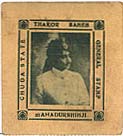
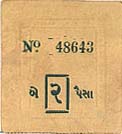
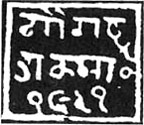
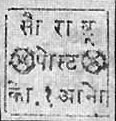
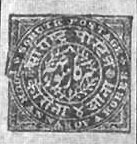
Soruth was a feudatory state of India and issued
its first stamps in 1864. The stamps were only good for postage in that
state. Some examples of Soruth stamps is as follows:
Indian
writing
|
|
|
Indian
writing
|
|
|
SORUTH
POSTAGE
|
|
|
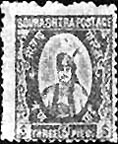
SOURASHTRA
POSTAGE
|
|
|
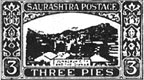
SAURASHTRA
POSTAGE
|
|
INDIA
FEUDATORY STATE
UNITED STATES OF SAURASHTRA
|
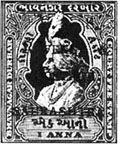
United States of Saurashtra included 217 state of
India and and was formed in 1948. It issued and used other state stamps
with an overprint for postage. Some examples of United States of
Saurashtra stamps and overprints is as follows:
U. S. S.
REVENUE & POSTAGE SAURASHTRA overprint
|
|
|
POSTAGE
& REVENUE ONE ANNA
(Overprinted
on stamps of Soruth.)
|

|
|
SARKARI
(Overprinted
on stamps of Soruth.)
|
|
Saurashtra forms the
western part of Indian peninsula and constitutes a part of the state of Gujarat.
It harboured one of the largest concentration of princely states in India before
1948. Out of these, Morvi, Dhrangadhara and Nawanagar issued currency notes of
limited liability known indigenously as ‘Hawalas’. These were issued during
the currency exigencies experienced in World War I (1914-1918). They are simple
in design and have minor security features such as embossed vignettes, microtin
and underprints.
Kutch planned an issue of
its own Paper currency sometimes in 1942-1948. These notes were to be printed by
Water low and sons, London, but never issued. They are known from a sole set of
security drawings and specimens resting in Kachchh Museum, Bhuj.
World War II broke out in
September 1939 and the British took a severe beating until 1941. There was a
serious crunch in metallic supplies during the war and small change emission was
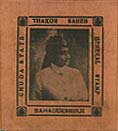
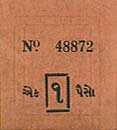
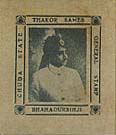
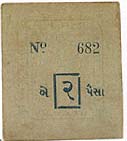
hit worst. In response to this emergency, many Princely States in India, some of
them tiny and insignificant, issued coupons to replace coins of low
denominations. These states were located in western India, within Gujarat,
Rajasthan, Sind, Baluchistan and Central Provinces. The legality of this measure
is a debated aspect but it appears that the coupons were issued in a strictly
regimented and standardized manner, mainly from state treasuries or banks under
state patronage. Most of them bear same designs as state fiscal stamps but the
paper differs in being pressboard. Primary study indicates that the coupons
reached a wide circulation, with some of them remaining current as late as 1946.
Currency issues of the
following states have been classified (Total 36):
As a part of British
Empire that often remained outside the theatres of war, India served as a safe
haven for housing the Prisoners of War. Camps were set up, often in places
situated in the hinterland, during the Boer War and the two World Wars. The
monetary transactions in these camps were facilitated by use of Coupons, as
other forms of currency were prone to be forged by the inmates and as such were
a source of impending economic danger. The first ever use of such Coupons is
said to have been facilitated in the aftermath of the Revolt of 1857.
During the Boer War, camps
were situated in the fortified towns of Bellary, Ahmednagar and Trichinopoly.
Out of these camps, Coupons for monetary use are so far known only for the
Trichinopoly camp and its branch at Kaity in the Nilgiris.
Several camps were created
to house the German, Italian and Japanese prisoners during World War II and a
complete listing of camps using monetary Coupons have been appended. Certain
small Coupons used in the Central Internment Camp, located at Ahmednagar or
Dehradun are also included.
In the aftermath of the
Indo-Pakistan War of 1971, Coupons were issued for the use of Pakistani
prisoners. However, the location of these camps is still a mystery.
Currencies in this
section have been classified in:
§
Anglo-Boer War
§
World War II