
The island forms part of the Mascarene Archipelago, all that remains of an ancient land mass which once united Asia and Africa. To the southwest lies R�union Island, with its savagely beautiful volcanic landscape, while some 560 km (350 miles) east appears Rodrigues Island, a mere dot in the ocean, surrounded by even smaller islets and reefs, and an integral part of Mauritius.
Small as Mauritius is, covering only 1,865 sq km (720 sq miles), it is one of the most densely populated places in the world and supports around a million people, most of them descendants of Indians brought in to work the sugar plantations after the abolition of slavery. There's also a large Chinese community and a number of Creoles, descended from French colonists. Africans and Malagasy add to the mixture of races and religions, one happy result being that there's nearly always a festival going on in one of the numerous Hindu or Chinese temples, mosques or Christian churches.
Independent since 1968, Mauritius is hard at work now keeping down its population growth and pushing up its income. The friendly inhabitants of all the rainbow of races will confide their problems but will also express their optimism in the progress being achieved by their welcoming Indian Ocean homeland. For Mauritius has a fascinating past, an inviting present and a rosy future.
Port Louis
The island capital was named after France's Louis XV. It's a busy place and the little harbour has an important, wide-awake look. Place d'Armes is the town's main square. At one end stands imposing Government House, the oldest building in Mauritius. It was built in 1738 in colonial style for Mah� de La Bourdonnais, the island's most illustrious governor. He is commemorated by a statue near the waterfront, a diplomatic step away from the regal figure of Queen Victoria.
Local culture is promoted by the Mauritius Institute. Its Natural History Museum on Chauss�e Street merits a visit for its displays including a stuffed specimen of the much lamented dodo. St Louis' Catholic Cathedral gives on to a square with an attractive fountain dating from 1786 and a statue of the 13th-century French saint-king. A discreet distance away is St James's Anglican Cathedral, looking as though it has been transplanted from a 19th-century English hamlet. To pay tribute to the islander's tolerant religious and racial views, you will also want to see the Jummah Mosque on Royal Road, with finely worked doors, and, a fair distance away in the same direction (too far to walk), the Indo-Tamil Temple, ornate and multi-domed in contrast to the barren peaks behind.
The market is near the mosque. A fantastic spectacle awaits those who manage to be present mid-morning: a combination of coloured saris, flashing earrings, Chinese smiles and Creole exuberance, vast vegetable baskets, shining cookware and luscious fruits.
North Coast
This is the most touristic part of Mauritius, stretching along the coast road between Port Louis and Cap Malheureux, at the tip of the island.
Pamplemousses lies 11 km (7 miles) north of St Louis. The village surrounds the church of St Francis, the oldest on the island (1756). But Pamplemousses is mostly famous for its Botanical Gardens, begun in 1735 when Mah� de La Bourdonnais bought the property. From 1767, the French Intendant Pierre Poivre was responsible for planting trees and flowers on the land. Today the gardens are reduced to a quarter their original size but their loveliness has only increased with time.
At Mont Choisy, one of the most popular beaches on the island, shaded by casuarinas, you'll find perfect safe bathing with plenty of windsurfing and sailing possibilities. From here onwards lie some of the island's most inviting beaches gleaming with powdery white sand, sheltered from the wind and protected by a coral reef perfect for underwater exploration.
One of the most splendid resorts - and the most renowned - is Grand Baie, the centre for many sea-related activities.
The Centre
The interior spreads north of the road linking Port Louis and Mah�bourg. It's the sugar-cane region, composed of the cool central plateau and the lowlands close to the coast. Follow the old - Royal Road - (Route royale) from Port Louis to Curepipe and Mah�bourg. You first come to Beau Bassin. Here the Balfour Gardens, situated at the edge of a gorge, provide a pleasant and instructive interlude.
Rose Hill is one of the few towns on Mauritius with an English-sounding name. Its chief claim to fame, apart from a wide range of cultural activities, is a remarkable old pharmacy, straight out of a Victorian novel.
A short drive north of Rose Hill lies the Ch�teau de R�duit, a magnificent colonial mansion surrounded by tropical gardens (grounds but not interior open to the public). Not far away, in a stunningly beautiful site at the foot of the Moka Mountains, lies the gracious old Creole house called Eureka, built at the beginning of the 19th century out of indigenous woods.
In the middle of the island lies the island's principal residential town, Curepipe, a delightful, relatively cool place 550 m (1,804 ft) above sea level where the temperatures all year round are lower than on the coast. Today Curepipe's population numbers 60,000, including the elite of Franco-Mauritian society. The town offers some of the best shopping on the island, notably for model boats (particularly beneath the arcades).
Before leaving Curepipe, most tourists visit the Trou aux Cerfs (Deer's Hole), just out of town. It's the forested crater, 300 m (985 ft) wide and 100 m (325 ft) deep, of an extinct volcano, with a pond on the bottom. From the road circling the summit there are some magnificent panoramas over practically the whole island: fields of sugar cane rolling down to the sea, and a mountain chain to the
south. East Coast
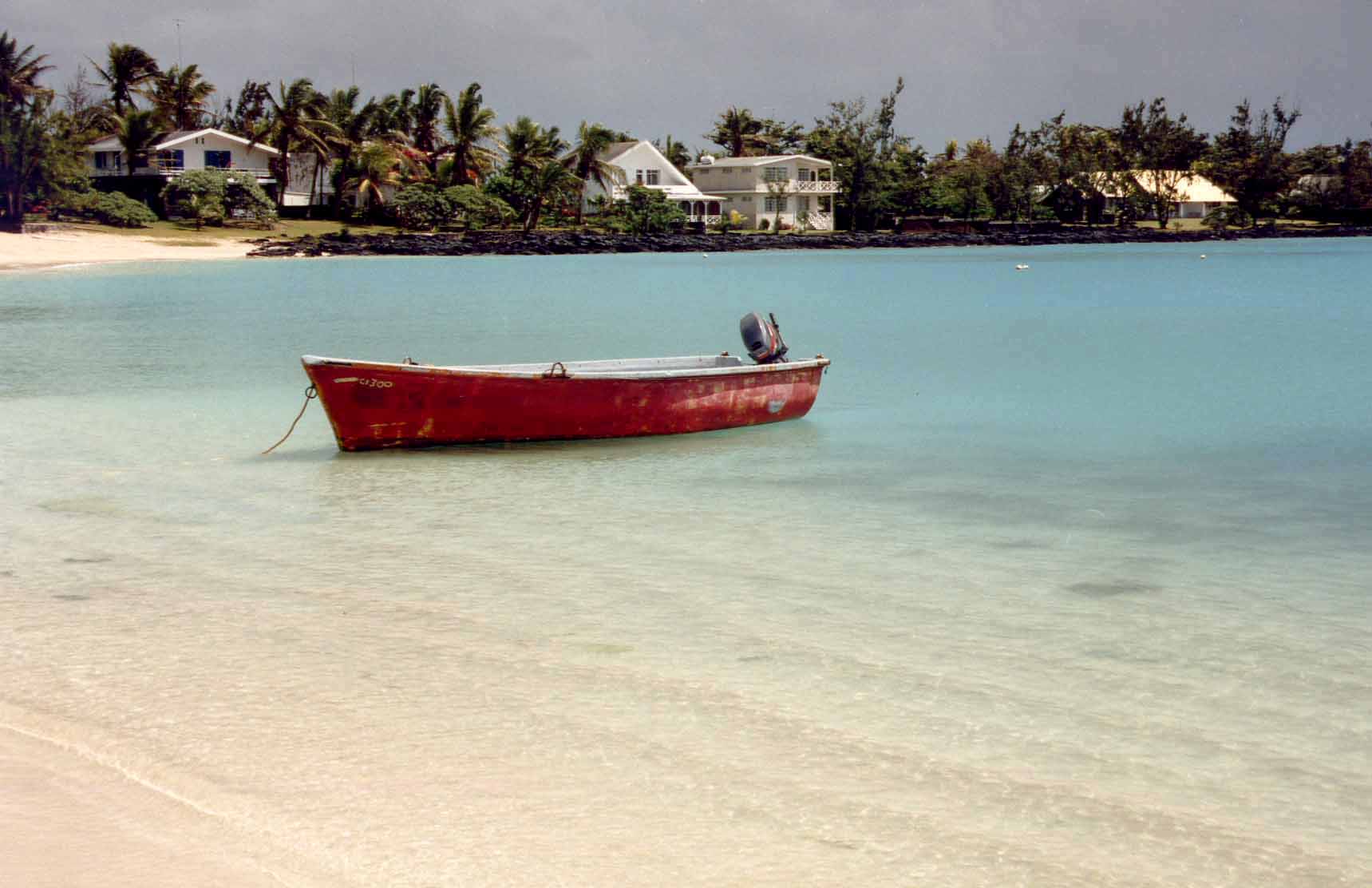
The former Royal Road leads straight to Mah�bourg, a bustling little fishing and commercial town. Because it lies off the usual tourist route, it has been able to maintain a more traditional, more authentic Mauritian atmosphere than Port Louis. From Mah�bourg, a short road leads through flowers and trees, past the resort of Pointe d'Esny and a row of luxurious villas, to Blue Bay, surrounded by a semi-circle of casuarina trees. The beach here is often considered one of the best on the island because of its deep, clear blue waters - an ideal bay for water sports of all kinds.
The bay of Grand Port, where the Dutch first landed in 1598, is just to the north of Mah�bourg. It was also in these waters, in 1810, that Napoleon's navy beat the British (who got their revenge on land four months later). A few reminders of that era remain scattered here and there - like the cannon pointing their barrels out to sea at Pointe du Diable.
Beyond Anse Jonch�e, a vast area has been set aside for the Domaine du Chasseur (also called the Domaine des Grands Bois), a magnificent nature and hunting reserve where deer, monkeys and wild boar live in the heart of a lush tropical forest containing a whole selection of interesting botanical specimens to delight the naturalist and hiker.
In a similar vein, nearby Le Val Nature Park is located in the heart of a valley, surrounded by lush vegetation. You can see carp, freshwater fish, shrimp, and prawns bred in chemically treated water, as well as birds, deer and monkeys.
Further south, the Ile aux Cerfs, a 20-minute ferry crossing from Touessrok, has deer roaming wild. It is one of the most popular excursions in Mauritius. The beaches and lagoon are perfect for bathing.
The South
The south coast is the most rugged, the most hilly and without doubt the most beautiful. Strangely, it is less popular with visitors. South of Port Louis, the small town with the delightful
Climate
The heat is never unbearable. The rainy season is between the end of November and March. On the plateau it's 19�C (66�F) on average in August and 25�C (77�F) in February; it's warmer on the coast