 WHILE THERE
WHILE THERE
 City Tours - When arriving in a city for the first
time, especially one in which I don't know anybody, I like to take a city bus (or canal,
if possible) tour, generally on my first full day there. They usually cost around $20-40
American, and in many cities you can buy a 24-hour ticket, which allows you to get on and
off as many times as you like at the major tourist spots in the city. Tours given in
English are common. Get on one in the mid-morning or early afternoon and ride the entire
loop, writing down sites that look especially appealing. Ride the next morning on the same
ticket, stopping for a closer look at the places you wrote down yesterday. Many cities,
for example Vienna, Amsterdam, and Berlin, have city busses or trams that go to most of
the major tourist sites for the price of a regular fare.
City Tours - When arriving in a city for the first
time, especially one in which I don't know anybody, I like to take a city bus (or canal,
if possible) tour, generally on my first full day there. They usually cost around $20-40
American, and in many cities you can buy a 24-hour ticket, which allows you to get on and
off as many times as you like at the major tourist spots in the city. Tours given in
English are common. Get on one in the mid-morning or early afternoon and ride the entire
loop, writing down sites that look especially appealing. Ride the next morning on the same
ticket, stopping for a closer look at the places you wrote down yesterday. Many cities,
for example Vienna, Amsterdam, and Berlin, have city busses or trams that go to most of
the major tourist sites for the price of a regular fare.
Observe your surroundings - This is obvious when sightseeing, but just as
important when simply out on a stroll. You will see things that are very different to what
you are accustomed, and some that are amazingly similar. Notice both; these are the things
that create the "feel" of the place you are visiting.
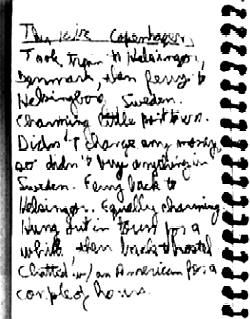
Keep a journal - In conjunction with the above, try to write a little
every night; places you visited, people you met, things you saw that day. It doesn't have
to be anything formal, and no one has to see it unless you want them to. Here's a small sample. In the years to come, this may well turn
out to be your most prized souvenir of the trip.
Planes, Trains, or Auto - Europe boasts of an efficient, highly organized
rail network. Riding the European rails is an experience not to be missed. Investigate the
various Europass/Eurail passes available; here's a convenient link: EUROPRAIL INTERNATIONAL You will
generally save money with a pass, as opposed to buying your tickets a la carte. Be sure to
buy your pass before leaving home, as many cannot be purchased once there. Trains are
particularly convenient if you plan to be mostly in bigger cities and towns; most train
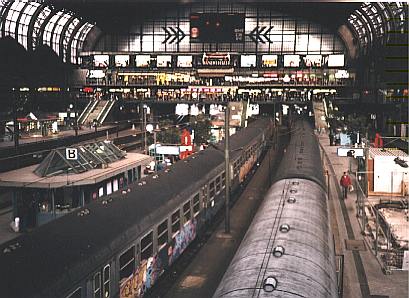
stations are centrally located. Many larger train stations have restaurants and shopping
centres right in the station. Click here to see the station
in Hamburg, as an example. If your plans call for more off-the-beaten-path venues,
consider a combination rail and drive pass, giving you the best of both worlds.
Intra-continental flights are, of course, available. Remember though, that while most
train stations are central, airports are generally on the outskirts of town. Unless
you are travelling a great distance, or wish to avoid a long ferry ride, taking a plane,
door to door, may not save much time over a train.
Times, Numbers, and Dates - Take a moment to learn the European system
for these basic concepts. Times are expressed like a military clock.
Everything is pretty much the same up till 12:59 PM (or 12.59 in European); the next
minute, when it's 1:00 PM in America, it's 13.00 in Europe (actually, there's a time
difference, but you get the idea). To calculate quickly, simply subtract 12 hours
from any hours greater after 12. This is especially important to remember when reading the
train timetables. Numbers swap the decimal points and commas; One thousand dollars and
fifty cents is written as $1,000.50 in America, the same amount of European somethings
would look like 1.000,50. Finally, dates are written as day/month/year;
in America it's month/day/year.
Currency Calculation - There are some travelers who insist on bringing a
pocket calculator, to 'translate' the local currency into terms they can understand. While
not a bad idea, this task can be handled much quicker and less obtrusively with a little
bit of simple mental calculation. Translate a round, easy-to-figure amount of local
currency into your own, and you're all set. Let's look at a few examples -- Italian
currency, with it's relatively low-valued lira, can often prove confusing, so we'll study
this one first. Recently, the U.S. dollar was worth approximately 2000 lira. We can easily
figure that 4.000 lira is approximately $2.00 U.S. It follows, then that 10.000 lira
is $5.00, 50.000 lira is $25.00, and so forth. Another example -- if American dollar fetches
approximately 7.5 French francs, then 75 francs = $10.00, 750 francs = $100.00, etc.
The idea is to provide a quick, easy method of determining whether the meal, sweater, or
bus ride that costs x local currency units is a good deal by the standards to which
we're accustomed. Precision is unnecessary. The calculator-carriers, should they arrive at
a figure of, say, $9.87, would probably round off to $10 anyway.
Language
Barrier? no problemo - I admire people who learn a foreign
language prior to international travel. They are able to communicate with
the locals, and can enjoy their visit on a level that non-local speakers
can't. I have never done that, but have found that, at least in well-touristed
areas, enough people speak enough English to enable the
linguistically-challenged such as myself to get by. Smaller towns can be
more of a challenge, but even in these places, you will very possibly find a
local who wants to practice the English he's studying on you. I do take
the time to learn the local 'polite' words -- please, thank you, pardon me,
etc. I recall being in a little deli in Prague, having to point at the
items behind the counter that I wanted to eat. After this non-verbal
exchange, I said the local word for 'thank you' in Czech. The look on the
clerk's face told me that the effort was appreciated.
Personal Security - European cities are generally safe, probably
more so than most American cities. However, petty theft, such as pocket-picking and
unattended bag swiping, does happen. By taking a few safeguards, you can lower your
susceptibility. I usually don't carry a wallet in Europe; instead, I have a money
belt fastened around my waist, and under a layer of clothing. I think this is
safer, although less convenient than a pouch hung around your neck and under a shirt. With
this setup, the cord around your neck could be cut by a slick enough thief.
Inside my money belt is what I feel are the items I can least afford to lose --
credit card and/or ATM card, passport, airline ticket, rail pass, and any cash I don't
think I'll be spending that day. I keep a small amount of cash in a more accessible
location, for the day's purchases. If you are in a large public area, like a train
station, never leave bags unattended, even for the briefest period of
time. Thieves are known to congregate in such places, and prey on tourists -- and
you will be made for a tourist, despite your best efforts. Finally, leave the fancy
jewelry at home; you won't impress anyone with it anyway. Are you there to see the
sights, or to have people stare at you?
Answering Nature's call - Should you find yourself in the commercial or
shopping district of any major European city, this will never be a problem. Major American
fast-food chains have set up shop in most, if not all of these areas. I won't mention
these business' names; you know them as a bunch of clowns, colonels, and kings. I am not
recommending eating in these places (you'll have to make that decision for yourself -- I
personally prefer a hearty helping of local flavor when I travel), but they do all have
clean rest rooms, and no one seems to mind if you wander into the establishment just to
use them. Also remember that they don't have two things common to some European rest
rooms, which many Americans find perplexing: an attendant requiring a tip for use of the
facilities, and the dreaded European squat-toilet. By the way, if you need to ask where
the facilities are, don't use the term 'rest room' -- try 'toilet' or W.C. (water closet).
Shopping - Some travelers consider this one of the trip's highlights;
others feel it's a chore to be avoided at all costs. Even if you fall into the latter
category, you'll probably want to pick up a few things, either as momentos of an enjoyable
place, or gifts for the folks back home. Your options are either to mail the items home,
which can be slow, risky, and/or expensive, or to carry them with you for the duration of
the trip. Should you decide on the latter, these few tips may be of some use: Look for
physically small items, so as not to take up as much precious baggage space. Pack them in
some soft clothing in your bag, to protect as much as possible. Avoid fragile items; they
may not survive the trip. Hold off on the bulk of your shopping until the last stop in the
trip, so you won't have as much to carry with you, lug on and off trains, etc. If you are
a shop-aholic, and have limited the bags you brought with you, you may want to consider
buying a new suitcase or rucksack, in which to take home the plunder. The good news is
that there is no additional sales tax in Europe. The tax, (called VAT, for Value
Added Tax) is calculated in the posted price.
Stay in e-touch - Print out email addresses of
friends and loved ones before you leave. There are numerous internet cafés in just about
every major city in Europe, especially in the West. Drop in, and for the cost of a few
pounds, guilders, or what-have-yous, you can compose a generic greeting to send to those
on your list of addresses. There's a world-wide listing at the Internet Café Guide. This is not a
replacement for the old fashioned handwritten postcard; think of it more as an
enhancement, with the added bonus that you get to soak up a healthy dose of local ambiance
along with your latte and biscotti.
Post-Trip
Identify photos - As soon as possible, identify the photos from your
trip.A few words in the photo album underneath the picture is all it takes. If your photo
album is a shoebox, mark the back of each picture with a soft tip pen. The name of that
scenic small town you visited will now be fresh in your mind. If you don't do this, you
may wish you had in ten years, when that name is not readily available. Keeping a journal
with notes of each day's photos can be a tremendous help down the road.

Last updated on 07/24/2001