are special events in which local communities engage, either as a way of marking seasonal changes - a behavior which one of my humans insists is an indication of pagan spiritual values that underlie contemporary U.S. culture - or as something to pass the time. The Iditarod (and its offshoots, the Iditaski, Iditarun and Iditashoe, among others) are examples of the latter. What I've never understood is what my canine cousins possibly get out of pulling a wood-and-sinew contraption through hundreds of miles in snow and ice. In the dark. In Alaska. In February. After observing my humans watching the SuperBowl champion New England Patriots stomp the bejeezus out of the Pittsburgh Steelers last week, I've decided that my distant relations, the Huskies, Malamutes and other sled dogs of the world, are the jocks of the canine kingdom. This speaks well of their fortitude and musculature, but not so much of their intellect.
One such regionally-observed seasonal marker was observed by Marcia Fairbanks, who was kind enough to send me the following:
For twelve Septembers, on a hillside at an elementary school in a NW neighborhood of Portland, OR, hundreds of assorted parents, kids, singles, lovers, dogs have gathered before dusk to witness the return of 40,000 Vaux's Swifts to their roost in the school's chimney. Blankets are spread, picnics opened. Children and dogs cavort. Then someone calls out, "here they come!" The tiny black dots in the sky become a dark cloud, then a succession of funnels as the 4.75-inch birds make their high-speed descent. The crowd cheers the birds, boos the raptor on the lip of the chimney as it picks off snacks, and appauds when the last swift enters the chimney. No laser show, not celebrity guests, just awesome nature to entertain the crowd that shows up nightly until the swifts migrate south with the change of season. Marcia saw this when she visited Portland and was lucky enough to witness the show. Incidentally, the Portland Audobon Society has a great site. They discuss the Vaux's Swift and the very show at Chapman Elementary that Marcia viewed.
Other examples of Bizarre Regional Rituals include these two forms of that exquisitely humanoid preoccupation, the Betting Pool.
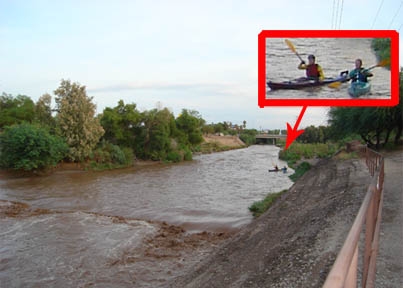
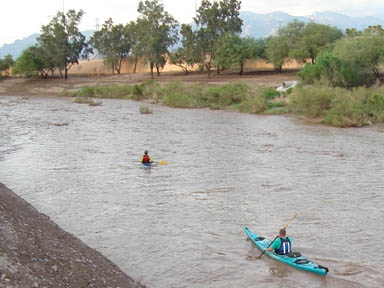
For those who aren't residents of sunny southern Arizona, the Santa Cruz is what the locals euphemistically refer to as a river. Western hyperbole claims that it was once possible - a century ago, before overpumping of groundwater reduced the contents of the aquifer underlying much of south central Arizona to a fraction of its previous capacity and caused considerable ground subsidence, among other problems - to take a steamboat from Ambos Nogales, on the Arizona/Sonora (Mexico) border, north along the Santa Cruz river to the Gila and from there to the Colorado River and the Sea of Cortez. Well, this never was the case, since faulting in the bedrock underlying parts of the Santa Cruz valley means that there were times the river never actually flowed along the surface of the ground. However, it was once true that parts of the Santa Cruz saw perennial streamflow.
|
|
|
This story was contributed by William M., a Minnesota native who now lives and works in Tucson. Apparently, as the ice forms on the myriad lakes of Minnesota, locals gauge the thickness so as to know when its safe to venture onto the ice to do some fishing. The Minnesota Fish and Wildlife Service has even issued a chart indicating what thickness of ice will bear what load. One should wait, according to MN FWS, until the ice is AT LEAST 14 inches thick before driving a 4 x 4 onto it. Anyway, locals will strip an old car of its engine and push it out onto the ice. The betting pools are set up, with the winner being the person who most closely guesses the day on which the car will fall through the weakening ice in the springtime. Then the hulk is hauled out with a winch and stored until the following winter, when it is pushed back onto the ice...probably hauled there by the same dogs who will be pulling sleds around Alaska in February.