
THE ONE AND ONLY MULRONEY
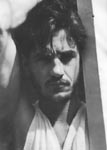
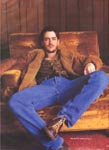
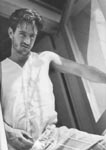
He has a hunger in his acting and music in his heart. He's called Dermot Mulroney.
Dermot Mulroney, besides being a gifted and versatile actor (his radically different knockout performances in the movies Lontime Companion and Bright Angel are among my favorites), is also one hell of a musician. Playing his violin stand-up like a cello, he was the inspiration of our late-night jam sessions when we were shooting the HBO film The Last Outlaw in New Mexico. Watching him in action, either playing music or performing in a scene, is at once an exciting and satisfying experience. And I'm happy to say that in working with Dermot and getting to know him, I found his heart to be as big as his talent.
Steve Buscemi: Did you order hamburder on you pizza?
Dermot Mulroney: No, Pepperoni and mushrooms.
SB:Now you know something about me - I'm gullible. You told me you can get hamburger on pizza.
DM: You can. You can get hamburger on pizzas all the time.
SB: O.K. Now, did you act as a kid?
DM: Yeah, in neighborhood plays.
SB: And this was where?
DM: Alexandria, Virginia. There was a woman who had all the local kids come over in the afternoon and rehearse plays and put them on at weekends. She made us sell the tickets and run the lights and do the makeup. I played the stage manager in Pullman Car Hiawatha, a Thornton Wilder play, when I was nine.
SB: What do your parents do?
DM: My father is a recently tenured professor at Villanova (University], after having done thirty years of private tax-law practice in D.C. My mother is a traveler, an actress, and a hell of a gal. They're both from Iowa, and there's some of the Iowa farmer in me - not that my parents were farmers. I think I'm like a putterer.
SB: Like a...what did you say?
DM: Putterer! Somebody who fixes things and putters around the house.
SB: Right. You're not talking about golf?
DM: No. Although I could if you'd like.
SB: No. I hate golf. Did your mother make you take music lessons?
DM: No. My older brother Sean started, and I naturally followed suit, playing the cello. Conor started the next year.
SB: You have two brothers?
DM: Three brothers and a sister; I'm the middle one. I didn't ever loathe practicing music. I didn't ever like it much, but I always enjoyed sitting in the symphony orchestra. It's a glorious, glorious feeling. About three years ago, I joined the Beach Cities Symphony in Manhattan Beach and played two concerts with them. It flooded me with old feelings to play in an ensemble with eight or ten cellists. You have to think like a fish in a school of fish.
SB: And I hear you have hootenannies at your house.
DM: Yeah, our house and other people's houses.
SB: Oh, it's a little bit of rotating hootenanniey thing. And who shows up?
DM: We get some pretty amazing players. We have an accordion, a couple of guitars, a cello and my borther Kieran plays the fiddle and banjo. My friend Eric is a great tin whistler. It's a nice little combo.
SB: I recall when we worked together on The Last Outlaw that you said there's a sort of mean steak that runs through your family.
DM: I think that was day-one blues. [both laugh] I don't think there was any night that I was ever so humiliated, and I just said, "O.K., you crazy bastards, I'm a mean guy!"
SB: Yeah, but you're not. Though, when need be you can summon it?
DM: Am I mean or not? I do have a temper, buy I've got a handle on it, that's for darn sure.
SB: You're married to Catherine Keener, a really good actress. Do you guys help each other prepare for auditions?
DM: All the time. That's the only reason I still know how to audition. I would have to confess to being less helpful to her. It's real difficult trying to tell someone how to act, in acting or real life.
SB: So she's an influence?
DM: Absolutely. She's really specific and direct. I've got habits and instincts that I'd easily fall into impress somebody at an audtion, but it's old hat to her, so it's, Find somthing else pal. You gotta do a little thinking instead of just winging it.
SB: You acted with Sam Shepard in Bright Angel, and then he cast you in his film Silent Tongue.
DM: Yeah, as the prototypical Shepard "son" character, with the sins of the father bearing down on him and madness and alcohol in his genes!
SB: It's a very atypical Western.
DM: It's a film that only certain people will see and only certain people will like.
SB: You've done a lot of films that haven't had much commercial success.
DM: I've only done two that have had it - Young Guns and Point of No Return.
SB: Do you think you just prefer noncommercial films?
DM: I'm drawn to that material, and that material is drawn to me. Whereas the big cheese [in Hollywood] have no idea who I am, which is fine with me.
SB: I know River Phoenix was a buddy of yours. You met him on Silent Tongue, and then you worked with him again on The Thing Called Love.
DM: Largely because of his recommendation. I know [director] Peter [Bogdanovich] was leaning toward me anyway, but River was basically the one who said, "Hire him." So I have him to thank for providing me with that experience.
SB: Does River sing in the film?
DM: He sings and plays guitar. Wrote some original tunes. Beautiful, beautiful. His songs "Lone Star State of Mond" and "Picture Window" are gorgeous tunes that, needless to say, have been running through my head for the last couple of weeks. I loved him a lot. [pauses] Both films are incredibly interesting an made more so by River's presence in them. The character he played in Silent Tonue is just... unearthly. Full, uncultured madness. Like a dog.
SB: Sam Shepard plays music, doesn't he? Did you jam with him?
DM: We had a little session or two. On night T-Bone Burness, a freind of River's, happened to be going through town. So there was T-Bone and Sam and River on guitars and me on cello in this tiny little bar in Raslow, New Mexico. Played for a few hours, just hackin' away at it as usual, but it was memorable experience.
SB: Let's talk a little about this short movie by Tom DiCillo we just worked on together.
DM: It's called Scene Six, Take One. It'll probably be about thirty minutes long, and it's a crazy, hilarious, heartbreaking film we shot in five long days on 42nd Street in New York.
SB: It's a movie about making a movie, and you play the cinematographer, Wolf. At some point during the filming, I turned to Tom, and I said, "Is this a comedy or a tragedy?"
DM: My feeling was that in front of the camera the tragedy was going on, and behind the cameras it was all just a barrel of laughs. It's the kind of film that has a lot to say about how difficult it is in the human condition to have anything go right.
SB: I imagine it was fun for you to be working with Catherine?
DM: It was a gift, truly, to be the cameraman for your own wife. It's beautiful - to see her placed in front of you, fifteen hours a day. I was sort of a silent observer to her brilliance.
SB: Right before that you worked on Bad Girls, following your all-male experience -
DM: With you, on The Last Outlaw .
SB: And Bad Girls is an all-female Western. Well, not totally all female.
DM: Not all. Considering, you know, that I was in it for example.
SB: What did you play in that?
DM: I would say I played the mysterious, silent, heroic type. In other words, I had few lines.
SB: So you had a lot of free time and played a lot of dominoes?
DM: A lot of dominoes at lunchtime with wranglers and firemen, and a little bit of golf. Keeping my dog Earl away from the pigs was practically a full-time job. What would you have done in this situation?
SB: I would not have played golf, that's for sure.
DM: You probably would have written a feature film or produced something.
SB: No I think I would have gone a little crazy.
DM: Oh well, I did that, too. We can quit here, probably unless you've got more to ask?
SB: I don't know. I'm kind of at a loss.
DM: I hope I get to interview you sometime.
SB: That would be nice.
DM: Hey, Steve, so why don't we talk later this evening and really spill the beans?
