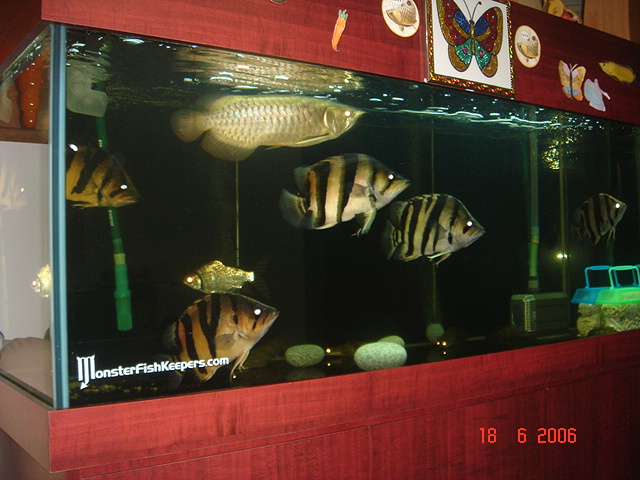
I have been keeping aro since 2003 & Siemese tiger since 2004. Currently I have 1 X Malaysian Golden Crossback (14") and 6 STs ranging from size of 7-9". A 11 strips Fei Feng & a couple of bottom tankmates - endies. All are housed in a 5' X 2' X 2' rosewood cabinet tank with 1 X 5ft 3 layers OHF (bio & mec) filter and 2 X 2028s served as biological filters.
MALAYSIAN GOLDEN AROWANA
There are several names for it, some calls it Cross Back Golden, Pahang Gold, Malayan Bony tongue, Bukit Merah Blue, Taiping Golden, Electric Blue Golden and the Malaysian Gold. These are basically referring to the same type of fish - the Golden Arowana. It will have golen colour completely crossing its back when the fish is matures. The main reason for so many terminologies is because Cross Back Golden Arowanas can be found in various parts of Malaysia such as Perak, Trengganu, Bukit Merah Lake and Johor.
Due to its relatively low supply and great demand in the market, it is currently one of the most expensive Asian Arowanas. The main reason for it high price is due to its scarcity as well as lesser number of successful spawn. Currently, only Malaysia and Singapore farms are breeding the Malaysian Golden.
Cross Back Golden are further classified into Blue-Based, Purple-Based, Gold-Based, Green-Based and the Silver-Based types, implying the core colour of the scales. The terms Blue-Based and Purple-Based are being used interchangeably by some breeders since these Cross Backs Purple Core when viewed at an angle but appears totally blue at another. Gold-Based is one of the Cross Back with a flourish golden colour at it's scales right to the core of the scales instead of one that is blue or purplish in colours. The Golden-Based variety seems to have colour crossing its back earlier than the rest. This is one type of Arowanas that is most stunning to look at since a mature fish is able to achieve the much dreamed about 24K gold colour which other golden varieties are incapable of! Just imagine a 2 footer Arowana, fully wrapped with golden scales swimming majestically, making occasional turns with ease and confidence to show that is it indeed the King of Aquarium. Of course, there are also the exotic Green-based and Silver-Based types which have green and silvery cores on its scales respectively.
It is becoming more difficult to differentiate the sub-varieties since it is quite common to find a fish that has the qualities of two or more sub-varieties. This is due to the inter-breeding between these different varieties by the fish farm operators and thus most Cross Backs are not as pure as it used to be. But on the other hand, it did produce a fish with enhanced qualities from each variety. The breeding of other varieties like the Platinum While Golden Arowana and the Royal Golden Blue Arowana has also evolved over recent years. Both of these command premium price tags and are very much sought in Japan due to their scarcity. Malaysian Farms constitute most exports of these high quality fish in the world as this fish is originated from there.
SIAMESE TIGER (DATNIOIDES MICROLEPIS)
The Siamese tiger fish, Datnioides microlepis, is an absolute gem if you have a big tank.
Common name: Siamese tigerfish, Tiger dat, Siamese tiger datnoid, Finescale tigerfish
Scientific name: Datnioides microlepis
Origin:Found in south-east Asia in the fresh and brackish waters of the Chao Phraya or Mekong basins. Usually in areas with lots of submerged branches, such as flooded forests.
Temperament: Although rather peaceful towards other species, smaller fish may be seen as food.
Stocking: Tigerfish are semi-aggressive and territorial to species of their own kind so it is better to keep a single specimen or a group of at least five individuals. They should not be kept with smaller fish that may be seen as food, on the other hand do not keep these fish with overly aggressive species such as large cichlids.
Suitable tankmates: Suitable companions include; knifefish, bichirs, arowanas, large cyprinids such as tinfoild barbs and silver sharks, and medium-sized catfish.
Size: Although slow-growing the Tigerfish will grow to at least 30cm/12" in the aquaria. There are reports however, of this fish reaching 60cm/24" in the wild.
Aquarium: For a group of adults a tank size of 180x60x60cm/6'x2'x2' would be the minimum recommended size. For a single specimen a minimum tank size of 120x38x38cm/48"x18"x18" should be adequate.
Diet: Tiger fish eat meaty foods such as cockles, mussels, prawns, earthworms or baitfish such as silversides and whitebait. Juveniles will accept frozen/live bloodworm or brineshrimp and may eat carnivore pellets but will not accept dry flake foods. Wild fish at semi-adult size may be reluctant to feed at first and will take a few days to settle in. Live foods such as earthworms and bloodworm which wriggle should encourage these new fish to start feeding.
Breeding: Has been bred on rare occasions in the aquaria.
Notes: Tigerfish are becoming more and more popular with aquarists due to their striking appearance, dark vertical bands and unusual chracteristics such as their independently moving eyes. These fish are built for predation with large extendible mouths, so do not under-estimate this when choosing tank mates - which may be seen as an easy snack!
FEI FENG/FLYING PHOENIX
Technical scientific name:Semaprochilodus family (6 specimens) found in fishbase.com or 4 sub species or Characiformes(ie pirahna); Family: Prochilodontidae
Reason: Known to be a lucky prosperity fish and a good ally to asian arowanas
Fish characteristics: can grow to a foot long++, stripes in dorsal/pelvic/caudal tail with numbers differentiations
Colors present are red/orange/yellow colors on gillplates found variantly in species, fast swimmers; mouth similay to kissing fish ;dorsal finnages varies in length; fries & juveniles do not have a developed features and full bloom color until maturity
Fish behavior: territorial, not suitable in a school of same specimens upon adulthood;cleans your internal glass tanks as its scavengers for feeds
Diet: eats almost anything like leftovers or dung/moss/algae but not known to be a predator
Tank Size: at least 3ft;ideal 5ft ; foilage subjective for cover
Water: Clean and pure
Temperature: samilar to aro likings will suffice.
POLYPTERUS ENDLICHERI
Scientific name: Polypterus endlicheri endlicheri
Pronounced: poll-it-terr-us end-lick-err-eye end-lick-err-eye
Origin: There are two sub-species of P. endlicheri: P. endlicheri endlicheri and P. endlicheri congicus. They are quite widespread through Africa being found in the Chad, Nile, Niger, Volta, Bandama, Coemoe and Oueme river systems and tributaries, but are most commonly imported from Nigeria.
Size: Both sub-species of P. endlicheri are rather bulky fish, and large ones can weigh several pounds and reach well over 30cm/12" in length, sometimes well over 45cm/18". Very big ones are sometimes seen for sale, but most are sold at sizes of about 25-30cm/10-12". Really young fish (under 15cm) are much less common. P. endlicheri congicus is said to grow larger than P. endlicheri endlicheri, and there are reports of wild fish reaching almost 100cm/39" in length.
Price: Because of the large size that most specimens are imported at, not many fish can be packed in a box.
This means that freight costs form a high percentage of the end retail price of the fish. At the moment, 45cm/18" P. endlicheri congicus are selling for about ?0-75 each.
Habitat: This fish lives in muddy and weedy streams, backwaters and swamps, and has also been recorded in mangroves. It is capable of air-breathing, thanks to an auxiliary respiratory organ, and can withstand very poor water conditions, making it an easy fish to keep in the aquarium.
Diet: P. endlicheri, like most Polypterus species, is a piscivore. Therefore it is not a good idea to keep it with anything it might look upon as food. In captivity, it isn't too difficult to train these fish to accept dead foods, such as frozen lance fish, and other meaty foods.
Stocking: Polypterus can be kept together, but they are territorial and may bite each other. Their tough armour plating prevents much real physical damage occurring, but for a more peaceful aquarium, it's best to stick to a single specimen unless you have an enormous tank.
Aquarium: Polypterus are pre-historic fishes and have ganoid scales. This makes them less 'bendy' than other fish, so they can find turning around in narrow tanks a little difficult. For an adult endlicheri, you ought to provide a tank of at least 120 x 60 x 60cm/48" x 24" x 24", preferably larger - the wider the better.
Decorate the aquarium with heavy rocks and bogwood to provide shelter for the daylight hours. Use dim lighting to keep the fish at ease. Aquatic plants can be grown: Vallisneria, Crinum, Microsorium and Bolbitis are worth a try. The protein-rich diet of Polypterus calls for a powerful filtration system that is capable of handling sudden surges in pollution - an external power filter or two would be a good idea.
Breeding: Spawning are rare, but this species been bred successfully in captivity. (Check out the excellent www.endlichericlub.net for more information). In the wild, P. endlicheri breed during an extended breeding season between May and November - usually coinciding with the rainy season. Different populations breed at different times of the year. So in the Chad, the fish spawn between July and November, while in the Bandama River, they spawn between May and August. On rare occasions you might see very young ones for sale with frilly external gills. These fish can be sensitive to pollution.
Availability: The relatively large size and seasonal availability of
P. endlicheri means that it's not seen for sale that often in the UK. Unless your local shop imports their own fishes (unlikely if it's a small shop or is not part of a chain), you'll need to ask your dealer to order one of these specially for you.
However, not all wholesalers import wild African fishes, so it could take a little tracking down. The fish here was borrowed from Maidenhead Aquatics in Harlestone Heath.
Health: Virtually all Polypterus, and definitely all endlicheri, are wild caught, and they often come into the UK carrying passengers of some kind, including flukes and other parasites. Keep a close eye on new fish after purchase and be ready to treat them if they show signs of illness. Once settled in, they are very hardy and are simple to keep.
Notes: These fish can jump out of the aquarium if startled, so use a tight fitting cover. Because of the weight of these fish, it is advisable to use clear plastic or perspex covers rather than glass ones, which could shatter if hit by a leaping Polypterus.