
The Council disputed by one third of the catholic Church
Keepers of the Alexandrian Christological Tradition:
These Churches were committed to the Alexandrian Christology which was officially endorsed at the Council of Ephesus, the Third Ecumenical Council. The Tome of Leo sought to reconcile and rehabilitate the Antiochene Christology which had been brought into question at Ephesus. The Antiochene school of Christology emphasized a sharp distinction between Christ's divinity and humaninty. The Alexandrian school taught a Christology which emphasized the complete unity of divinity and humanity, "without confusion, change, separation or division" in the one nature and person of our Lord Jesus Christ.
Pope Leo's attempt at a new theological formula was seen as an offense to the Church's offical Christology as taught by St. Cyril of Alexandria and the Ecumenical Council of Ephesus. Questions also arose due to the fact that Nestorians (& Nestorius himself) were claiming victory as a result of Leo's Tome and the Chalcedonian definition. Although the next two Councils (Constantinople II and III) attempted to find a middle ground between Ephesus and Chalcedon, this ancient wound to the unity of the Church is only being healed in our day.
The Oriental Orthodox (consisting of the Armenian, Coptic, Ethiopian, Eritrean, Indian and Syrian Churches) did not accept the Council of Chalcedon. These Churches rather upheld the original three Ecumenical Councils and were in turn falsely accused of following the heresy of Monophysitism.
Monophysites taught that Christ is solely Divine: His humanity was "swallowed up" by His Divinity. Oriental Orthodox are Mia-physites -following St. Cyril of Alexandria and, before him, St. Athanasius the Great, who taught the "one nature (mia physis) of the Word of God incarnate." While the prefix "mono" connotes numerical oneness, "mia" conveys our doctrine of Christ's composite oneness. We are thus Orthodox Miaphysites rather than heretical Monophysites.
While the Latin Catholic and Byzantine Orthodox Churches upheld the Antiochene Christology, Oriental Orthodox have maintained the historic Alexandrian Christology. Chalcedonians teach Christ is in two natures. Oriental Orthodox teach that Christ's one composite nature is from two natures.
Modern ecumenical dialogue between our ancient Churches has revealed that the two respective Christologies, Ephesian (i.e., from the Council of Ephesus) and Chalcedonian -if properly understood- are orthodox and compatible. Theologically, this1500 year old schism has been settled in our day through the offical Christological Statements between the Latin Catholic Church and Oriental Orthodox Churches as well as the landmark Agreed Statement on Christology between the Byzantine and Oriental Orthodox Churches in which we state:
"We have now clearly understood that both families have always loyally maintained the same authentic Orthodox Christological faith, and the unbroken continuity of the apostolic tradition, though they have used Christological terms in diferrent ways. It is this common faith and continuous loyalty to the Apostolic Tradition that should be the basis for our unity and communion."
This was discovered long ago by the 12th century Armenian Church Patriarch St. Nersess the Gracefilled who wrote in his Pontifical Letter, "If one says 'one nature' in the sense of the indissoluble and indivisible union and not in the sense of confusion, and if one says 'two natures' as being without confusion, alteration or signifying division, then both positions are within the orbit of orthodoxy."
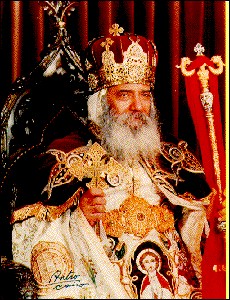
His Holiness Pope Shenouda III
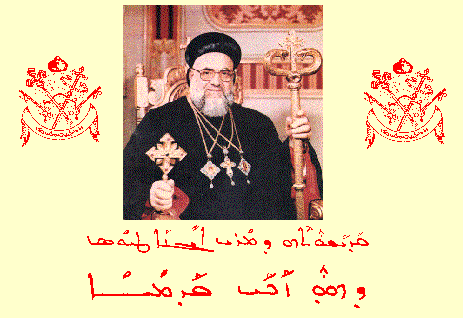
His Holiness Moran Mor Ignatius Zakka I
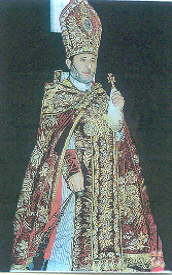
A credal formula composed by St. Justinian the Emperor
"Only-begotten Son and Word of God and Being immortal, Who deigned
to take body through the holy Mother of God and Ever-Virgin.
You, the unchangeable One, became man and you were crucified,
O Christ our God, and you trampled down death by death.
You, one of the Holy Trinity, are equal in glory with
the Father and the Holy Spirit; save us."
-A credal formula composed by St. Justinian the Emperor, written to heal the schism over Chalcedon; it was accepted by all Orthodox Churches
and Catholicos
of all Armenians
His Holiness Karekin II
- The Contemporary Relationship b/t the Catholic & Oriental Orthodox Churches
- Common Declaration on Christology -by H.H. John Paul II and H.H. Karekin I
- On the Christolgy of the Monk Eutyches
- Orthodox Unity -An Oriental Orthodox website promoting unity among Orthodox
- The Christological Controversy -by the Byzantine Orthodox Monachos website
- Severus of Antioch's Objection to Chalcedon -from the same website
- Armenian Church History and Doctrine -by Fr. Shenork Souin -Armenian Orthodox
- The Oriental Orthodox Churches -by Fr. Ronald Roberson, Latin Catholic
- Problems of Consensus in Christology: The Function of Councils
by Archbishop Tiran Nersoyan, Armenian Orthodox
- Monophysitism Reconsidered -by Fr. Matthias F. Wahba, Coptic Orthodox
- St. Nersess Theological Review -Containing excellent essays by theologians of both Orthodox traditions on the topic of consensus in Orthodox Christology
vor Khachetsar vasun mer, voghormya mez."
"Holy God, Holy and Mighty, Holy and Immortal,
Who was Crucified for us, have mercy on us."
-The traditional Trisagion of the Armenian Church
sung to the Second Person of the Holy Trinity
A detailed historical account of the proceedings of the Chalcedonian Council.