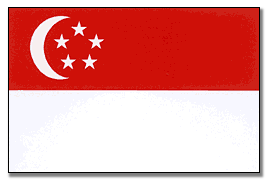
Its Origin
The national flag was unveiled on 3 December 1959, together with the state crest and the national anthem, at the installation of the new Head of State, the Yang di-Pertuan Negara. It was created by a Committee led by then Deputy Prime Minister, Dr Toh Chin Chye. It replaced the Union Jack, which had flown over Singapore for 140 years (1819-1959). Upon Singapore's independence in 1965, it was adopted as Singapore's national flag.
Its Meaning
The flag consists of two equal horizontal sections, red above white. In the upper left section are a white crescent moon, and five white stars forming a circle. Each feature of the flag has its own distinctive meaning and significance. Red symbolises universal brotherhood and equality of man. White signifies pervading and everlasting purity and virtue. The crescent moon represents a young nation on the ascendant. The five stars stand for the nation's ideals of democracy, peace, progress, justice and equality.
The Origin
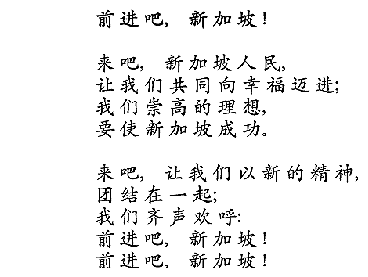
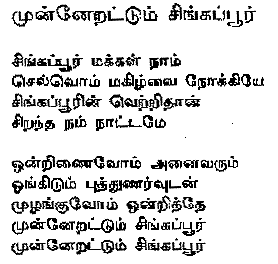
The national anthem was written in the wake of nationalism during 1956-57. Its composer, the late Encik Zubir Said, had written it on the basis of two words, "Majulah Singapura" which means "Onward Singapore". It was launched on 3 Dec 1959 together with the national flag and the state crest, at the installation of the new head of state, the Yang di-Pertuan Negara. Upon Singapore's independence in 1965, "Majulah Singapura" was adopted as the republic's national anthem.
Its Meaning and Lyrics
The national anthem was originally written in Malay. The lyrics are provided as follows. You can also find its musical score and lyric translations into the three other official languages below.
Mari kita rakyat Singapura
Sama-sama menuju bahagia
Cita-cita kita yang mulia
Berjaya Singapura
Marilah kita bersatu
Dengan semangat yang baru
Semua kita berseru
Majulah Singapura
Majulah Singapura

A new recording of the national anthem, Majulah Singapura, with a grander and more inspiring arrangement, was launched on 19 January 2001.
The new anthem recording was the culmination of more than a year's work by the Ministry of Information and the Arts. The main objective was to make Majulah Singapura, one of Singapore's beloved national symbols, more accessible to all Singaporeans.
Several leading local composers were invited to re-arrange the national anthem in May 2000 in the key of "F". Cultural medallion winner, Phoon Yew Tien's version was chosen by an evaluation panel, headed by Bernard Tan. The orchestration is in a slower tempo and uses more instruments to create a majestic rendition of the anthem.
Singapore's very own flagship orchestra, the Singapore Symphony Orchestra, with Lim Yau at the helm, did the new recording at Victoria Concert Hall on 20 November 2000. The new arrangement has been recorded in seven versions including orchestral, choir/solo and piano.
(English Translation)
Come, fellow Singaporeans
Let us progress towards happiness together
May our noble aspiration bring
Singapore success
Come, let us unite
In a new spirit
Let our voices soar as one
Onward Singapore
Onward Singapore
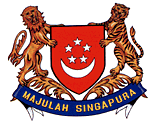
The national coat of arms or state crest was first launched on 3 December 1959 together with the national flag and national anthem at the installation of the Yang di-Pertuan Negara at the City Hall steps.
Its Meaning
The state crest consists of a shield emblazoned with a white crescent moon and five white stars against a red background. Red is symbolic of universal brotherhood and equality of man, and white signifies pervading and everlasting purity and virtue. The five stars represent the five ideals of democracy, peace, progress, justice and equality. Supporting the shield are a lion on the left and a tiger on the right. Below the shield is a banner inscribed with the Republic's motto, Majulah Singapura. The lion represents Singapore itself and the tiger, the island's historical links with Malaysia.
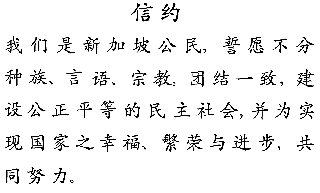
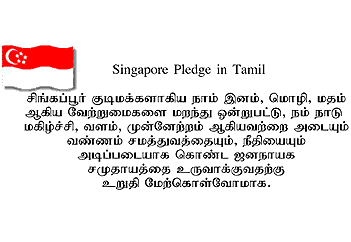
Initially penned by Mr S Rajaratnam in 1966, the Pledge was written against the backdrop of racial riots in the 1950s and 1960s. Mr Rajaratnam revealed that the dream was about building "a Singapore we are proud of". He believed that language, race and religion were divisive factors, but the Pledge emphasises that these differences can be overcome if Singaporeans cared enough about their country. The draft text was handed to the then Prime Minister Mr Lee Kuan Yew, who polished the text before submitting it to the Cabinet.
Its Meaning
We, the citizens of Singapore,
pledge ourselves as one united people,
regardless of race, language or religion,
to build a democratic society
based on justice and equality
so as to achieve happiness, prosperity and
progress for our nation.
(Malay Translation)
Kami, warganegara Singapura,
sebagai rakyat yang bersatu padu,
tidak kira apa bangsa, bahasa, atau ugama,
berikrar untuk membina suatu masyarakat yang demokratik,
berdasarkan kepada keadilan dan persamaan untuk mencapai kebahagiaan,
kemakmuran dan kemajuan bagi negara Kami.

Its Origin
On the records in the 13th century Malay Annals, a prince from Palembang was shipwrecked and washed ashore to an island. There he saw a creature which he believed was a lion. So he named the island "Singa Pura" which means "Lion City", from which the name Singapore was derived.
Its Meaning
The lion head symbolises courage, strength and excellence, as well as resilience in the face of challenges. It is in solid red against a white background - the colours of the national flag. Its mane's five partings represent the same five ideals that are embodied in the five stars of the national flag, namely democracy, peace, progress, justice and equality. Its tenacious mien symbolises resolve to face and overcome any challenges.

The Vanda Miss Joaquim, an orchid variety, is Singapore's national flower. It is an indigenous hybrid between the Vanda teres and the Vanda hookerana and was first discovered in the garden of Miss Agnes Joaquim in 1893. It was registered within the same year.
On 15 April 1981, following an announcement by then Minister of Culture S. Dhanabalan, the Vanda Miss Joaquim was proclaimed the national flower of Singapore. The selection of a national flower was part of our overall effort at fostering national pride and a sense of identity.
Its Meaning
Vanda Miss Joaquim was chosen as Singapore's national flower from among 40 other contenders, including some 30 orchids. It was selected particularly because of its hardy and resilient qualities and its ability to bloom throughout the year. These are characteristics which reflect Singapore's quest for progress and excellence in all aspects of life.