Text/pics c/o Mark: [email protected]
Stanton Moor
Stanton Moor was the focus for an active prehistoric community covering many years. The stone circles on the moor are imaginatively referred to in the texts as Stanton Moor I, II, III and IV, although II is known widely as the Nine Ladies.
Stanton Moor is typical of moorland across these islands with its wide expanse of heather. The soil is sandier than usual for a moor, and the tracks are cut into the moor, well trodden through unimaginable time before us. The northern end of the moor is clothed in silver birch woods, a presumably recent feature but compared to stone circles any forest is a "Johnny-come-lately". In addition to four stone circles, the moor is scattered with an ancient burial mounds of a range of shapes and ages. The picture above is looking north across the moor with the birch woods in the distance. This sandy track has started at the southwest corner, turned to head north and if we follow it we will pass site IV on our right, III on our left, enter the woods and shortly come upon the Nine Ladies in a clearing on the left.
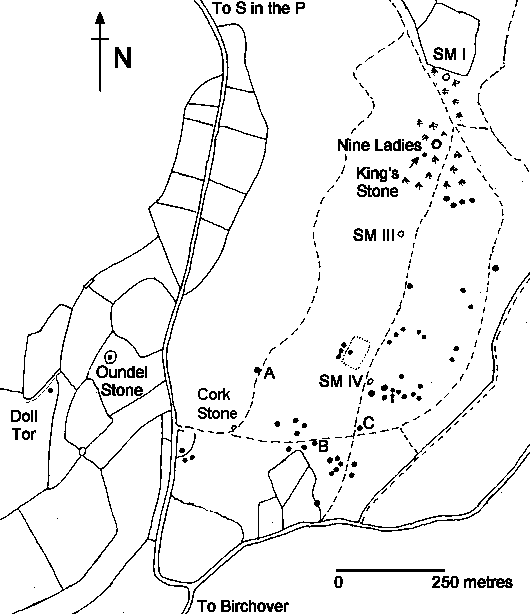
Map of Stanton Moor
Stanton Moor I
This is quite a ruinous site and can barely be made out, even when searching for it with map and descriptive aids. To find it use the map reference (SK 249637) and follow the nearby old wall boundary along until you are in the right area It is an embanked stone circle, but expect to see no more than a pile of earth with a slightly hollowed centre. Trees have grown over the whole site and though a couple of larger stones can be made out, these were not present on the earliest recorded sketch of the site from 1787, nor was one entrance through the bank, the other three sites are all in better condition.
Stanton Moor I was dug into by Rooke in 1787, and again by Heathcote in 1938. The cairn which originally lay in its centre, was positively full of finds, numerous collared urns, cremations, two miniature cups and a cordoned urn as well as a bronze awl, an object of great worth at the time of burial.
Stanton Moor II (The Nine Ladies)
This is one of the best-known sites in Derbyshire, strangely more popular than Arbor Low in my experience, though Arbor Low has all the official road signs leading to it. On a solstice expect to find crusty individuals littering the place, not bad sorts most of them but not everyone's cup of cup of mushroom tea.
Here is a picture of the Nine Ladies looking to the east.
http://www.geocities.com/Athens/Parthenon/6197/9ladies1.jpg
The path across the moor runs through the woods in the background. You can see the very light airy nature of silver birch woodland, making the clearing itself a very open, clear spot, beautiful on a sunny day. The bank can be just about made out around the stone circle, but years of trampling have reduced it considerably.
From this picture (I hope) you can see why the Nine Ladies is so popular. The setting is quite picturesque, and the stones themselves make a nice scene. Not so tumbled down that only an archaeologist looking at Robert Pirsig's 'underlying form' gets excited at them, nor placed in an earth bank taller than the stones themselves which is not the way a member of the public expects a stone circle to look.
Throughout the year it is common to arrive here and find one or two others looking at the circle, often walkers on an undemanding stroll across the moor. Come up here on the evening of June 21st and you can hardly move for crowds of hippies. If that is your thing I suggest you go up - I am sure it makes for a good evening, otherwise you'd best chose one of the other 363 (less mystically significant) days of the year.
Stanton Moor III
This site has a very neat embankment, with little evidence of standing stones, except perhaps at the two entrances.
Here is a photo of Stanton Moor III
http://www.geocities.com/Athens/Parthenon/6197/stan3.jpg
it is a very well preserved little embanked circle; unfortunately the only surviving stones are those, which flank the entrances. Because of its open nature and wide diameter it has a 'henge' like feel to it. You have to walk right past it to get to the Nine Ladies and it is worth a look.
The central area has a disturbed cairn, this contained a faience bead. There have been no stones in recorded history (Pegge 1787) at this site, as opposed to the other three circles on the moor, so perhaps this circle was always an earth-bank and therefore more properly a ring cairn. There is another curious property of the circle worth noting, it has a triangular aspect to it with three distinct sides, yet maintains a constant diameter (like a British 50 pence coin). The triangle is oriented quite accurately north south, with one entrance in the northern angle, and an opposite one midway across the southern side.
Stanton Moor IV
This is quite a ruinous circle, where the embankment is relatively high and small in diameter compared to site III.
http://www.geocities.com/Athens/Parthenon/6197/stan4.jpg
Here is a photograph of Stanton Moor IV. from the west side of the track, which crosses the moor, raised slightly on a bank. It is possible to make out a circular feature in the heather on the opposite side of the track. It is easy enough to mistake it for a random bump, also a ring cairn of similar proportions lies right beside the track some distance before.
There are 70 burial mounds or cairns together with other sites dating from the early bronze age across Stanton Moor, three are particularly noteworthy and are labelled on the map. Cairn A is rectangular in shape, unusual by national standards although the burial mound adjacent to the Bull Ring is also rectangular (this may have been the result of ploughing close by the Bull Ring Cairn, but that is not the case here on Stanton Moor). Measuring 12 by 6 metres and 1 metre high it housed thirteen cremations mostly of young women, six cremations were held in collared urns. J. P. Heathcote's photograph of one that he excavated is shown below.
Cairn B is less than 0.75 metres high, the pit in its centre held a cremation with a dolerite battle-axe. At the crossroads of the paths across the moor, Cairn C is quite conspicuous, 1.5 metres high and 15 metres in diameter, two concentric kerbs of stones can be seen where part of the earth has been removed from the mound. The cairn has a cist at its centre, which held a single cremation, but twelve other cremated remains were also interred within the cairn, most with flint tools, many with urns.
•
Note: To view pictures, copy & paste the http address into your web browser.
•
•
•