Books
Mainly, some of my favourite reads....
Losing Faith : Daniel Blythe Five people meet at University,
discuss their hopes and dreams and share similar ideologies. Eight years
later, on a reunion holiday in France, one of them, Faith, suddenly dies,
and as the remaining four come to terms with her death, they realise they
are no longer what they used to be. Mike's social conscience has bowed
before the lure of profit from property speculation, while Luke's disciplined
religious faith has found a softer niche in Pastoral England. Nicole is
dissatisfied with her career as a teacher, and the fourth? Well, he is
still in love with Faith... This novel cleverly uses time distortion to
switch between the present and the past as the nameless narrator struggles
to accept the extent to which his sense of identity was grounded in Faith.
Faith herself becomes more mysterious as the circumstances surrounding
her death become clearer and the unexpected appearance of her sister adds
an eery postscript to her life. The ambitious crafting of the plot does
not distract from the novel's essential preoccupation with the malaise
of late twentysomethings, and the tense writing is subtle enough to convey
the ennui that has settled over their present despite the disturbing hauntings
of the past. A fine novel. (Claire Allfree)
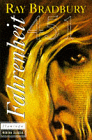 Fahrenheit 451
: Ray Bradbury In Fahrenheit 451, Ray Bradbury's classic, frightening
vision of the future, firemen don't put out fires--they start them in order
to burn books.Bradbury's vividly painted society holds up the appearance
of happiness as the highest goal--a place where trivial information is
good, and knowledge and ideas are bad. Fire Captain Beatty explains it
this way, "Give the people contests they win by remembering the words to
more popular songs.... Don't give them slippery stuff like philosophy or
sociology to tie things up with. That way lies melancholy."
Fahrenheit 451
: Ray Bradbury In Fahrenheit 451, Ray Bradbury's classic, frightening
vision of the future, firemen don't put out fires--they start them in order
to burn books.Bradbury's vividly painted society holds up the appearance
of happiness as the highest goal--a place where trivial information is
good, and knowledge and ideas are bad. Fire Captain Beatty explains it
this way, "Give the people contests they win by remembering the words to
more popular songs.... Don't give them slippery stuff like philosophy or
sociology to tie things up with. That way lies melancholy."
Guy Montag is a book-burning fireman undergoing a crisis of faith.
His wife spends all day with her television "family", imploring Montag
to work harder so that they can afford a fourth TV wall. Their dull, empty
life sharply contrasts with that of his next-door neighbour Clarisse, a
young girl thrilled by the ideas in books, and more interested in what
she can see in the world around her than in the mindless chatter of the
tube. When Clarisse disappears mysteriously, Montag is moved to make some
changes, and starts hiding books in his home. Eventually, his wife turns
him in, and he must answer the call to burn his secret cache of books.
After fleeing to avoid arrest, Montag winds up joining an outlaw band of
scholars who keep the contents of books in their heads, waiting for the
time society will once again need the wisdom of literature.
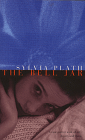 The Bell Jar
: Sylvia Plath Sylvia
Plath's Bell Jar tells of a young woman in the 60's,still unsure of her
direction in life, who receives a scholarship to work for a glamour magazine
in New York attending parties, dinners and the theatre. She finds little
joy in her work and though she makes a few friends she feels alone,she
becomes lost and confused only finding despair and isolation against the
back drop of the big city. She returns to the small town where she grew
up only to sink deeper into depression and suffers a break down. The Bell
Jar is an excellent read. It is often claustrophobic and shows the repressed
atitudes to emotions and mental illness in the '60s.
The Bell Jar
: Sylvia Plath Sylvia
Plath's Bell Jar tells of a young woman in the 60's,still unsure of her
direction in life, who receives a scholarship to work for a glamour magazine
in New York attending parties, dinners and the theatre. She finds little
joy in her work and though she makes a few friends she feels alone,she
becomes lost and confused only finding despair and isolation against the
back drop of the big city. She returns to the small town where she grew
up only to sink deeper into depression and suffers a break down. The Bell
Jar is an excellent read. It is often claustrophobic and shows the repressed
atitudes to emotions and mental illness in the '60s.
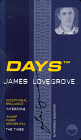 Days : James
Lovegrove The right amount of credit on your card will buy you anything--a
rare matchbook, an albino tiger, the women in the Pleasure department.
Days is the grandest of department stores, whose security men are licensed
to kill and whose seven owners, a group of very different brothers, brood
in a penthouse, fetched endless vast meals by a grumpy butler. James Lovegrove's
novel inhabits that realm where satire borders on allegory and realism
is full of wild magic; it was, nonetheless, shortlisted for the Arthur
C. Clarke prize. Security man Frank has reached a point of alienation such
that he can no longer see himself in the mirror; Gordon and Linda have
just got their first Days storecard, and are keen to undergo the Days experience;
the Book Department's feud for space with their neighbours in Computers
is about to enter a new phase. There are flash sales in Ties and Dolls,
and a riot in Third World Musical Instruments. And who is sleeping in the
Bed Department's four- poster? Endlessly inventive and savage in its humour,
Lovegrove's novel will change for ever the way you feel about superstores,
and gives a whole new meaning to the phrase "shop till you drop".
Days : James
Lovegrove The right amount of credit on your card will buy you anything--a
rare matchbook, an albino tiger, the women in the Pleasure department.
Days is the grandest of department stores, whose security men are licensed
to kill and whose seven owners, a group of very different brothers, brood
in a penthouse, fetched endless vast meals by a grumpy butler. James Lovegrove's
novel inhabits that realm where satire borders on allegory and realism
is full of wild magic; it was, nonetheless, shortlisted for the Arthur
C. Clarke prize. Security man Frank has reached a point of alienation such
that he can no longer see himself in the mirror; Gordon and Linda have
just got their first Days storecard, and are keen to undergo the Days experience;
the Book Department's feud for space with their neighbours in Computers
is about to enter a new phase. There are flash sales in Ties and Dolls,
and a riot in Third World Musical Instruments. And who is sleeping in the
Bed Department's four- poster? Endlessly inventive and savage in its humour,
Lovegrove's novel will change for ever the way you feel about superstores,
and gives a whole new meaning to the phrase "shop till you drop".
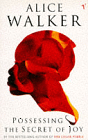 Possessing The
Secret Of Joy : Alice Walker A novel about a character from Alice
Walker's Pulitzer Prize-winning novel, "The Color Purple". This is Tashi's
story, a shattering account of a young African woman whose decision
to go through the female initiation ceremony has terrible consequences.
I mainly read this as it is cited by Tori Amos as the main inspiration
for the the song Cornflake Girl, but boy, I did not regret it.
Possessing The
Secret Of Joy : Alice Walker A novel about a character from Alice
Walker's Pulitzer Prize-winning novel, "The Color Purple". This is Tashi's
story, a shattering account of a young African woman whose decision
to go through the female initiation ceremony has terrible consequences.
I mainly read this as it is cited by Tori Amos as the main inspiration
for the the song Cornflake Girl, but boy, I did not regret it.
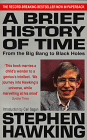 Brief History
Of Time : Stephen Hawking. Stephen Hawking, one of the most brilliant
theoretical physicists in history, wrote the modern classic A Brief History
of Time to help non-scientists understand fundamental questions of physics
and our existence: where did the universe come from? How and why did it
begin? Will it come to an end, and if so, how? Hawking attempts to deal
with these questions (and where we might look for answers) using a minimum
of technical jargon. Among the topics gracefully covered are gravity, black
holes, the Big Bang, the nature of time and physicists' search for a grand
unifying theory. This is deep science; the concepts are so vast (or so
tiny) that they cause mental vertigo while reading, and one can't help
but marvel at Hawking's ability to synthesize this difficult subject for
people not used to thinking about things like alternate dimensions. The
journey is certainly worth taking for as Hawking says, the reward of understanding
the universe may be a glimpse of "the mind of God"
Brief History
Of Time : Stephen Hawking. Stephen Hawking, one of the most brilliant
theoretical physicists in history, wrote the modern classic A Brief History
of Time to help non-scientists understand fundamental questions of physics
and our existence: where did the universe come from? How and why did it
begin? Will it come to an end, and if so, how? Hawking attempts to deal
with these questions (and where we might look for answers) using a minimum
of technical jargon. Among the topics gracefully covered are gravity, black
holes, the Big Bang, the nature of time and physicists' search for a grand
unifying theory. This is deep science; the concepts are so vast (or so
tiny) that they cause mental vertigo while reading, and one can't help
but marvel at Hawking's ability to synthesize this difficult subject for
people not used to thinking about things like alternate dimensions. The
journey is certainly worth taking for as Hawking says, the reward of understanding
the universe may be a glimpse of "the mind of God"
 A Certain
Age : Rebecca Ray A coming-of-age novel which provides an account
of adolescence and its trials and tribulations, including: parents, first
love, first sexual encounters, school and friends. Teenager Rebbecca Ray's
debut novel paints a deeply disturbing portrait of the life of an adolescent
girl growing up in small-town England in the dying breaths of the 20th
century. The humiliations of her first day at secondary school soon give
way to grudging acceptance as Ray's unnamed heroine learns how to "fit
in". Letting boys touch her and hanging out with the misfits and trouble-makers
makes daily life bearable. Which is just as well as home life is far from
bearable. With a brow-beaten, ineffectual mother, whose own feelings of
self-worth have long since been ground to a pulp by a bullying, overbearing
husband, it comes as no surprise when their 14-year-old daughter starts
dating a man old enough to be her father. Sex, drugs, paedophilia and masochism
are all shrugged off by our 14-year-old leading lady whose feelings of
self-loathing grow deeper, page by gripping page, until they reach a disturbing,
inevitable conclusion. Written in the first person, Ray's narrative is
stark and shocking. She describes a life, a family, a society too darkly
accurate to be pure fiction. As a novelist,Rebbecca Ray has found a suitable
channel for her emotions
A Certain
Age : Rebecca Ray A coming-of-age novel which provides an account
of adolescence and its trials and tribulations, including: parents, first
love, first sexual encounters, school and friends. Teenager Rebbecca Ray's
debut novel paints a deeply disturbing portrait of the life of an adolescent
girl growing up in small-town England in the dying breaths of the 20th
century. The humiliations of her first day at secondary school soon give
way to grudging acceptance as Ray's unnamed heroine learns how to "fit
in". Letting boys touch her and hanging out with the misfits and trouble-makers
makes daily life bearable. Which is just as well as home life is far from
bearable. With a brow-beaten, ineffectual mother, whose own feelings of
self-worth have long since been ground to a pulp by a bullying, overbearing
husband, it comes as no surprise when their 14-year-old daughter starts
dating a man old enough to be her father. Sex, drugs, paedophilia and masochism
are all shrugged off by our 14-year-old leading lady whose feelings of
self-loathing grow deeper, page by gripping page, until they reach a disturbing,
inevitable conclusion. Written in the first person, Ray's narrative is
stark and shocking. She describes a life, a family, a society too darkly
accurate to be pure fiction. As a novelist,Rebbecca Ray has found a suitable
channel for her emotions
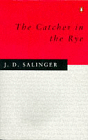 The Catcher In
The Rye : J.D. Salinger Since his debut in 1951 as The Catcher in
the Rye, Holden Caulfield has been synonymous with "cynical adolescent."
Holden narrates the story of a couple of days in his sixteen- year-old
life, just after he's been expelled from prep school, in a slang that sounds
edgy even today and keeps this novel on banned book lists.
The Catcher In
The Rye : J.D. Salinger Since his debut in 1951 as The Catcher in
the Rye, Holden Caulfield has been synonymous with "cynical adolescent."
Holden narrates the story of a couple of days in his sixteen- year-old
life, just after he's been expelled from prep school, in a slang that sounds
edgy even today and keeps this novel on banned book lists.
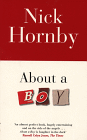 About A Boy :
Nick Hornby Will Lightman is a Peter Pan for the 1990s. At 36, the
terminally hip North Londoner is unmarried, hyper-concerned with his coolness
quotient and blithely living off his father's novelty song royalties. Will
sees himself as entirely lacking in hidden depths--and he's proud of it!
The only trouble is, his friends are succumbing to responsibilities and
children and he's increasingly left out in the cold. How can someone brilliantly
equipped for meaningless relationships ensure that he'll continue to meet
beautiful Julie Christie-like women and ensure that they'll throw him over
before things get too profound? A brief encounter with a single mother
sets Will off on his new career, that of "serial nice guy." As far as he's
concerned--and remember, concern isn't his strong suit--he's the perfect
catch for the young mother on the go. After an interlude of sexual bliss,
she'll realise that her child isn't ready for a man in their life and Will
can ride off into the Highgate sunset, where more damsels apparently await.
The only catch is that the best way to meet these women is at single-parent
get-togethers. In one of Nick Hornby's many hilarious (and embarrassing)
scenes, Will falls into some serious misrepresentation at SPAT ("Single
Parents-- Alone Together"), passing himself off as a bereft single dad:
"There was, he thought, an emotional truth here somewhere, and he could
see now that his role-playing had a previously unsuspected artistic element
to it. He was acting, yes, but in the noblest, most profound sense of the
word." What interferes with Will's career arc, of course, is reality--in
the shape of a 12-year-old boy who is in many ways his polar opposite.
For Marcus, cool isn't even a possibility, let alone an issue. For starters,
he's a victim at his new school. Things at home are pretty awful, too,
since his musical-therapist mother seems increasingly in need of therapy
herself. All Marcus can do is cobble together information with a mixture
of incomprehension, innocence, self-blame and unfettered clear sight.
About A Boy :
Nick Hornby Will Lightman is a Peter Pan for the 1990s. At 36, the
terminally hip North Londoner is unmarried, hyper-concerned with his coolness
quotient and blithely living off his father's novelty song royalties. Will
sees himself as entirely lacking in hidden depths--and he's proud of it!
The only trouble is, his friends are succumbing to responsibilities and
children and he's increasingly left out in the cold. How can someone brilliantly
equipped for meaningless relationships ensure that he'll continue to meet
beautiful Julie Christie-like women and ensure that they'll throw him over
before things get too profound? A brief encounter with a single mother
sets Will off on his new career, that of "serial nice guy." As far as he's
concerned--and remember, concern isn't his strong suit--he's the perfect
catch for the young mother on the go. After an interlude of sexual bliss,
she'll realise that her child isn't ready for a man in their life and Will
can ride off into the Highgate sunset, where more damsels apparently await.
The only catch is that the best way to meet these women is at single-parent
get-togethers. In one of Nick Hornby's many hilarious (and embarrassing)
scenes, Will falls into some serious misrepresentation at SPAT ("Single
Parents-- Alone Together"), passing himself off as a bereft single dad:
"There was, he thought, an emotional truth here somewhere, and he could
see now that his role-playing had a previously unsuspected artistic element
to it. He was acting, yes, but in the noblest, most profound sense of the
word." What interferes with Will's career arc, of course, is reality--in
the shape of a 12-year-old boy who is in many ways his polar opposite.
For Marcus, cool isn't even a possibility, let alone an issue. For starters,
he's a victim at his new school. Things at home are pretty awful, too,
since his musical-therapist mother seems increasingly in need of therapy
herself. All Marcus can do is cobble together information with a mixture
of incomprehension, innocence, self-blame and unfettered clear sight.
 Prozac Nation
: Elizabeth Wurtzel. Like many people, Elizabeth Wurtzel has problems.
Unlike most of them, she can write a book about it. Prozac Nation tugs
at the heartstrings of a generation raised on early Manic Street Preachers
albums and the timeless legacy of The Smiths. From the classic cover photo
of a wasted, painfully beautiful girl, to the closing chapter, Elizabeth
Wurtzel succeeds in simultaneously turning the act of being depressed into
an art form, whilst also showing it to be a harrowing waste of life. You
can either read the book from the perspective of someone who thinks ‘yes,
that’s my life, yes, you’re right’, or perhaps ‘uh, maybe I’m not quite
as f*cked up as I thought I was…’
Prozac Nation
: Elizabeth Wurtzel. Like many people, Elizabeth Wurtzel has problems.
Unlike most of them, she can write a book about it. Prozac Nation tugs
at the heartstrings of a generation raised on early Manic Street Preachers
albums and the timeless legacy of The Smiths. From the classic cover photo
of a wasted, painfully beautiful girl, to the closing chapter, Elizabeth
Wurtzel succeeds in simultaneously turning the act of being depressed into
an art form, whilst also showing it to be a harrowing waste of life. You
can either read the book from the perspective of someone who thinks ‘yes,
that’s my life, yes, you’re right’, or perhaps ‘uh, maybe I’m not quite
as f*cked up as I thought I was…’
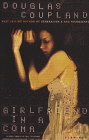 Girlfriend
In A Coma : Douglas Coupland Karen goes into a coma one night in
1979. Whilst in it, she gives birth to a healthy baby daughter; once out
of it, 18 years later, she finds herself a middle-aged mother whose friends
have all gone through all the normal marital, social and political traumas
and back again. Once again, Douglas Coupland manages to pull at the
strings of Generation X, even if this book does get a little strange towards
the end.
Girlfriend
In A Coma : Douglas Coupland Karen goes into a coma one night in
1979. Whilst in it, she gives birth to a healthy baby daughter; once out
of it, 18 years later, she finds herself a middle-aged mother whose friends
have all gone through all the normal marital, social and political traumas
and back again. Once again, Douglas Coupland manages to pull at the
strings of Generation X, even if this book does get a little strange towards
the end.
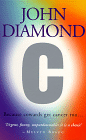 C- Because
Cowards Get Cancer Too : John Diamond Once upon a time, being "unwell"
meant a columnist was, how shall we put it, indisposed. Now, being truly
unwell is no excuse for not filing your copy, and the resulting column
is in danger of becoming something of a genre. If so, then here is its
best exponent. John Diamond was just a common-or-garden Times columnist,
a "sometime smoking, unexercised and overweight man of fortyish", and,
being an expert hypochondriac, expectantly waiting for his first heart
attack. Until 27 March 1997. Then he was diagnosed as having cancer. C
is his "attempt to write the book I was looking for the night I got the
bad news." C is a blow-by-blow account of the progress of his cancer and
its various treatments, interlaced with forays into the daunting medical
literature, autobiographical reminiscences, and meditative reflections
on what this all means. As a guide to cancer, Diamond is usefully knowledgeable,
able to cut through the medical profession's defensive euphemisms and tell
us what's really going on. As a guide to himself, Diamond is unstintingly
honest, so we get the whole man with all his personal strengths and foibles,
and it's actually difficult to read the prognosis with which he leaves
us.
C- Because
Cowards Get Cancer Too : John Diamond Once upon a time, being "unwell"
meant a columnist was, how shall we put it, indisposed. Now, being truly
unwell is no excuse for not filing your copy, and the resulting column
is in danger of becoming something of a genre. If so, then here is its
best exponent. John Diamond was just a common-or-garden Times columnist,
a "sometime smoking, unexercised and overweight man of fortyish", and,
being an expert hypochondriac, expectantly waiting for his first heart
attack. Until 27 March 1997. Then he was diagnosed as having cancer. C
is his "attempt to write the book I was looking for the night I got the
bad news." C is a blow-by-blow account of the progress of his cancer and
its various treatments, interlaced with forays into the daunting medical
literature, autobiographical reminiscences, and meditative reflections
on what this all means. As a guide to cancer, Diamond is usefully knowledgeable,
able to cut through the medical profession's defensive euphemisms and tell
us what's really going on. As a guide to himself, Diamond is unstintingly
honest, so we get the whole man with all his personal strengths and foibles,
and it's actually difficult to read the prognosis with which he leaves
us.
Winter In The Morning ; Janina Bauman Using diaries she kept
as a teenage girl, the author describes the horror of the siege and surrender
of Warsaw in 1939. With the curfew came raids, beatings and enforced moves.
Relatives and friends disappeared, food became scarcer and clandestine
meetings more dangerous. During the terrible months of the Nazi "Aktion"
in 1942, it was on Janina that her mother and sister increasingly depended.
Hounded from shelter to shelter, they kept on the move as thousands were
rounded up for deportation to the camps. Early in 1943 they escaped
the ghetto: what followed where years of hiding until finally the beginning
of hope.
 The Hitchhikers
Guide To the Galaxy : Douglas Adams Enough said really, but starting
to look a little dated now.
The Hitchhikers
Guide To the Galaxy : Douglas Adams Enough said really, but starting
to look a little dated now.


 Red
Mars / Green Mars / Blue Mars - Kim Stanley Robinson.
Red
Mars / Green Mars / Blue Mars - Kim Stanley Robinson.
Quite simply, this is one of the only 'proper' trilogies I have
read - not contrived by some hack. These three books tell the story of
the colonisation of Mars over 500 years, starting off with a multi cultural
group of 500 people. This series has everything : sociological references,
hard science fiction, romance, tension, and a good dose of realism - everything
is explained as the author is a scientist who can explain things to all
levels. It may be a slog to some people (2000+ pages) but it is well worth
it.