
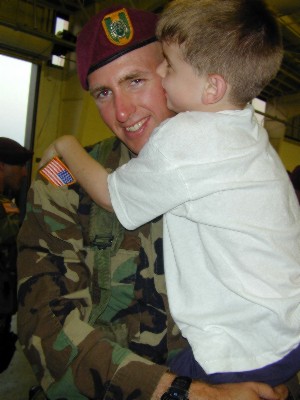
Just because children cannot express their fear, dissapointment, or worry in words as well as adults can does not keep them from experiencing it and acting out. Even very young children will notice changes in schedules and will know if you are worried and upset.
Do...
prepare your children for the deployment by talking about it about a month in advance. About a month before deployment it is likely that the deploying company will be spending extra hours getting ready to go. When this is happening it is a good time to start talking to your children about your soldier leaving. Let the kids pack one or two small things for the deploying parent to take along.
Do talk about the deployed parent regularly.. Plan a regular time for writing to your soldier. Let the children write their own letters or draw pictures, and mail them in seperate envelopes. Help them, if necessary, write the address on the envelopes... but let them put the postage on and drop it into the mailbox.
Do tell the school/teachers about the deployment. It is likely that some worry will manifest at school, and it helps if the teacher is prepared for it. Share any concerns that you have with the school teacher and school counselor.
Do get maps of the area of the deployment. It gives children a sense of security to know that the person that they are missing is somewhere on a map.
Do get a family picture made, and put a picture of the soldier in the children's room. Try and have pictures of every day activities, too, and a picture of the child with the deployed parent. Each child should have her/his own picture, something that is only theirs. It's great to have the absent parent read bedtime stories on tape or have a recorded video tape.
Do count down days, but not too early! Six months out is probably too early to make a paper chain. We made ours 30 days out, and the paper rings changed colors as the days got closer. I added six extra rings to the chain past when my husband was supposed to be home, the Army has a way of making last minute changes. When I found out they would only be two days late, we took off the extra four rings-- and I told my son that Daddy was coming home early! It was very exciting taking off the last of the rings.
Do expect that children might manifest anger or sadness by acting out, bed wetting, nightmares, trouble at school, trouble sleeping or withdrawing. If any of these things last more than a week or two, and cannot be resolved through the help of school counselors, speak to a counselor that specializes in such issues.
Routines are very important to children, especially when there are other changes going on. Any child will miss an absent parent. Make life easier by keeping some stable routines; bedtime stories, letter writing activities, chores and homework time will make them feel like they have some control over their world because they know what happens next.
Don't...
say things that will frighten the children. Avoid saying words like "war" and "fighting", because associations with these words as they are heard on TV and movies are negative and scary. It is likely that the mission involves peacekeeping, and that is a safe thing to stress. My son enjoyed wearing his "My Daddy is a Peacekeeper in Kosovo" shirt while my husband was away; he liked knowing his daddy was helping protect other children while he was gone.
Don't make your children head-of-household during the deployment. Elevating their status while a parent away will burden them with responsibility that they shouldn't have to try and fulfill and dissapoint them by having it pulled when the deployment is over. This could even cause resentment toward a returning parent.
Try not to invite children into your bed during the deployment. It may make everyone feel less lonely to cozy up at night, but this also makes the transition for the soldier coming home harder--the children might feel replaced. If the children ARE staying in your bed at night, start weaning them back into their own rooms months before the homecoming... you will want the children back in their own rooms when you are reunited with your spouse!
If any behavior that your child exhibits during the deployment worries you, don't be afraid to seek the advise of a counselor. Tricare offers low cost appointments ($6-$10 a visit).
Don't forget your own mental health during the deployment. To have to carry the weight of two parents may be difficult, especially if it is the first time you've had to do it on your own. If you are not taking care of yourself, it will make your parenting job even more difficult. Look for a friend or support network to confide in- don't use your children as your best friends. You are likely to have venting to do that your children should not be sounding boards for; telling your children your worries and fears may frighten them, and they could hold themselves responsible. Avoid putting them in that position.
