|
|
01 Basic Skills - Day 8
90.00.05 Drill - Man on Man Marking
Small game where each player is given a specific player to man up on. For beginners, players can be paired off. If necessary introduce a rule that the player can only tackle the one they are allocated to man up on. For advanced players pair them off against different players e.g. if A,B & C versus D, E & F, then if A marks D, B marks E and C marks F make it that D marks B, E marks C and F marks A. That way each player must find the player they are marking each time there is a turn over.
NOTE: This drill should be done for a maximum of 10 minutes.
-----oooooOOOOOooooo-----
Skills Progression - Under 11
Emphasis
Basic Skills - It is important that every player is performing every basic skill with the correct technique by this age. This may require remedial sessions for some players.
Advanced Skills - Most players will be reaching a level of co-ordination that will enable them to cope with more advanced skills. The Coach should be conscious that players will not be able to cope equally and should tailor the session accordingly.
Result - Players should concentrate on their individual performance and sportsmanship. Too much emphasis on winning can result in selfish play and / or too much concentration on the skills development of the better players at the expense of the rest.
Game Plan
Players should:
- Be encouraged to retain possession and keep it off the opponents;
- Know basic position play for a full field game and hold these positions;
- Understand the concept of changing the play;
- Understand the concept of manning up on opponents;
- Keep their sticks down and / or on the ball or ground at most times;
- Take free hits quickly (closest player takes the free hit if there is "something on");
- Used the whole width of the ground (play the ball wide if there is "no easy pass");
- Understand the concept of achieving an individual goal for the game;
- Work to a set plan to get the ball out of defence.
Skills Standard
- Two on One - Players should be able to eliminate an opponent "two on one";
- Trapping On The Run - Players should be able to trap on the run from both the front and side;
- Trapping For Next Move - Players should be able to trap the ball in a position for the next move. Under 11's will not necessarily "read" the correct next move but should be encouraged to decide where they are going before receiving the ball and trap it for this move;
- Hitting On The Run - Players should be able to hit on the run off either foot;
- Dribbling - Players should be able to perform both open and Indian dribbles competently and comfortably beat an opponent;
- Reverse Push - Players should be able to perform a reverse stick push;
- Space - Players should be able to recognize space both on and off the ball;
- Recognize Two On One - Players should be able to recognize a two on one situation in an actual game;
- Basic Tackling - Players should understand basic tackling techniques - lunge, flat stick;
- Goalkeepers - should be able to stop with the feet and clear with the feet or stick. They should also be taught angles and coming out to close the angles.
NOTE: The Skills Progression - Under 11 will be complete by the end of this session, and this completes the Basic Skills Progression - from the next session, 03.00 Advanced Skills, we will start concentrating on the various skills that would be required for senior players.
02.00 will describe Match Play & Responsibilities - Basic Play of players for the Club Style which we play. Further Skill Progression exercises will detail Match Play & Responsibilities - Advanced Play - this will be detailed under specific Advanced Skills and noted as such for a specific Match Play & Responsibilities.
-----oooooOOOOOooooo-----
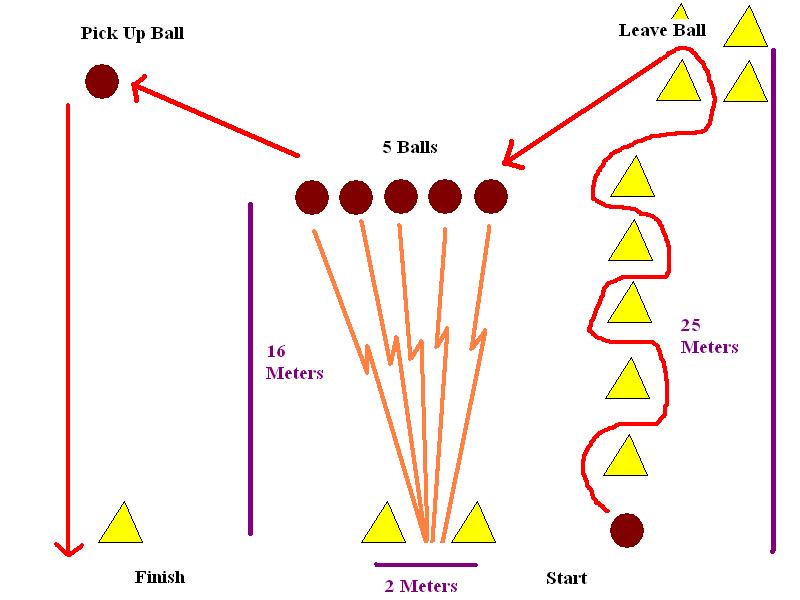
90.00.11 Drill - Skills Test
Timed skills test. Player starts by dribbling through the hats then leaves the ball in a square, The player then runs to where 5 balls are laid out and hits them into the "goal". Then runs to pick up ball and dribble it to the finish. Players can judge their improvement by maintaining a record of their times.
 -----oooooOOOOOooooo-----
01.01.25 Flat Stick Trap
- This is the easiest way to trap a ball which is coming along the ground;
- However many players tend to be lazy and not get their eyes behind the line of the ball.
Execution of Skill:
- Same grip as for dribble. LEFT hand can shift anticlockwise for comfort;
- Eyes to focus on ball throughout its travel until the trap has been completed;
- Feet must move quickly to get eye behind the line of the ball as early as possible;
- Bend knees to get down low;
- Stick is placed flat on the ground, tilted forward;
- Let the stick "give" to the degree required to make the ball stay on the stick;
- Keep face of the stick at 90o to the direction of the ball;
- Ball should be trapped in a protected position near the front foot;
- Ball should be trapped in a position to allow immediate movement in any direction.
Watch For:
- Players keep their eyes behind the line of the ball;
- Players watch the ball all the way onto their stick;
- The stick is not held too softly or too firmly;
- Players are well balanced.
Practice Drills:
- Hit / Trap Game. Team at each end try to hit through the other team and over the line to score;
- Hitting and trapping in pairs;
- Pairs counting how many times they can pass the ball back and forth in a minute.
-----oooooOOOOOooooo-----
01.01.26 Reverse Stick Trap
- Used as an advanced skill so as to immediately perform the next move, e.g. goal shot;
- Also used when a player does not have time to get around to trap the ball on the flat stick.
Execution of Skill:
- Same grip as for dribble;
- Eyes to focus on ball throughout its travel until the trap has been completed;
- Feet must move quickly to get eye behind the line of the ball as early as possible;
- Bend knees to get down low;
- Left hand reverse the stick, right hand lets the stick turn;
- Stick tilted forward to prevent a rebound;
- It the stick is upright, trap the ball behind the front (right) foot;
- If the stick is upright, keep face of the stick at 90o to the direction of the ball;
- If the stick is flat on the ground, have left knuckles on the ground;
- If stick is flat, angle it forward so ball will move to strong side;
- Let the stick "give" to the degree to make the ball stay on the stick.
Watch For:
- Players watch the ball all the way onto their stick;
- The stick is not held too softly or too firmly;
- Players are well balanced.
Practice Drills:
- Hit / Trap Game. Team at each end try to hit through the other team and over the line to score;
- Hitting and trapping in pairs;
- Pairs counting how many times they can pass the ball back and forth and reverse trap in a minute;
- Small game points for goals and reverse stick trap.
-----oooooOOOOOooooo-----
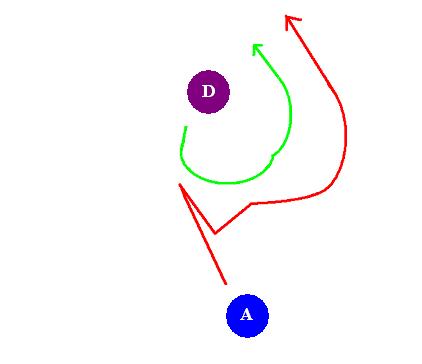
01.01.27 Ball Protection - Running To The Right
- Used as a basic way of protecting the ball from an opponent;
- Used to protect a ball from an opponent tackling from the front.
Execution of Skill:
- While controlling the ball watch the opponent coming at you;
- As opponent draws just near enough to tackle, drag ball backwards and to the right;
- Turn the body so that the LEFT shoulder points at the opponent;
- Move the LEFT leg forward and to the right so it is between the opponent and the ball;
- Dribble the ball to the right;
- As opponent tackles, push LEFT leg out so that the stick strikes the leg and NOT the ball;
- If close enough, lean in on opponent so as to push past then cut in behind & go forward;
- If can get past, cut in behind so that the opponent is totally eliminated;
- If cannot get behind, keep opponent on your left as this is a weak tackling position.
Watch For:
- Player does not run to the right too early such that the opponent can run on an angle;
- Player keeps the LEFT leg between the opponent and the ball;
- If possible, the player pushes past the opponent to get in front.
 Practice Drills:
- Opponent rushes from the front to tackle. Player runs to the right to protect ball;
- Small games points for running to the right.
-----oooooOOOOOooooo-----
01.01.28 Ball Protection From The Side
- Used to prevent opponent tackling;
- Used when under pressure and not in a position to pass;
- Used to protect the ball from an opponent attempting a steal tackle.
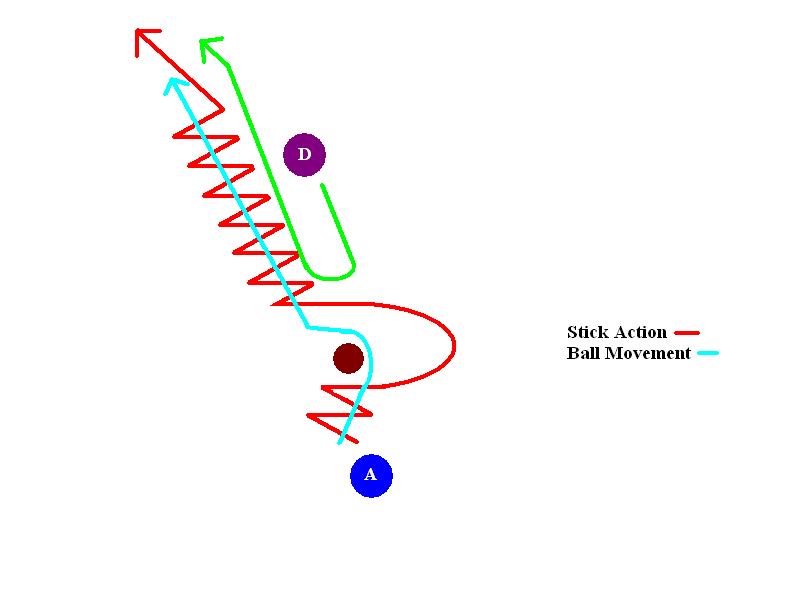
Execution of Skill
- Dribble in a straight line watching the opponent's stick;
- As tackler swings at the ball move the stick SLIGHTLY out & in front of the ball;
- For reverse side protection, reverse stick over ball first;
- Hold stick FIRMLY;
- Run stick along the ground such that the tackler will strike the stick;
- Once tackler has withdrawn the stick, normal dribble can continue.
Watch For:
- Stick is held firmly;
- Stick is NOT touching the ball;
- Stick is NOT swung back to create a stick obstruction;
- Stick head is in front of the ball to prevent it being played by the opponent.
 Practice Drills:
- Player runs in a straight line and protects from tackler from the side;
- Everyone has a ball and tries to knock each others ball out of the confined area while protecting their own ball.
-----oooooOOOOOooooo-----
01.01.29 Ball Protection From In Front
- Used to prevent an opponent tackling;
- Used when under pressure and not in a position to make a pass;
- Used to protect the ball from an opponent attempting a poke tackle.
Execution of Skill:
- While controlling the ball, watch tackler's stick;
- As tackler swings or pokes at ball, move stick SLIGHTLY out & in front of the ball;
- Hold stick FIRMLY between tackler and the ball;
- Once tackler has withdrawn the stick, normal dribble can continue.
Watch For:
- Stick is held firmly;
- Stick is NOT touching the ball;
- Stick is NOT swung at opponents stick to create a stick obstruction.
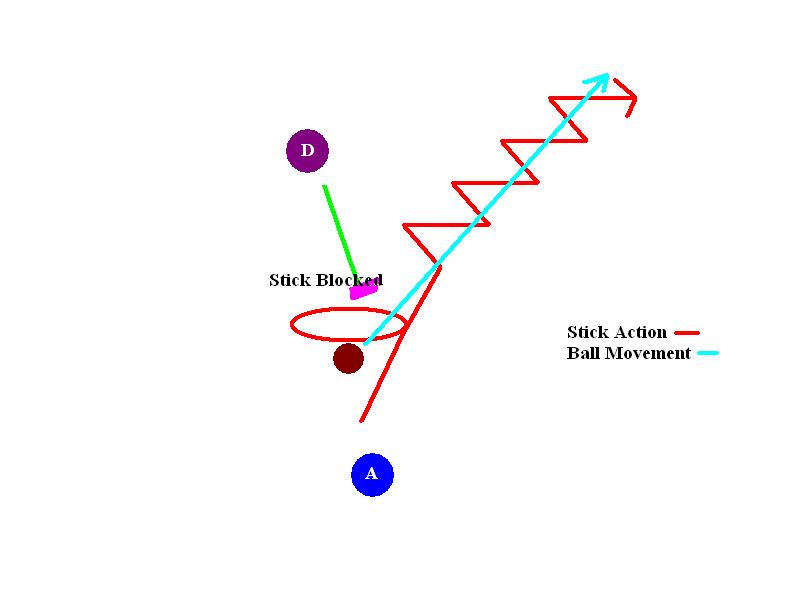 Practice Drills:
- Player controls ball while opponent in front performs a poke tackle;
- Everyone has a ball and tries to knock each others ball out of a confined area while protecting their own ball.
-----oooooOOOOOooooo-----
01.01.30 Ball Protection From Behind
- Used to prevent an opponent tackling;
- Used when under pressure and not in a position to make a pass;
- Used to prevent a chasing opponent from catching up;
Execution of Skill:
- While running with the ball, watch the chasing opponent;
- Watch which side the opponent is attempting to pass you to make the tackle;
- Move ball to OPPOSITE side of the body to where the tackler is;
- Move body TO the side where tackler is and run the tackler off the ball;
- Drag the ball as the body moves but NOT far enough for the tackler to see it;
- ASAP resume original direction (i.e. prevent being channeled;
- Continue to watch opponent as well as the ball;
- Repeat either side of body as often as necessary.
Watch For:
- Player is watching the opponent;
- Player moves the ball away from the opponent BEFORE moving the body;
- Player moves body to run the opponent off the ball;
- Body is ALWAYS between opponent & ball (opponent SHOULD NOT see the ball).
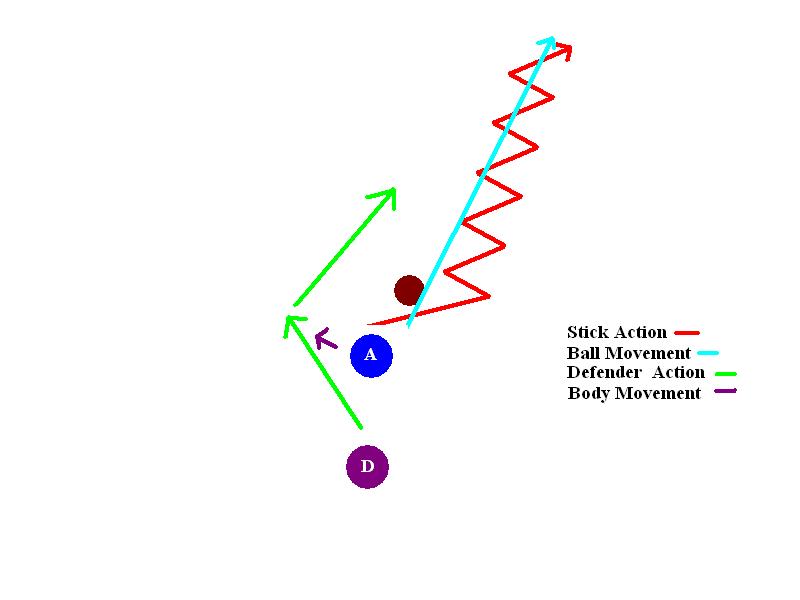 Practice Drills:
- Player runs with ball while opponent tries to catch up from behind;
- Everyone has a ball and tries to knock each others ball out of the confined area while protecting their own ball.
-----oooooOOOOOooooo-----
NOTE: These patterns are samples of patterns which the players need to be able to perform during play. The more they can manouvuer the ball away from the opponent using ball protection and elimination techniques, the more the player will be able to beat the opponent in a ONE on ONE situation.
It must however be noted that these techniques do not eliminate the basic of Hockey being a team sport and that passing is a major component of the game.
Other Patterns For Eliminating Opponents:
Reverse to Front Stick Drag
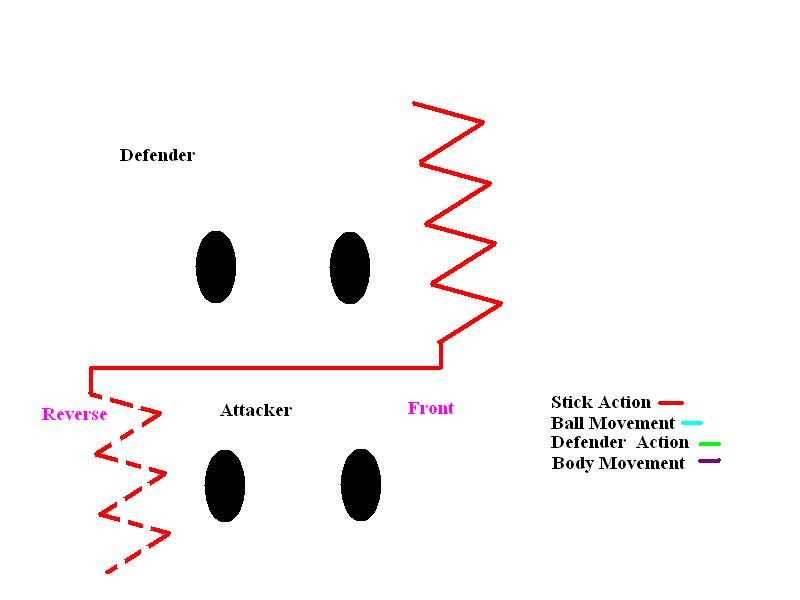 Front to Reverse Stick Drag
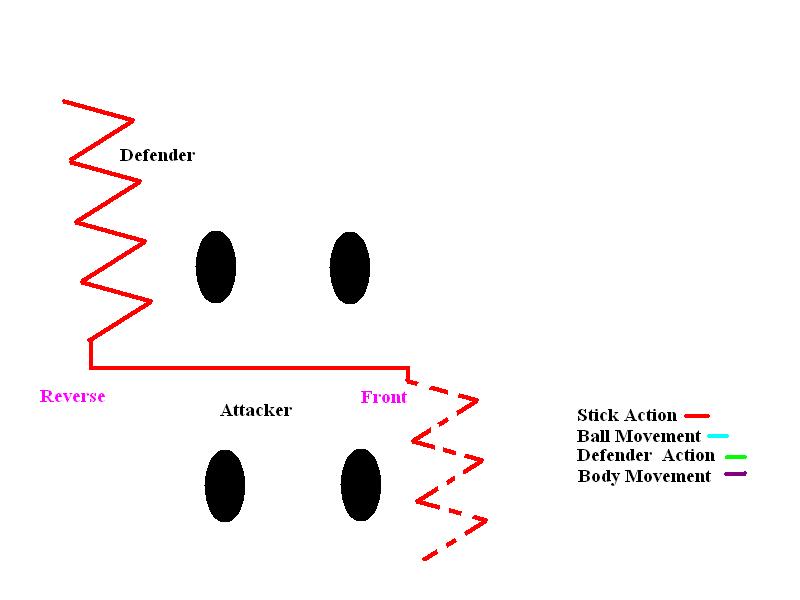 Front to Reverse Stick - Figure Four
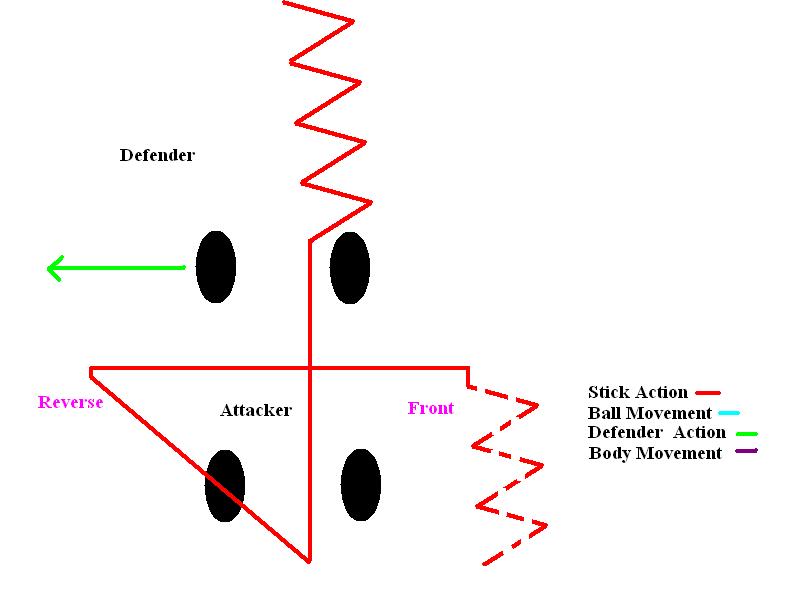 Reverse to Front Stick with Pull Away
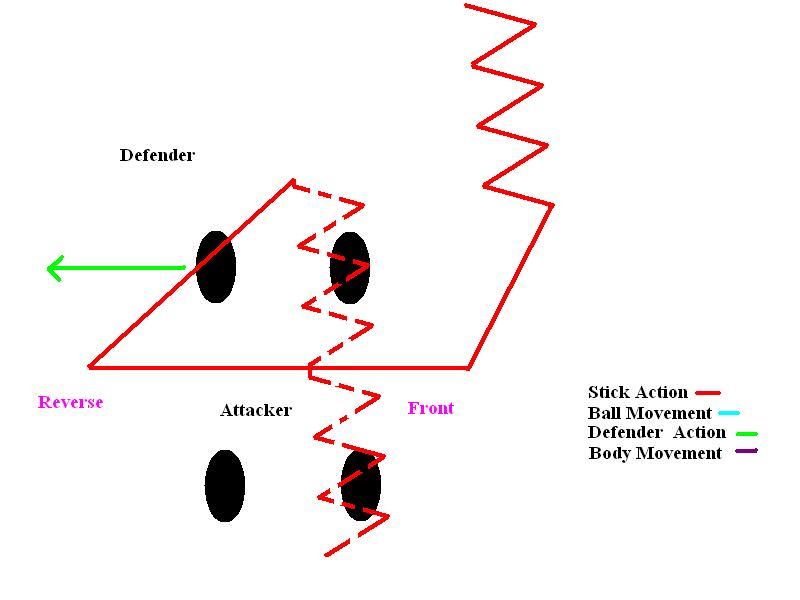 Reverse to Reverse to Front Stick with Pull Away
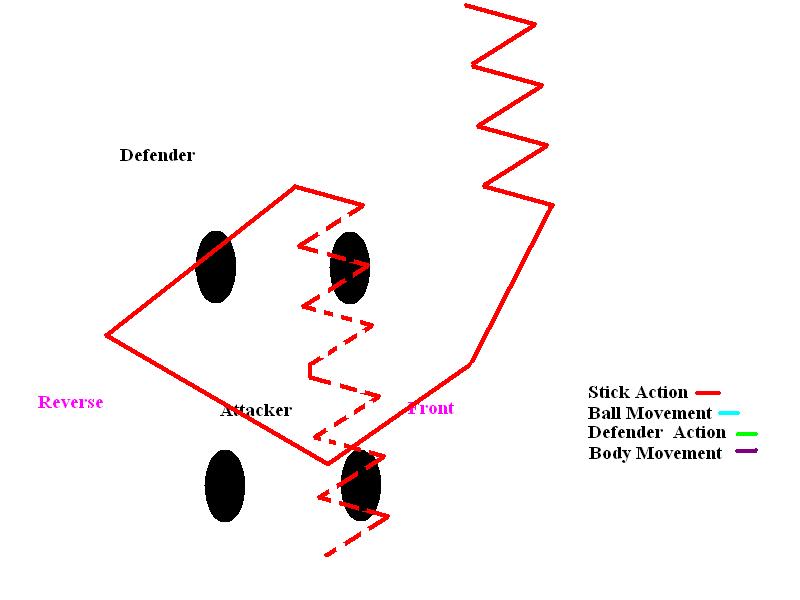 Front to Front to Reverse with Pull Away
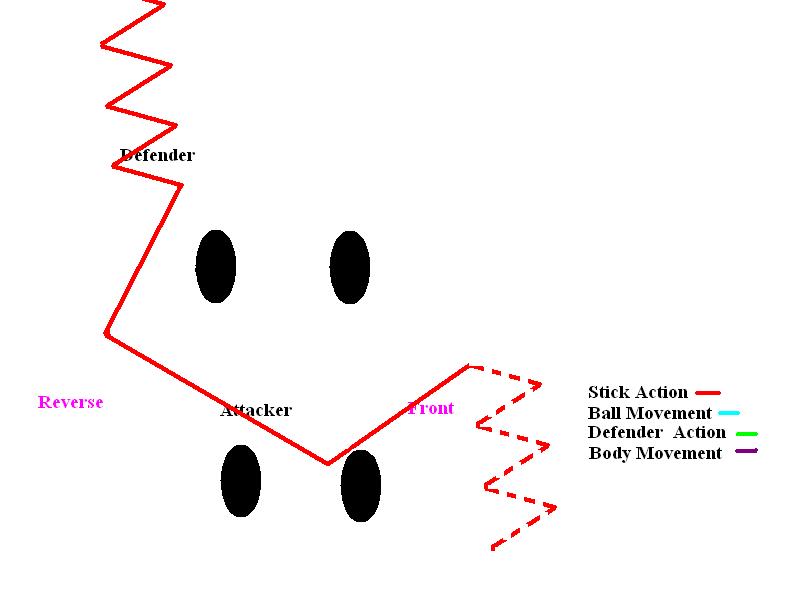
|
|
)