|
|
01 Basic Skills - Day 7
90.00.06 Drill - Passing To Marked Players
A and B pass back and forth looking for a signal and lead from C, D, or E while F, G and H mark C, D, and E. If C, D or E gets the ball, they have a shot on goal.
NOTE: this drill should be done for a maximum of 10 minutes.
-----oooooOOOOOooooo-----
01.01.19 Trapping Deception
Objective:
- As with all skills a deception will assist the player to execute the skill under less pressure.
Execution of Skill:
- Get in the position for a normal trap;
- Just before the ball arrives either accelerate forward or drop back to receive the ball in a different position.
Watch For:
- Player does not move too early;
- Player has looked around to see where to move to be in the best space when receiving the ball.
Practice Drills:
- Hit the ball to a player with an opponent on one side player must deceive the opponent when trapping.
-----oooooOOOOOooooo-----
01.01.20 Reverse Stick Passing
- Used as a deception;
- This pass is more deceptive than a push from left to right.
Execution of Skill:
- Quickly reverse the stick over the ball and push it to the right keeping the stick on the ball;
- Alternatively use the bottom (RIGHT) hand to punch the ball - use a small swing to impart a lot of power.
Watch For:
- Face of the stick is at right angles to direction of the pass;
- Pass is made firmly;
- Pass is quick enough to be deceptive.
Practice Drills:
- Players pair off and pass the ball using the reverse stick;
- Small game points for goals on reverse stick pass;
- Two on ones.
-----oooooOOOOOooooo-----
01.01.21 Pushing Left To Right
- Used to pass the ball quickly without telegraphing the pass to the opposition;
- Use as a more powerful pass than a reverse stick pass.
Execution of Skill:
- Feet continue to move forward so as not to telegraph the pass;
- Push left elbow forward so that left hand turns the stick under the ball (anticlockwise);
- Ensure that the face of the stick is at right angles to the direction of the pass;
- Push both hands in the direction of the push to keep the stick upright (prevents the ball being lifted).
Watch For:
- Feet and body do not turn;
- Stick face is turned far enough to be at right angles to the push;
- Stick is kept upright to prevent lifting of the ball.
Practice Drills:
- Stand side on and push to a team mate on the right;
- Two on ones (with passive then active defenders).
-----oooooOOOOOooooo-----
01.01.22 Two on One
- Used to eliminate a single opponent by passing or using the team mate to deceive and eliminate the opponent one on one;
- Often the players do not recognize actual or potential two on one situations as they occur in the game.
Execution of Skill:
- The player with the ball should run fast so that the defender has little time to react to the situation;
- The player with the ball should run at and draw the defender;
- The player with the ball can then either pass or dummy the pass and beat the defender one on one;
- If the defender does not commit at the player with the ball, this player can keep running if the pass is covered;
- Passes should be firm and accurate;
- Passes should NOT be made across the face of the defender (run at and not away from the defender to pass);
- The player off the ball should try to move the defender at the right time.
Watch For:
- The player with the ball runs at the defender;
- The player runs fast;
- The player with the ball watches the defenders movements as well as the team mates position;
- The pass is firm;
- Deceptions are used.
Practice Drills:
- Two on one and a goal shot;
- Three on two where players try to create two on ones;
- Small game points for two on one.
-----oooooOOOOOooooo-----
01.01.23 Jinking
- Used to beat a flat stick tackle.
Execution of Skill:
- Grip is as per basic dribble. The LEFT hand should be comfortable;
- Before jinking drag the ball sideways to cause defender to lay the stick flat but also to make it easier to jink;
- As the ball moves sideways roll the stick under the ball and give it a small scoop or flick just high enough to get over the stick;
- Player should continue to move forward with the ball so that the ball does not run too far forward;
- If necessary have players start at walking pace with a passive defender then build up to a full sprint with an active defender.
Watch For:
- Stick stays on ball throughout the drag and jink;
- The ball does not run too far forward off the stick.
Practice Drills:
- One on one with stick laid on ground then build up to active defender;
- Small games points for goals and jinking.
-----oooooOOOOOooooo-----
01.01.24 Stick Feints
Objective:
- Used to deceive and eliminate opponent one on one.
Execution of Skill:
- Do not do a lot of stick work while approaching the opponent otherwise attention will be focused too much on the ball;
- Move / dummy so that the defender is tricked into moving in the wrong direction;
- Dummy movement can be with either body or the stick;
- Player should focus on the opponent's feet, stick and weight transference;
- The ball should be moved immediately the opponent reacts to the dummy;
- The player should cut in behind the defender and protect the ball as quickly as possible;
- Deceptive moves include:
- Swerve and Drag;
- Show and Go;
- Dummy Over The Ball;
- Body Swerve.
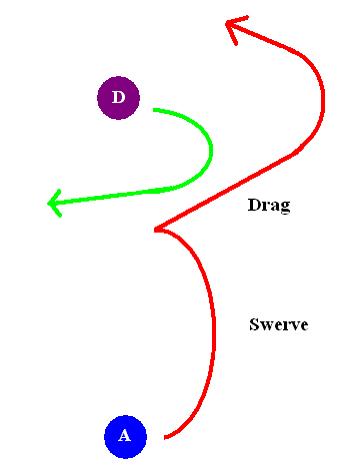
Swerve & Drag - move the ball to the right and as defender shifts to that side swerve towards the left. As the defender shifts back watch for when the defender's weight is shifting and / or the defender's legs cross. Immediately drag the ball to the right and then cut in behind the defender.
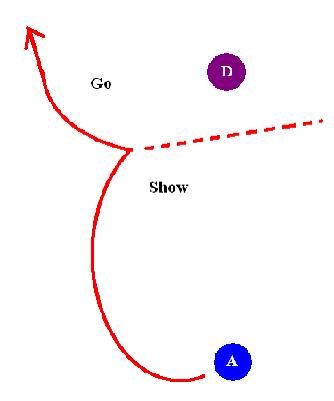
Show & Go - Move to the left and move body around as if to pass the ball to the right. When the defender shifts to the right and / or lays the stick down flat to cut of the pass immediately drag the ball left then cut in behind the defender.
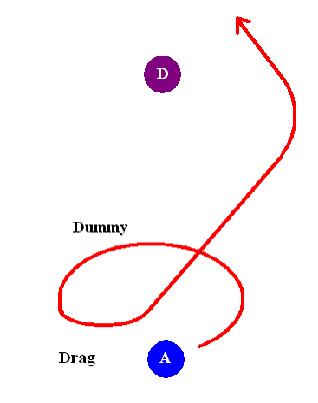
Dummy Over The Ball - Move the stick across in front of the ball as if to pass from Right to Left. In the same motion drag the ball back to the right and cut in behind the defender.
Watch For:
- Dummy moves are realistic enough to trick a defender;
- Player watches defenders movement;
- Player moves the ball immediately the defender reacts to the dummy;
- Player does not get to close to the defender before moving the ball;
- Movement of the ball is quick;
- The player cuts in behind the defender after getting around.
Practice Drills:
- One on Ones with passive defender moving up.
-----oooooOOOOOooooo-----
01.01.24 Signaling And Leading
:
- Used so that team mates can communicate without letting the opposition know;
- Used to deceive opponents without confusing team mates.
Execution of Skill:
- Players must get eye contact before a signal is made;
- The signal should be known by each player (eyes, finger, stick, etc. - the players should decide what they consider to be the best for their team) and hidden from the opponent;
- The receiver should make a dummy lead to deceive the opponent and / or move the opponent out of position (DEFENDERS must always position themselves between the ATTACKERS, ensuring that the GOAL KEEPER STILL HAS LINE OF SIGHT OF THE BALL);
- The dummy lead should be slow enough so that the opponent can follow;
- The PASSER should make a dummy pass to deceive the opponent;
- The RECEIVER should make the actual lead as late as possible to prevent the opponent reacting early.
Watch For:
- Players make eye contact before signaling;
- The actual lead is not made until the passer is ready to pass;
- The pass is made when the receiver can get there to receive it (The PASSER must not assume that a ball hit through by them will be picked up by the RECEIVER if the receiver is not in the POSITION or READY to RECEIVE IT);
- Deceptions are used.
Practice Drills:
- Two players with an opponent closely marking one;
- Small points game for signaling and leading.
|
|
)