|
|
Playing Style - Advanced Programme
General Discussion:-
NOTE: We have now reached the end of our basic and advanced skills programme - from this point onwards; we are going to concentrate on two aspects of the game:
Day one of the week - Technical Aspects of Play (Example: Day XXX (ODD DAYS) - Close Range Shooting for Strikers, 16 yard clearance from Defenders using "Escape Routes", Short Corner pushing and stopping for the short corner battery - basic techniques are coached)
Day two of the week - Match Play (Example: Day XYZ (EVEN DAYS) - Defensive Pattern transition from Offensive Pattern - GK-2-3-3-2 to Defensive Pattern - GK-1-3-4-2)
At this point in time, we need to concentrate on ensuring that the players are competent at an Under 13 level.
Skills Progression - Under 13
Emphasis
Decisions - Player should be able to cope with the concept of making and being responsible for their own decisions during games. They should be encouraged to evaluate their decisions both during and after the game.
Skills - Emphasis should still be placed on the correct performance of skills with remedial skills sessions as and when required.
Rules - Players should have a reasonable knowledge of all playing rules especially those that affect the way they play.
Game Plan
- Look of the ball and man-up (NOTE: Ball Side / Help Side Concept);
- Communicate with each other to ensure that all opposition players are manned up (NOTE: Ball Side / Help Side Concept);
- Retain width and depth;
- Create and exploit space both on and off the ball;
- Be encouraged to set their own goals for the game;
- Be encouraged to create two-on-ones in a game;
- Understand the concept and value of back passes.
Skills Standard
- Push - Players should be able to push the ball from left to right;
- Channeling
- Players should be able to mirror and channel opponents;
- Tackling - Players should be able to perform lunge and reverse stick tackles;
- Dribbling - Players should be able to change pace and perform stick feints when dribbling;
- Vision - Players should be able to see beyond the immediate opponent while dribbling;
- Deception - Players should be able to perform methods of deceiving opponents;
- Signaling - Players should be able to signal and lead to receive ball in space. The passer should be able to pass into space and execute any necessary deceptions.
- Ball Protection - Players should be able to protect the ball using the body;
- Goal Scoring - Players should understand good goal scoring positioned;
- Penalty Corners - Players should be able to cope with penalty corner variations;
- Goalkeepers - Should be able to slide, defend a basic penalty corner and stop with the hand.
-----oooooOOOOOooooo-----
03.01.14 Back Passes - Concepts & Values
Color Key: - Blue - Back Passes
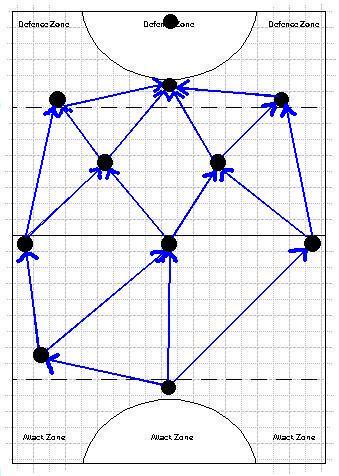
Philosophy - Discussion on the concept of Back Passes.
The GOLDEN RULE in DEFENCE is NO SWITCHES ACROSS THE GOAL WITHIN OUR DEFENSIVE ZONE. SWITCH PASSES ARE ONLY TO HAPPEN IN THE ATTACKING ZONE.
The general philosophy of attack is to be able to change the direction of the attack from one specific channel to another when the route intended has been blocked through defensive actions of the opponents. To enable this change of direction, we need to utilize a Back Pass to a team mate - the following should be place for the Back Pass to be successful:
The Back Pass diagram shows a number of "V" forms where for example the Center Forward can Back Pass to the Right Wing Forward, Center Midfield, or Outside Left Midfield.
The "V" should already be in place to enable the attack to be turned into Double Defence the instant that the attacker looses the ball to an opposition player.
An Exercise:
Double Defence
Firstly in two's to practice forcing the player in possession wide and preventing the inside pull;
In three's: now practice the shepherding and the winning of the ball in the double defense.
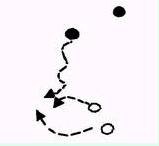
EXERCISE:
1 v 2 - when the tackle is made the player in possession then becomes the attacker in the 1 v 2. Duration: 20 min with regular breaks. Constant metamorphosis from defender to attacker.
Player engages to force the player in a direction towards the smaller area of the field. Stick positioning is very important:
Needs to meet head on to slow the ball carrier.
Practice the angle of the technique. Stick covers the inside option until the ball carrier has extended to prevent the inside pull. Stick position changes.
Lean on the ball carrier. Very close to her. Needs to feel the tackler.
Attacker has no option but to attend to the ball.
Only option for the attacker is to spin out then the defender wins. Organize again.
The inside option is covered and the pressure is on the attacker to do something.
In Threes:
With the extra person now we do the player coming in for the double defense.
Tackler needs to step into the tackle and surprise the attacker.
The Attacker with the ball must have the sense of the surrounding field, attackers and the opposition defenders to be able to understand whether the current play has the opportunity of creating a goal scoring chance - all to often, Attackers, especially Center Forward, Right Forward, Outside Left Midfield and Center Midfield run themselves into a closed channel with zero option of either:
Creating a goal scoring opportunity, or
Creating an opportunity to change the play from the current channel to a different channel.
The net result of such an attack is an immediate counter-attack by the opposition where the original attacker, plus support player are found out of a defensive position, this places undue pressure on the Defensive Players, to defend higher in their zone than where they should - defending in the higher zone means that there will always be a zone between the Full Backs and Sweeper, where an intelligent attacker will place the ball for an Outside Forward to run onto and create an attack - the Sweeper will be required to follow that player, which means that the central zone is open for an attack, this is what we want to do to the opposition and not have the opposition to do to ourselves - typically in today's hockey, a large number of goals are scored using this method - the players who should prevent it from happening start with the Attacker who was tackled in a closed zone, and subsequently caught out of position.
***** ***** *****
Questions to ensure that you are aware of requiring a Back Pass
Keywords
Attack Awareness
Field Awareness
Opposition Awareness
Back Pass Option Awareness
Which mean the following:
Attack Awareness:-
Is there a chance of success with this attack?
Where are my attack team mates?
Are they in the position to assist me in the event of trouble?
Am I sure that I can get a safe pass away to my attack team mate?
Is my next action likely to place the whole Team under pressure?
Field Awareness:-
Where am I on the field compared to the Opposition Goals?
Where am I on the field compared to our own Goals?
Where is my next move on the field?
Is my next action likely to place the whole Team under pressure?
Opposition Awareness:-
Where am I on the field compared to the Opposition?
Am I under a direct threat of a tackle or having a blocked channel in my current play action?
Am I under a threat of a subsequent tackle or having a blocked channel after my current play action?
Am I under threat of having my attack team mates marked or checked so that I cannot execute a pass to my team mate?
Where is my next move on the field?
Is my next action likely to place the whole Team under pressure?
Back Pass Option Awareness:-
Where am I on the field compared to the Opposition?
Am I under a direct threat of a tackle or having a blocked channel in my current play action?
Am I under a threat of a subsequent tackle or having a blocked channel after my current play action?
Am I under threat of having my attack team mates marked or checked so that I cannot execute a pass to my team mate?
Where is my next move on the field?
Is my next action likely to place the whole Team under pressure?
These questions should be continually asked throughout the game by each player irrespective of whether it is a Back Pass, Defence Pass, or an Attack Pass.
If the answer is YES - I AM GOING TO GET INTO TROUBLE WITH MY NEXT ACTION - THE OPTION IS THERE FOR A BACK PASS - IDEALLY, THE QUESTIONS SHOULD BE CHANGED TO SAY "AM I GOING TO GET INTO TROUBLE TWO MOVES TIME" - IF IT IS THE NEXT MOVE, THEN I AM PROBABLY ALREADY IN TROUBLE AND I AM GOING TO PUT THE WHOLE TEAM UNDER PRESURE .......... IDEALLY WE SHOULD BE THINKING TWO OR THREE MOVES AHEAD OF OUR CURRENT ACTION............... BY BEING AWARE OF THE ATTACKING OPTIONS, DEFENSIVE OPTIONS, FIELD OPTIONS.......... IT IS ALL TOO EASY FOR A PLAYER TO ONLY THINK OF THE CURRENT MOVE....... HOW DO I BEAT THIS CURRENT DEFENDER? ...... INSTEAD OF THINKING:
IF I BEAT THIS DEFENDER, WHERE WILL I FIND MYSELF ON THE FIELD?
WHAT WILL BE MY NEXT MOVE AFTER ELIMINATING THIS DEFENDER?
WILL THERE BE ANOTHER DEFENDER THAT I WILL ENCOUNTER?
WHERE IS MY ATTACK TEAM MATES AFTER THIS MOVE?
WILL THEY BE ABLE TO HELP ME IF I AM IN TROUBLE?
WILL I BE IN THE POSITION TO TAKE A SHOT AT GOAL AND SCORE?
IF I MAKE A MISTAKE WHAT WILL HAPPEN?
From this set of questions, the Attacker needs to be thinking ahead and understanding the possibility of the cause of their action - getting into trouble as an Attacker, places the whole team under pressure ......... no side can afford to create opportunities for the Opposition to counter attack with a player or players out of position......... NIETHER CAN WE AFFORD THIS TYPE OF COUNTER-ATTACK.
***** ***** *****
The Decision On The Back Pass - When
Keywords
Attack Awareness
Field Awareness
Opposition Awareness
Which mean the following:-
Attack Awareness:-
Where is the attack going?
If the ATTACK has a the opportunity of being stopped either through a tackle, being channeled to a dead-end, coming to an end through some other mechanisms, either with the current move, or with the next movement ............ TIME TO LOOK FOR A BACK PASS............. IDEALLY THE BACK PASS SHOULD BE AVAILABLE ONE MOVE EARLIER THAN THE MOVEMENT WHICH GETS YOU INTO TROUBLE..........
Field Awareness:-
Where am I on the field?
Is my position on the field of such nature that there is nothing Constructive that I can do in trying to continue with the current attack ....... and the possible result of continuing the attack will be for the opponents counter attacking .... TIME TO LOOK FOR A BACK PASS............. IDEALLY THE BACK PASS SHOULD BE AVAILABLE ONE MOVE EARLIER THAN THE MOVEMENT WHICH GETS YOU INTO TROUBLE..........
Opposition Awareness:-
Where is the opposition on the field relative to me?
" Is my position on the field relative to the opposition of such a nature that there is no Constructive action that I can take to enable the attack to continue ....... without it being stopped or channeled out of harms way....... TIME TO LOOK FOR A BACK PASS............. IDEALLY THE BACK PASS SHOULD BE AVAILABLE ONE MOVE EARLIER THAN THE MOVEMENT WHICH GETS YOU INTO TROUBLE..........
***** ***** *****
The Decision On The Back Pass - How & To Whom
The Decision...................
Keywords
Potential Trouble Position Awareness
Which means the following:-
How do I know that I am in trouble and what is the best Back Pass to make - to whom should the Back Pass go?
Have I asked myself the questions during the course of play which has allowed me to understand that I am in "Potential Trouble Position Awareness" ...... if no .......how do I know that I am in trouble in the first place ..... if I do not know that I am in trouble ...... then what can I do to get out of something that I do not understand in the first place ...... or am I just playing from instinct and without thinking ...... ASK AGAIN AND AGAIN AND AGAIN AND AGAIN.................
Do I know where my attack team mates are ........who is the closest to me ....... who is the furthest ....... who is marked ...... who is open ...... what are the angles that the ball must travel relative to the nearest opposition ....... will my attack team mate be placed under greater pressure than myself ...... will the opposition be able to intercept my pass ...... what if I over hit the pass ....... what if I under hit the pass ....... what if I misdirect the pass....... WHAT IS THE IMPACT OF ME MAKING AN ADDITIONAL MISTAKE IF I AM ALREADY IN TROUBLE BECAUSE OF A MISTAKE...................................? and what else must I be aware of in my immediate surroundings on the field ............. the Umpire, the Out Lines of the field, a possibly substitution taking place in my vicinity..... nothing is more frightening than having a Back Pass picked up by an opposition substitute and return to the back of your own net ...... it has happened - believe me - I have seen it .......
***** ***** *****
Who To Pass To
Keywords
Back Pass Awareness
Which means the following:-
Am I aware of the Back Pass options on the field, and am I able to make the correct decision?
The GOLDEN RULE in PROVIDING A BACK PASS is ALWAYS BE AWARE OF THE REQUIREMENT TO HAVE A BACK PASS OPTION TO CHANGE THE DIRECTION OF THE ATTACK, OR TO GET OUT OF TROUBLE EARLY ENOUGH AND THEREBY BEING ABLE TO PREVENT A COUNTER-ATTACK BY THE OPPOSITION. YOU AS THE PLAYER IS THE ONLY PERSON WHO CAN CONTROL THE SITUATION THAT YOU FIND YOURSELF IN AT ANY POINT IN THE GAME......... THE COACH CANNOT DO IT, THE TEAM CAPTAIN CANNOT DO IT, NOR CAN YOUR TEAM MATES DO IT, THEY CAN ONLY BE IN THE SITUATION TO RECEIVE A BACK PASS FROM YOU........... BUT IF YOU ARE NOT AWARE OF THE POSSIBILITY OF USING A BACK PASS, YOU WILL NOT FIND YOUR ATTACK MATE GETTING INTO A RECEIVING POSITION FOR THE BACK PASS.
The GOLDEN RULE in RECEIVING A BACK PASS is ALWAYS BE AWARE THAT YOUR TEAM MATE WILL REQUIRE YOU TO BE IN A POSITION TO RECEIVE A BACK PASS FROM THEM. YOU AS THE PLAYER IS THE ONLY PERSON WHO CAN ENSURE THAT YOU ARE IN THE POSITION TO RECEIVE THE BACK PASS........ YOU MUST BE AWARE OF WHAT IS HAPPENING ON THE FIELD AROUND YOU....... ATTACK AWARENESS..... FIELD AWARENESS...... OPPOSITION AWARENESS....... AND ENSURE THAT YOU ARE ABLE TO ANTICIPATE THE TIMING OF A BACK PASS - BACK PASS AWARENESS - FROM YOUR TEAM MATE........ AND REMEMBER TO COMMUNICATE WITH YOUR TEAM MATE IF YOU SEE SOMETHING DEVELOPING WHICH THEY MAY NOT BE AWARE OF............ A SUBSTITUTION HAPPENING BEHIND THEIR BACK...... AN OPPONENT COMING FROM BEHIND, OR FROM AN ANGLE WHICH WILL PREVENT A SUCCESFULL PASS - EVEN IF THEY HAVE SEEN IT, AND IT ALLOWS THE BALL CARRIER THE CONFIDENCE IN UNDERSTANDING THAT WHAT THEY ARE SEEING & DOING IS CORRECT....... THIS IS WHY WE ARE TEAM MATES......... AND REMEMBER TO COMMUNICATE WITH YOUR TEAM MATE TO ENSURE THAT THEY ARE AWARE OF YOUR POSITION ON THE FIELD....... ESPECIALLY IF YOU ARE AWARE OF DEVELOPMENTS IN THE OPPOSITION DEFENSE WHICH MAY PLACE YOU UNDER PRESURE IF YOU RECEIVE A BACK PASS FROM YOUR TEAM MATE......... YOU MUST MAKE SURE THAT YOUR TEAM MATE'S BACK PASS TO YOURSELF IS AN EFFECTIVE PASS....... BE AVAILABLE FOR THE BACK PASS..... RATHER THAN BEING OUT OF POSITION........... BUT ENSURE THAT YOU ARE THINKING AHEAD FOR YOUR NEXT ATTACK PASS - DO NOT GET CAUGHT WITH LOOKING AT ONLY THE CURRENT SITUATION THAT YOU ARE FACED WITH ............... BE PREPARED FOR FURTHER PLAY ACTION.REMEMBER THE OTHER GOLDEN RULE............... IF THE OPPONENTS DO NOT HAVE THE BALL, THEN THEY CANNOT SCORE - KEEP THE BALL AWAY FROM THE OPPONENTS.
USE the BACK PASSES option to CHANGE THE DIRECTION OF THE ATTACK, or TO GET OUT OF TROUBLE EARLY ENOUGH IN THE PLAY ACTION.........
***** ***** *****
Passing Directions................
Examine the Back Pass diagram and look at the directions of the Back Passes .......... the directions are in the "V" and back to the closest team mate - THERE ARE NO BACK PASSES WHICH ELIMINATE A TEAM MATE BY HITTING TO A DEEPER TEAM MATE - the longer the pass, the more options there are to:
Have the pass intercepted by the opposition;
Make a mistake and put the whole team under pressure;
LOOSE THE GAME.
There is also no SWITCHED Back Pass on the diagram, Back Passes are aimed into the adjacent channel, which ensures that an opposition player would need to anticipate this type of pass - look at the diagram - you will see that a large majority of the passes have at least TWO options available - this means that there would need to be at least THREE opposition players required to eliminate the Back Pass option. If the opposition have this type of Back Pass to concern them, they will be less inclined to commit defenders - and therefore provide more space for ourselves to operate in - THIS IS WHAT WE WANT TO HAVE HAPPEN ....... THE OPPONENTS MUST BE FORCED TO PROVIDE US WITH EXTRA SPACE BECAUSE OF THE OPTION OF THE MULITPLE BACK PASSES THAT WE CAN USE - THIS SPACE ALLOWS US TO CREATE THOSE EXTRA GOAL SCORING OPPORTUNITIES AND THAT IS WHAT WE WANT........
In the event of opposition loading the defensive zone, that is the area around the Goal Scoring Circle, A QUICK SERIES OF BACK PASSES COMBINED WITH ATTACKING PASSES CHANGES THE ANGLE AND DIRECTION OF THE ATTACK - THIS PLACES TREMENDOUS STRAIN ON A DEFENSE WHO NEED TO CONTINUALLY CHANGE THEIR DEFENSIVE POSITIONS AND CHANGE THEIR MARKED PLAYERS - THIS TYPE OF PLAY SWITICHING CREATES OPPORTUNITIES ........
USE BACK PASSES AS THE KEY TO SWITCH PLAY FROM ONE CHANNEL TO ANOTHER - THE COMBINATION OF A BACK PASS, FOLLOWED BY A QUICK ATTACK PASS DOWN THE NEW CHANNEL CREATES THE OPPORTUNITIES - REMEMBER - THE BACK PASSES NEED TO HAPPEN EARLIER THAN LATER ....... THE BACK PASSES NEED TO HAPPEN QUICKLY AND BEFORE THE OPPOSITION CAN ANTICIPATE THE BACK PASS HAPPENING....... WE WANT TO KEEP THE OPPOSITION GUESSING ALL THE TIME AND NOT BECOME STERYOTYPED IN OUR COURSE OF PLAY ACTION......... THE ATTACKER WITH THE BALL HAS THE ABILITY TO CREATE THE NEW ATTACKING CHANNEL IF THE REQUIREMENT ARISES - UNDERSTAND THIS AND MAKE USE OF IT ---------- BUT THE FIRST OPTION WILL ALWAYS BE TO TRY AND CREATE THE SCORING OPPORTUNITY FROM THE CURRENT ATTACK AND ONLY IF THE POSSIBILITY EXISTS FOR FAILURE, OR COUNTER ATTACK, USE THE BACK PASS OPTION........
***** ***** *****
To go round the back...... by Jools Autret
As a defender, I always find it frustrating not to get the ball when you are the only option available. Midfielders and forwards usually forget that our role apart from defending is one of support.
They should learn to go round the back!!!! They always (or often) want to go forward. But the defense is so important to make them achieve that. The role of the defense is not confined to one of tackling and passing forward. Rather (well, I strongly believe so) the defense line is there to "attract" the opponents in a trap. To make them come forward, producing a gap between lines, allowing midfielders more movement. However, I understand the concerns of midfielders and forwards: "what if they lose the ball stupidly, allowing the other team to score?" Well, as the old say states: "Practice makes perfect". They have to rely on their fellow partners! They are useful as well.
To start with:
I would put 4 players at the back with the right and left back with a very important role: giving options to midfielders and go forward. Exercises such as 5x5 should be organized where the aim of the defense is to bring the ball as long as they can; playing in triangles with a lot of passing. EASY STUFF.
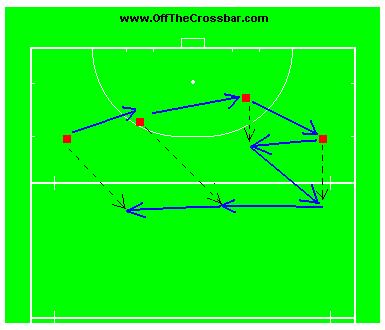
To go round the back is also helpful to learn how to clear the ball. This is different from "getting rid of it". Which people often do? Too many times, players play right in the centre, the most dangerous thing to do, against the golden rule. I would rather see a player striking the ball out, towards the side line and perhaps shout and express his/her disappointment (although against the team spirit).
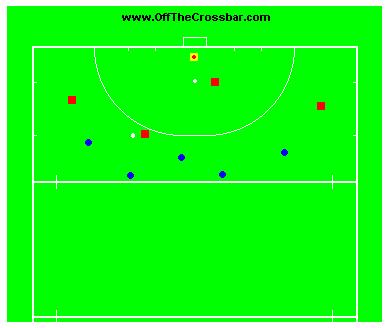
Few options are usually available.
The ball should go round the back with the centre back or the sweeper and then play left or right and immediately offering support. Passes must be precise, with enough strength. Other options can be given by midfielders, "calling" for the ball by moving towards the side lines!
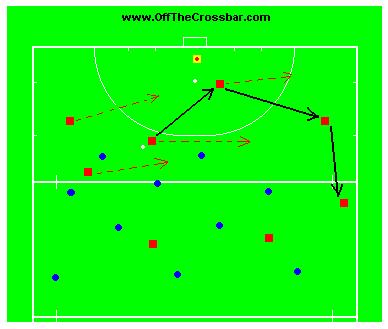
To go round the back involves not only the defense but also the midfielders. On that kind of exercise, aerial balls can be practiced.
It is crucial for a team to use the defense (everybody knows that�). I know that skillful players will always find a small gap to pass the ball but how many times do they find the gap but nobody to receive the ball? Too many. Hockey is a game of strategy. The aim is to keep the ball, build a strategy and score, not to push forward and eventually score.
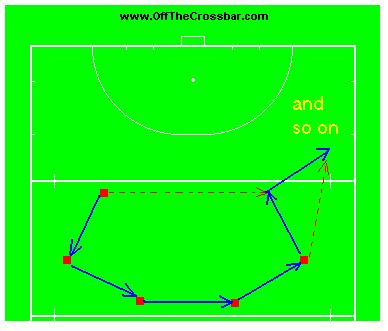
I have played left wing recently, and I understand why forwards don't always come back�But I am not the fittest and I always do my best to help my team mates.
|
|
)