| Biography for Humphrey Bogart "The trouble with the world is that it's always one drink behind." The exact date of Humphrey Bogart�s birth has been questioned for many years. Some sources indicate he was born on January23, 1899, but with Hollywood being what it was in the 30�s, the folks in Warner Brothers publicity department thought a Christmas birthday would be better for his image because, as they stated 'a guy born on Christmas can't be all bad.' Bogie was mostly portraying gangster heavies and �bad guys� during his early career, and only later became the hero and �good guy.� The 1900 census records prove the December birth date to be incorrect, although Bogart celebrated his birthday on Christmas day. Bogie�s father was a surgeon and his mother, an illustrator (Maud Bogart's drawing of her baby Humphrey appeared in an advertising campaign for Mellin's baby food). Humphrey Bogart attended Trinity School in New York City, and then Phillips Academy in Andover. He was expelled from Phillips and subsequently joined the U.S. Navy. While serving in the navy during WWI, he was wounded during the shelling of the Leviathan. This is one source of where he obtained the scar on his upper lip that caused his slight lisp. However, there is some dispute as to how Bogey's lip injury actually occurred. Another version has it that he caught a large wood splinter in his lip when he was twelve, another has it that his father hit him across the face and the ring on his finger torn open Bogie�s lip. (That same ring was given to Bogart by his father and can be seen in many of his films.) Another story of how Bogart got his scar and lisp goes back to his time in the Navy. Bogart was a guarding a prisoner who attempted to escape and hit Bogart in the face with his shackles. The surgeon who stitched up Bogart�s lip did not do a very good job and Bogart was left with his lisp. The truth is still something of a mystery. From 1920 to 1922 he managed a stage company owned by family friend William S. Brady and also performed a variety of tasks at Brady's film studio in New York (one of which may have been playing bit parts.) During this time he began stage performances. Alexander Woollcott described his acting in a 1922 play as "inadequate." Bogie carried the clipping of the review with him always. A talented stage actor during the 1920s, Bogart made his screen debut in a short, Broadway�s Like That (1930)and alternated stints in theater and film for the next few years. (Recently, an older film entitled Life (1920) has come to light. It seems Bogie had a small bit part in the film.) His career rose when he played Duke Mantee in "The Petrified Forest" on Broadway. Leslie Howard insisted Bogart recreate the role in the 1936 film adaptation, for which he earned a Warner Brothers contract. From 1936 to 1940 he appeared in many films, usually as a gangster. Although Bogart gained fame in The Petrified Forest (1936) and in Dead End 1937 (on loan to MGM), Warners kept him in B pictures such as Isle of Fury (1936) and secondary roles in bigger-budgeted movies such as supporting Bette Davis in Marked Woman (1937) and Dark Victory (1939). He was good at portraying gangsters in Angels With Dirty Faces (1938) and The Roaring Twenties (1939),but not so good as a zombie in The Return of Doctor X (1939), nor as a Mexican bandit in the Errol Flynn Western Virginia City (1940). His turning point came in 1941, starring as Roy Earle in High Sierra (1941) and then as Sam Spade in The Maltese Falcon (1941). Casablanca (1942) and Key Largo (1948) followed these memorable performances. Bogart must give thanks to George Raft for passing on the lead roles of "Mad Dog" Earle in High Sierra and Sam Spade in The Maltese Falcon. As he became more popular, Warners offered him roles that allowed him to still be a tough-guy, but at the same playing sympathetic characters. The role of "Rick" in Casablanca (1942), was just the first in a line of memorable performances. They continued with roles in To Have and Have Not (1944), The Big Sleep (1946), Key Largo (1948), The Treasure of the Sierra Madre (1948), In a Lonely Place (1950), The Caine Mutiny (1954) The Desperate Hours (1955), The Harder They Fall (1956.) Bogart performed rarer comic roles in All Through The Night (1942), Sabrina (1954), and We�re No Angels (1955), as well as The African Queen (1951), his Oscar-winning performance as Charlie Allnut. In 1947 he joined Lauren Bacall and others protesting the witch hunts of the House Un-American Activities Committee. He also formed his own production company and the next year made The Treasure of the Sierra Madre (1948). "Bogey" received the Best Actor Academy Award for The African Queen (1951) and nomination for Casablanca (1942) and as Captain Queeg in The Caine Mutiny (1954), a film made when he was already seriously ill. It�s reported the last thing he said was, "I should never have switched from scotch to martinis." A lifelong smoker, he succumbed to throat cancer in 1957. He died in his sleep at his Hollywood home following an operation for throat cancer on January 14. Bogie is interred at Forest Lawn, Glendale, CA, in the Garden of Memory, Columbarium of Eternal Light (not accessible to the general public). Bogart was respected during his life but didn't become a superstar until viewers rediscovered his films in the late 1960s. He remains arguably the most popular male star of Hollywood's Golden Age. |
 |
 |
 |
| My tribute to Humphrey Bogart |
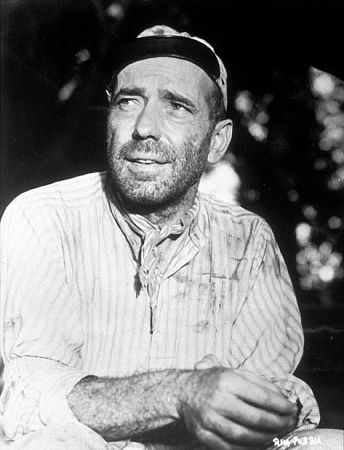
| Charlie Allnutt |
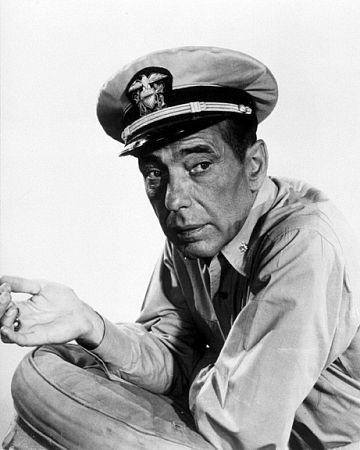
| Commander Queeg |
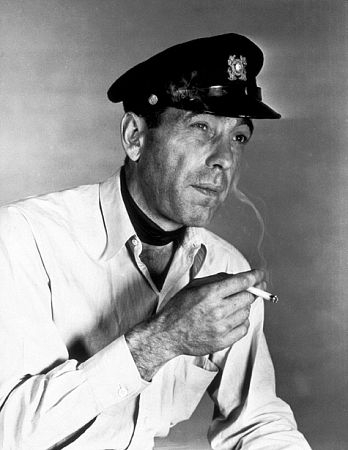
| Harry Morgan |