|
|
||||||
|
|
||||||
|
|
||||||
CY 2007 ANNUAL REPORT
|
||||||
|
|
||||||
PROGRAMS AND PROJECTS
|
||||||
|
The region through the ERDS embraced the needed
Research, Develoment and Extension Reforms through
the implementation of the four (4) banner programs. These include the a) vulnerability
assessment of watershed areas, b) determination of the carrying
capacities of the various areas for resources conservation, ecotourism and
sustainable development, c) rehabilitation and ecological restoration of
marginal and degraded landscape and seascape, d) development of strategies
for the production of quality planting materials. The implementation of these
programs is considered as a proactive mechanism to address the technology and
information needs of internal and external clients. |
|
|||||
a.
Research, Development and
Ecosystems Programs
The Research and Development undertakings
are highlighted by the following accomplishments : 1.
Vulnerability Assessment of Watershed This program provided detailed information about the priority watershed
particularly its strengths and weaknesses relative to its susceptibility to
various hazards. For the year, two (2) watersheds were subjected to
vulnerability assessment; the Panakuyan Watershed
Project in Libacao, Aklan;
and the Mambusao River Watershed in Mambusao, Capiz. The projects are geared toward attaining
the following objectives: §
To analyze and map the identified
hazards in the watersheds; §
To determine and analyze critical
factors that can affect the services of the watersheds; §
To identify and analyze societal and
economic factors that will be affected by the watersheds; and §
To gather primary and secondary data
and analyze secondary impacts of the watersheds to its environment. |
|
|||||
|
a. Vulnerability Assessment of Panakuyan
Watershed Panakuyan Watershed is
situated within the two (2) provinces of the |
||||||
|
|
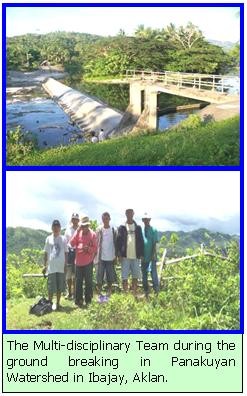
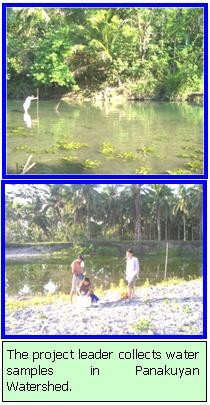
Through
the active participation of the Multidisciplinary Technical Working Group (TWG),
the ground truthing and GPS mapping, community
interview, primary and secondary data gathering were undertaken to gather all
pertinent data and parameters for the project. Initial findings revealed that
Panakuyan Watershed is vulnerable to landslides,
soil erosion, deforestations and biodiversity loss. The areas identified to
be most prone to deforestation and biodiversity were those in proximity to
residential areas. The recommended mitigating measures for landslides and soil erosion
include reforestation and soil and water conservation structures (SWC)
installation. These will consist of vengineering
structures such as brush woods to be constructed in sloping areas within
landslide prone areas. In appropriate areas, agro-forestry with SWC structures
may be established. As regards deforestation and biodiversity loss, one
mitigating measure is the full implementation of forestry laws which prohibit
the extraction of forest products from timberland areas. For areas with
suitable soils, agro-forestry may be practiced through the Community-based
Forest Management Program. This should, however, include technical and
marketing assistance to the beneficiaries and other logistics. |
|||||
|
b. Vulnerability Assessment of This project was conducted with funding complement from the Forest
Management Service. Accomplishments
during the period include the creation of a Multi-disciplinary Technical Working
Group (TWG), conduct of ground truthing and determination of the various hazards present
in the area which can possibly put the watershed vulnerable to negative
elements of the nature. Water samples collected from three (3) different sites of the Mabusao Watershed had been analyzed at EMB 6– Laboratory
in Socio-economic survey was also conducted with 44 respondents specifically
in Jamindan, Capiz within
Mambusao River Watershed. The results are being subject for collation
and analysis. 2. Determination of the
Carrying Capacities of Various Areas/Sites for Resources Conservation,
Ecotourism, and Sustainable Development The project aimed to determine the carrying
capacity of priority areas/sites for sustainable resource uses, management, biodiversity
conservation and protection, livelihood and ecotourism. The Carrying Capacity Assessment of Mount Kanlaon Natural Park (MKNP) is the study being implemented under this program. The
research attempted to attain the following objectives: §
To determine parameters/factors for
carrying capacity assessment in protected areas as inputs to model
development; §
To generate individual standards of
users according to recreation/ecotourism activities; §
To pilot test model for visitor
(human) carrying capacity in §
To provide technical/scientific basis
in policy formulation and institutional change for the sustainable management
of PA. Accomplishments for this year include the primary data gathering in the
different communities within the protected area through the assistance of the
personnel of MKNP, PENRO Negros Occidental and Other major accomplishments include the conduct of a Focus Group
Discussion among the MKNP technical staff and 30 tourists’ guides, support
tourist guides and porters from Guintubdan area in
La Carlota City, Negros Occidental. The important
information gathered from the discussion includes the tourism attractions and
activities offered to local and foreign visitors, the size, facilities
available, as well as the limiting factors for the use of the area or
facilities. Initial processing of the information obtained revealed that MKNP
has three (3) existing Ranger Stations located in Murcia, La Carlota City and
Canlaon City which also serve as visitors
information centers. |
||||||
|
3. Rehabilitation and Ecological Restoration
of Marginal and Degraded Landscape and Seascape This program has the following components: |
||||||
|
a. Development of
Rehabilitation Technology Manual for the Ecological Restoration of Marginal
and Degraded Landscapes. Accomplishments include the review
of literature on the different studies conducted on the rehabilitation of
degraded areas/marginal lands, which were sent to the Ecosystems Research and
Development Bureau in Los Baños for processing and
inclusion in the compendium. The first draft of the Compendium of Rehabilitation Strategies for
Mined-out and Volcanic Ash Laden Areas has been printed by the ERDB and
disseminated to all ERDS regional offices. |
|
|||||
|
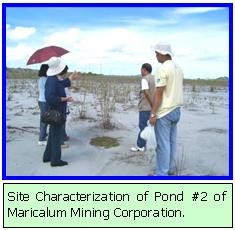
b. Establishment of Pilot Demonstration Project for Mined-out Areas in Sipalay Using Vegetative and Vengineering
Measures |
||||||
|
This project attempts to establish a pilot plantation of tree species in mined-out
areas; to introduce ground cover in spaces between the tree species; and
institute pilot vengineering structure in mined-out
area. For the year, the project has established a two-hectare plantation of forest
tree species. These include the planting of one (1) hectare Baluk-baluk plantation; 0.5 hectare of Kaatoan bangkal and 0.50
hectare of Rain tree. Soil analysis conducted by the Department of Agriculture Soils Laboratory
in Social impact assessment was also conducted among six (6) residents
within the mining area and the OIC-Site Manager of Maricalum
Mining Corporation. The assessment revealed that the respondents have
positive attitude towards the rehabilitation project of the DENR. They
believe that the project on plantation establishment in the mine tailing of
the corporation will really help in controlling wind (dust) erosion in the
area. The project could likewise improve the environment by increasing
vegetative cover and may also be a means to restore the bird habitat in the
area. The respondents shared further that the litter fall of the tree species
planted preferably the indigenous would also improve the soil condition of
the area. However, they foresee the problem of illegal cutting for charcoal
making by the community once the trees are already mature. When asked if they
are willing to participate in the maintenance and protection, they were
hesitant to commit in the absence of financial remuneration giving poverty
and economic and financial difficulties as major reasons that prohibit them
from doing such. Their condition of “Isang Kahig, Isang tuka” will not allow them to participate in the project
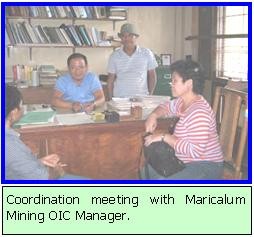
without any monetary compensation for a day’s work. The OIC Manager of Maricalum Mining Company has
also a positive attitude towards the rehabilitation project. He shared that
the company’s thrust at present is really the rehabilitation of the
mine-affected areas and he believes that the project together with other
rehabilitation projects can be a good legacy to prove that the environment
after mining is still repairable. He said that the company is willing to
consider the protection and maintenance of the project once established and
will be sustained permanently as part of their new land use plan. He is optimistic that this kind of project
will help solve part of the company’s environmental concerns. 4. Development of
Strategies for the Production of Quality Planting Materials This program is geared towards attaining the following objectives: §
To produce high quality planting
materials for reforestation and greening programs of DENR, LGUs, academe, and NGO §
To have available seedlings for
distribution; §
To produce sprouted cuttings from
various premium, fast growing, and other tree species; §
To establish a hedge garden for
continuous source of quality planting materials; and §
To conduct built-in researches with
respect to the propagation aspect of growing premium, fast growing and other
tree species. The program includes the following on-going projects: 1.
Establishment and Management of Seed
Production Areas (SPAs), Seed Orchards and other
Seeds Sources in 2.
3.
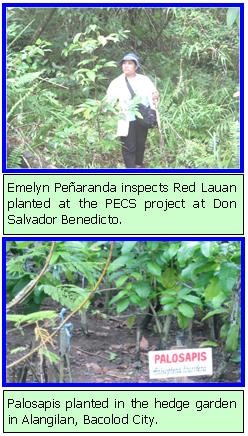
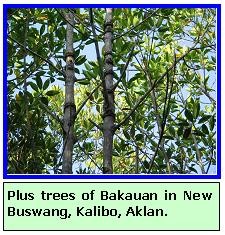
Establishment and Management of Clonal Nurseries Accomplishments under this program include the following: §
Verification of the existing stands
of Bakauan species and Mamalis in New Buswang, Kalibo, Aklan; and §
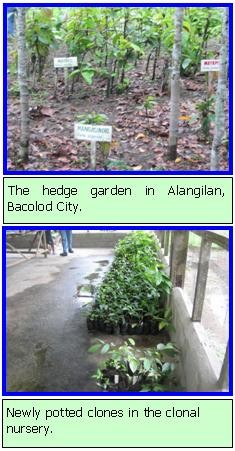
Operation and maintenance of two (2) clonal nurseries in Bacolod
City, Negros Occidental and Mambusao,
Capiz for
the production of quality planting stocks and development of protocols. A
total of 1,016 potted clones of different Dipterocarp
species was placed in these clonal
nurseries. |
|
|||||
|
§
Maintenance and protection of two
hedge gardens with 15 species of dipterocarps and
498 stock plants. §
Development of protocol for Beach Agoho and White Lauan through seedlings and cuttings. §
Production of Vermicompost
as component of the soil medium. §
Maintenance and protection of 40
hectare Dipterocarp plantations in the provinces of
Aklan, Antique, Capiz,
and Negros Occidental. |
||||||
|
b. Other Research and Development Activities 1. Improving and Maintaining Productivity of Bamboo
for Quality Timber and Shoots in |
||||||
|
|
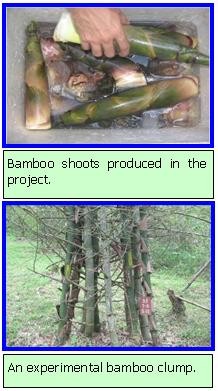
This is the ACIAR-funded and the Philippine Council for
Agricultural Resources Research and Development (PCARRD)-coordinated project on
bamboo, completed last March, 2007. The terminal report was already submitted
to ACIAR thru PCARRD. The study aimed to determine the best rehabilitation
techniques for damaged and less productive/unproductive existing natural
bamboo stands and generate effective management strategies and techniques in
improving the productivity of an unmanaged bamboo plantation. Results of the study on rejuvenating natural bamboo stands have shown
that cleaning and clearing of unmanaged clumps to free them from congestion
with annual maintenance of culm density of 6
shoots, 6 one-year old, 6 two years old and 6 three year old culms resulted
to the highest growth rate in terms of shoot and culm
production. Apart from maintaining this culm
density, applying fertilizer, and mulching were the other silvicultural
treatments used. 2. Socio-economic Impact of Free Patents in Results revealed that 90% of the patents distributed were used as
agricultural land while 10% were used as combination of
residential and agricultural and most (90%) of the patent holders are
male. All the respondents had no desire
to sell the land. They consider the land as a treasure to be kept and
developed and as an instrument to be negotiated to acquire capital for
entrepreneurial and productive endeavors. At most, 90% of the respondents
have stated their long term plan for the land. They wanted to maximize
production through additional planting and cultivation. Through ownership of
the land, they were motivated to acquire additional inputs on farm
technology to enhance and increase production. |
|||||
|
The social gains that they felt were prestige and peace
of mind that security brings to the owner of the land. Economically, the recipients have gained additional
income from farm production (10%) and a source of livelihood (80%). |
||||||
|
3.
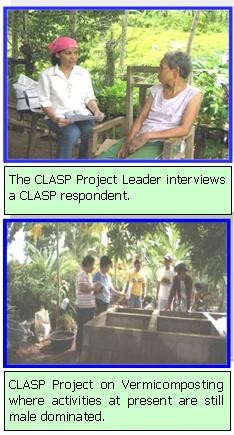
Gender Equity among CLASP Beneficiaries In support to the Gender and
Development Programs of the Department, the ERDS continued to conduct
researches to generate empirical information about the status of men and
women in ENR programs and projects that will serve as basis for policy
recommendations. The gender study entitled “Assessment of Gender Equity in Community Livelihood
Assistance Special Project (CLASP) Projects” was implemented during the
second quarter of CY 2006. The research aimed to compare the gender equity
perception of the male and female CLASP beneficiaries and to determine the
roles of men and women in the different CLASP projects. Results
showed that most (90%) of the respondents have no idea or not aware what
gender equity is all about. However, when explained to them, they believed
that they are practicing such at home and in their organization. After having
understood the concept of gender equity, the respondents were asked about the
benefits they get if they practice gender equity at home and in the
organization. The respondents reported that at home, the primary benefit of
gender equity is unity because there is no conflict as to who will do this or
that. The work is easier because the husband and the wife help each other
such that the burden on each spouse is lightened. There is harmony and good
interaction among the members of the family.
In the organization, there is group satisfaction and easy feeling
because of peaceful co-existence. Everyone assists those who lack capability.
There is good interaction among the members of the sexes. There is sharing of
tasks so the work is easily accomplished. There is no discrimination between
the sexes. |
|
|||||
|
In terms of the participation
of the men and women in the different CLASP projects, results showed that the
respondents have different and mixed perceptions and views on the participation
and responsibilities performed by men and women in the different livelihood
projects. Their participation is dependent on the nature of the work, whether
hard or laborious, light or easy. In the case of vinegar making, almost all
activities were shared by both men and women. However, for activities such as
the establishment of ponds, pens, and vermi
chamber, all male or predominantly male participation was noted. c. Implementation of
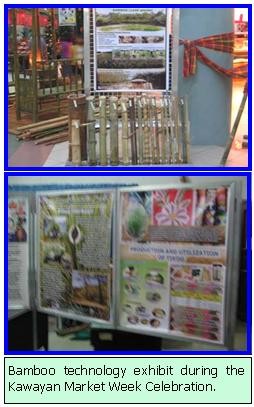
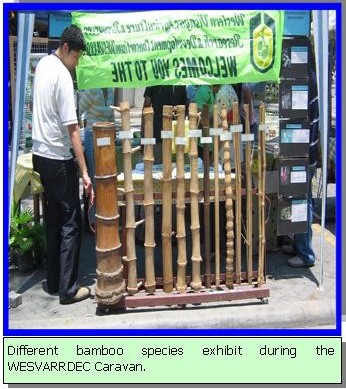
the WESVARRDEC bamboo Catalytic
Project
The Western Visayas
Agricultural Resources Research and Development Consortium (WESVARRDEC)
Catalytic Project on Bamboo titled “Bamboo Resource Inventory, Management and
Utilization in Western Visayas” was implemented
during the last quarter of CY 2006.
The consortium provided P120,000.00 budget
for the said project, the output of which will be an important input for
planning activities for major programs for bamboo in |
||||||
|
|
|
|||||
d. Implementation of
the Short Term Research Studies
Short term
studies are being conducted at the Satellite Office in Mambusao,
Capiz which include the following: §
Response of Mayapis
in the Different Commercial Organic Fertilizers; §
Regeneration of Rattan Through
Planting Stock Production from Wildlings; §
Optimization of Growth and
Survival of Yakal Seedlings through NPK
Supplementation; and §
Growth of Jathropa
in Open and Shaded Areas. |
||||||
e. Technology Transfer and Extension
1. ENR Technology Bulletin The articles submitted for publication in the DENR
Information Channel (DENRICH) constitute the target for this key result
area. As of the second quarter, the
following articles were submitted and published in the DENRICH: |
||||||
|
1. Things
to Remember in Clearer Writing 2.
Self Reliance under the Challenge of
Globalization –Part 1 3.
Self Reliance under the Challenge of Globalization
–Part II 4.
Bamboo
Industry in the 5.
DENR-Mirant Philippines for the project on Mangrove Nursery
and Rehabilitation of Oil
Spill-Affected Areas in Guimaras and 6.
Technology
Forum on Mangrove Management 7.
ERDS 6
conducts 3rd Mangrove
Damage Assessment in Oil-spill Affected Ares in Guimaras 8.
Eco-Park
Development 9.
Alternative
Fuel for a Cleaner Environment – Part 1 10.
Alternative
Fuel for a Cleaner Environment – Part 2 11.
Grouper
Culture in Floating Cages 12.
Biomass and
Carbon Sequestration of Yemane |
|
|||||
|
2.
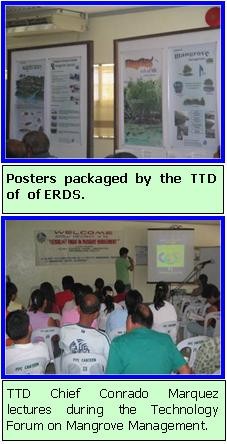
Promotion and Extension Services The Technology Forum on Mangrove Management was conducted at Panay Power Corporation, Brgy. Ingore, Lapaz, Topics discussed during the forum include the following: §
Introduction to Mangrove Management
in the §
Mangrove Ecosystem and Its Importance §
Establishment and Management of Mangrove Nursery and §
Fishpond Restoration §
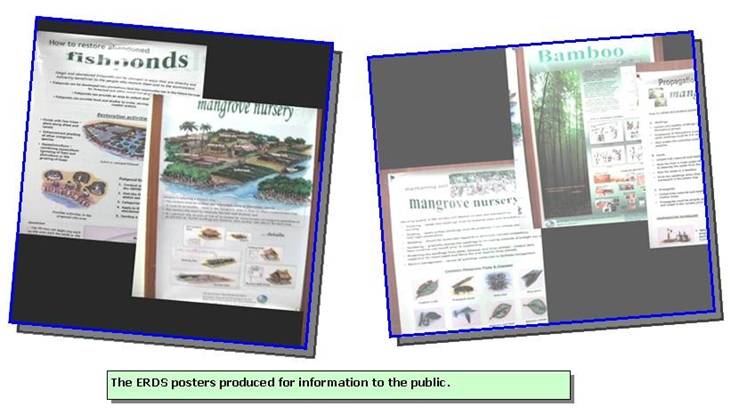
Livelihood/Enterprise Development in Mangrove Areas The lectures were enhanced through the exhibit put- up which
featured the posters in tarpaulin of mangrove ecosystems and its importance,
mangrove nursery and its components, plantation development, and fishpond
restoration. |
|
|||||
|
3. Monitoring and Utilization and Adoption of
Technologies The adoption and utilization of the technology was monitored to assess
the level of adoption and the impacts of effects of such technologies on the
lives of the users. Monitoring was done thru personal interview using the
prepared questionnaire from ERDB as well as actual site visitation. a.
Vermicomposting
Technology §
By Mr.
Hector Inamarga, owner of the Pugad
Lawin Farms in Tabayon, Banga, Aklan. §
Kabulihan Farmers and b.
Inland
Tilapia Culture by the Asosasyon Sang Magagmay nga Mangunguma sa
Bukid, Brgy. Quipot, Janiuay, c.
Grouper
Culture – by MACABATA-ARM, Cabilao Grande, Carles, d.
Mangrove
Nursery Establishment and Management, Dumangas, 4.
Establishment of Demonstration Areas Three (3) demonstration areas were continually
maintained and protected which include the following: |
||||||
|
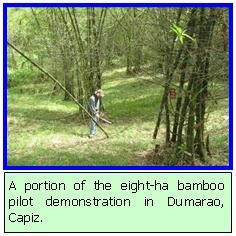
a. Pilot Bamboo The
demonstration project covers eight-hectare established plantation of bamboo
located in Codingle, Dumarao,
Capiz. This showcases the
generated technologies on bamboo production and deformation for cottage and
handicraft industry. The new feature on fertigation
(fertilizer-irrigation) technology is also being demonstrated. The project is
one of the strategies to rehabilitate a former cogonal
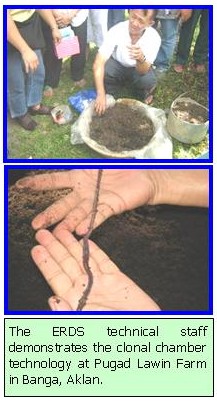
area. b. Pilot Demonstration on Vermicomposting
and Clonal Technology at the The
project promotes the Ecological Solid Waste Management and Forest Clonal Program thru the production of organic fertilizer
and high quality planting
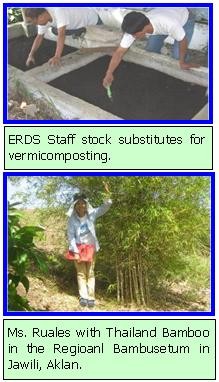
materials. Regional Bambusetum in Jawili, Tangalan, Aklan The Bambusetum showcases the production technology of the various
bamboo species from the different provenances. A 2-hectare plantation was
already established in Jawili, Tangalan,
Aklan with 17 different
species of bamboo now thriving in the area.
The project recorded an average of six poles per clump. Production of
planting materials from the available species was continually undertaken by
the farmer-cooperator. The project now contributes to the
increase in forest cover and reduction of soil erosion because the plantation
was established in a barren and degraded upland area in Tangalan,
Aklan. The plantation also helps in the increase of
biodiversity of plant species. 5. Packaging of Technologies/Training Modules The sector packaged a flyer on “Jatropha (Jatropha curcas): One Next Generation Sustainable Fuel
featuring the botanical characteristics, physical and chemical properties, distribution and
habitat, propagation methods, and properties of Kasla
as energy substitute source. The information on Alternative Fuel for Nleaner Environment was also packaged in flyer form. |
|
|||||
|
The technology on mangrove nursery and plantation
development and management was also packaged in poster form and printed in
tarpaulin which was used during the techno forum. 6.
The Annual Agency In-House Review of All On-going and Completed
Projects Agency in-house review is one major activity where the status of a
particular R and D project is ascertained.
The CY 2007 in house review was conducted on June 21-22, 2007 at the
ERDS Office, DENR, f. OTHER ACCOMPLISHMENTS
Submitted Research and Development
Proposals 1. The following proposals were
prepared and submitted to Dr. Farah Villanueva,
Finance Director of the Philippine Senate for possible funding. §
Environment
and Natural Resources (ENR) Training and Pilot-Demonstration for Capiz (Php 10,870,000.00) §
Strengthening
the Institutionalization of LGU’s Ecological Solid
Waste Management (ESWM) Implementation and Complimentary Agriculture and
Forestry Improvements Through Vermicomposting in
the §
Integrated
Development Project for the Sustainable Production and Utilization of Bamboo
in the §
Grouper
Culture in Floating Net Cages in Sapian, Capiz (Php 1,426,000.00) §
Commercialization
of Lanzones and Rambutan §
Native
Catfish Production 2. Additional proposals were also
submitted to PCARRD for possible funding of Food and §
Enhancing
Economics and Ecological Benefits Through the Sustainable Production and Utilization
of Bamboo Shoots in San Enrique, §
Commercialization
of Lanzones and Rambutan
|
||||||
|
|
||||||
|
______________________________________________ ___________________________________________ Email : [email protected] Updated
: May 7, 2008 |
||||||