Ok, here is the long-awaited update on India that I promised. First of all, let me just say that despite the beauty of the monuments in India, I'm happy to be back in Thailand. India was pure chaos - and I thought the traffic in Bangkok was crazy! We spent time in New Delhi, (visiting several monuments as well as a museum dedicated to Gandhi on the spot where he was assassinated), the city of Jaipur in the desert (known for its old forts), Agra (home of the Taj Mahal, of course!), and the city of Varanasi, which is situated on the banks of the holiest river in India, the Ganges.
I went to India with 4 other female Peace Corps volunteers. And, you're first question, I can tell, is going to be "Where was Denny?" The simple answer is that Denny didn't want to go. Amazing, isn't it? The Taj Mahal is perhaps the most famous building in the world, a masterpiece of grace, elegance, and beauty, and he says "whoppee - it's a big white block of rock." (Sigh.) So without further ado....
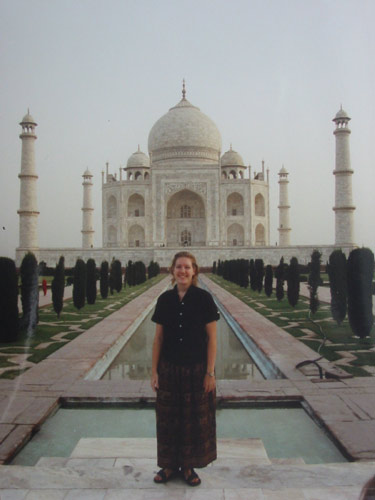 Now, a little
bit of history, for those of you who are history buffs. The Taj Mahal was built
by the Muslim ruler Shah Jahan as a tomb for his wife, who died giving birth
to their 14th child. As you may or may not know, Shah Jahan had planned to build
his own tomb in black marble - a mirror image of the Taj Mahal - on the other
side of the river. Unfortunately for Shah Jahan, his son had other plans. The
son overthrew his father, took the throne, and had Shah Jahan imprisoned in
the Agra Fort, about 5 miles away from the Taj where he spent the rest of his
days gazing out of the window at the Taj Mahal (and undoubtedly wondering where
his parenting skills went wrong). However, upon Shah Jahan's death, the son
was at least nice enough to have him buried next to his wife in the Taj. The
in-laid stone coffins that visitors see inside the Taj Mahal are not the real
tombs though, since it was customary at the time to have a false tomb in the
main room of your mausoleum. The actual tombs are buried below the Taj and are
(understandably) not accessible to the public. The Taj Mahal is actually more
impressive close up than it is from a distance. The entire face of the Taj Mahal
is covered with in-laid stone motifs. They are mostly floral patterns, but when
you consider the size of the building, one can only imagine the time and effort
it must have taken.
Now, a little
bit of history, for those of you who are history buffs. The Taj Mahal was built
by the Muslim ruler Shah Jahan as a tomb for his wife, who died giving birth
to their 14th child. As you may or may not know, Shah Jahan had planned to build
his own tomb in black marble - a mirror image of the Taj Mahal - on the other
side of the river. Unfortunately for Shah Jahan, his son had other plans. The
son overthrew his father, took the throne, and had Shah Jahan imprisoned in
the Agra Fort, about 5 miles away from the Taj where he spent the rest of his
days gazing out of the window at the Taj Mahal (and undoubtedly wondering where
his parenting skills went wrong). However, upon Shah Jahan's death, the son
was at least nice enough to have him buried next to his wife in the Taj. The
in-laid stone coffins that visitors see inside the Taj Mahal are not the real
tombs though, since it was customary at the time to have a false tomb in the
main room of your mausoleum. The actual tombs are buried below the Taj and are
(understandably) not accessible to the public. The Taj Mahal is actually more
impressive close up than it is from a distance. The entire face of the Taj Mahal
is covered with in-laid stone motifs. They are mostly floral patterns, but when
you consider the size of the building, one can only imagine the time and effort
it must have taken. Our first morning in India we ran into a man from a travel agency called Sights India, which was probably the most fortunate thing to happen to us on our trip. For $200 dollars a piece, the five of us had our own private SUV and driver, all our hotel accommodations arranged and paid for, and all of our train tickets taken care of, for 9 days. Not too bad, especially once we glimpsed the public transportation in India. I never did find out though, if the goats on the bus were charged the same fare as a person, or if they got to ride for the "kid" price. (Blame my dumb sense of humor on my father).
The SUV was also a nice escape after shopping in the markets, as we were constantly being bombarded by salesmen, beggars, and small children selling postcards, reaching into our pockets, pulling on our clothes, grabbing us, and pinching us to get our attention. It's amazing that Indian society tolerates as much poverty as it does. Thailand has poverty, yes, but at least the people here pride themselves on their ability to recognize a shower when they see one. It was almost as if the children in India were intentionally "dirtied up" in order to play on our sympathies. It would be interesting to visit the "non-tourist" areas of India, and compare it to the mobs in the tourist areas.
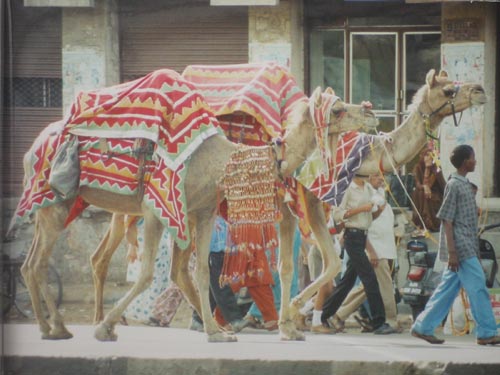 We did have
one point however, when the market was relatively calm, because everyone was
watching a parade go by. The camels in this picture were leading the parade.
We did have
one point however, when the market was relatively calm, because everyone was
watching a parade go by. The camels in this picture were leading the parade.The city of Jaipur, in the state of Rhajastan, is known for the number of camels still used in transportation. It was interesting driving along the road at the end of the day, and passing an almost endless stream of camels (most of them pulling carts) walking along the shoulder of the road, heading home for the day. It was tough to get a picture though, as nobody in India does anything for free. If you wanted a picture, the owner of the camel would expect a tip. In fact, by about the third day of our trip, I was ready to go ballistic with the number of people expecting tips. I came out of a stall in the ladies room one time, and here is a man standing at the counter wanting a tip for turning on the sink faucet for me. I just stared at him and asked "What are you doing in the ladies room?" At the first mosque we visited, what we thought were just friendly members of the congregation asked us if we had any questions, and explained a little bit about the history. As we left, one of the men followed us with the line "The mosque supports many people in our congregation who are very poor." Then he coughed and held out his hand for money. Well, we thought we'd be nice and donate something, but apparently it wasn't enough because he looked at it, sneered, and repeated his line. We told him we were volunteers in Thailand, making about $170 a month, and we couldn't afford to donate more. He looked cheated, as if he couldn't believe that all American tourists weren't rolling in money, but eventually he went away.
At one point we ran into a group of teachers asking for donations for their school. Since all of us volunteers are working in the schools in Thailand, we were excited to think that maybe they'd want to set up some sort of cultural exchange program or pen-pal program with a couple of Thai schools. But no, once they discovered that we wouldn't give them 100 rupees each, they wanted nothing to do with us.
The most persistent of money-seekers however, were the "official" guides at each monument who were willing to give you a "free" tour in extremely poor English for the small price of a 150 rupee tip. (150 rupees is only about $3, however, remember that I make about $5 a day). These people truly would not take no for an answer. In both American and Thai cultures, if you politely tell someone that no, you don't want their service, they usually go away. But in India it's a totally different story. Fifteen minutes later (I'm not making this up) they are still following us saying "Madam, you cannot possibly appreciate this monument with out a guided tour..." I'm thinking to myself "Sir, I cannot possibly appreciate this monument with a human leech following me." After a while, our little group just gave up and we only spoke to each other in Thai, claiming to the guides that "We no speak English." I don't think that they believed us, but at least we had the satisfaction of knowing that they wasted 15 minutes of their time without getting a single rupee from us.
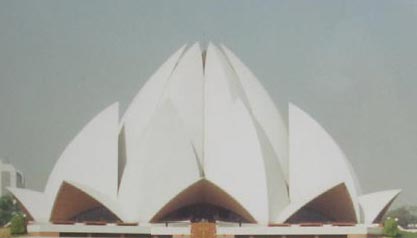 In fact, the
only temple or mosque where we weren't besieged with requests for money was
the Ba'hai Faith "Lotus Temple." It was an oasis in the desert. They
meant it when they said that their temple was to be used for peaceful reflection
without disturbance. They had an armed guard at the gate to keep out the riff-raff.
In fact, the
only temple or mosque where we weren't besieged with requests for money was
the Ba'hai Faith "Lotus Temple." It was an oasis in the desert. They
meant it when they said that their temple was to be used for peaceful reflection
without disturbance. They had an armed guard at the gate to keep out the riff-raff.
If the Jewish temple in Jerusalem was anything like the circus atmosphere in most of the Hindu and Muslim houses of worship today in India, I can understand why Jesus threw a fit and kicked everybody out. It is a sad reflection on a society which accepts, if not condones, the harassment of visitors in a house of worship. Perhaps I am being biased and judgmental, as it is not my culture. Or perhaps it is equally sad that the world's largest democracy cannot or will not support its population, and its children are forced to harass tourists for money so that they don't starve.
After a week, we left behind New Delhi, Jaipur, and Agra, and headed west to the holy city of Varanasi. Varanasi is on the banks of the Ganges River where thousands of devout
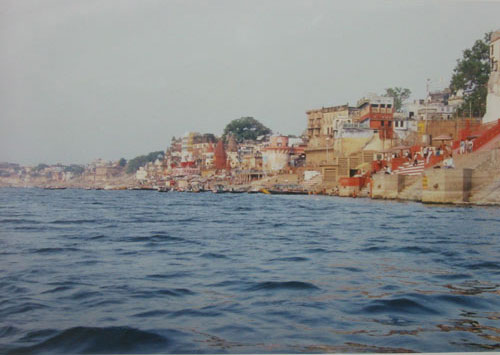 pilgrims
come each year to bathe in the water. Unfortunately, the Ganges itself is fairly
dirty and polluted, and that's just counting what we could physically see. Who
knows what chemicals or parasites are cruising around underneath the surface.
It doesn't seem to stop anyone from bathing or drinking the water though. We
took a boat tour, and saw people cupping their hands and drinking the water
- about 20 yards downstream from a decaying cow carcass lying in the river.
The vast majority of Indians are cremated when they die. Along this river are
several large crematoriums (we weren't allowed to take photographs though) and
the ashes get dumped into the river as well.
pilgrims
come each year to bathe in the water. Unfortunately, the Ganges itself is fairly
dirty and polluted, and that's just counting what we could physically see. Who
knows what chemicals or parasites are cruising around underneath the surface.
It doesn't seem to stop anyone from bathing or drinking the water though. We
took a boat tour, and saw people cupping their hands and drinking the water
- about 20 yards downstream from a decaying cow carcass lying in the river.
The vast majority of Indians are cremated when they die. Along this river are
several large crematoriums (we weren't allowed to take photographs though) and
the ashes get dumped into the river as well. Our last day in India we spent shopping in Pahar Ganj - or the backpacker's district. This is much like Khao San road in Bangkok, except narrower and with twice as many people. It took us a while to find the road, actually, since people would tell you how to get to their brother-in-law's jewelry shop, their cousin's restaurant, their sister's clothing shop, their friend's money exchange - basically anywhere except where you wanted to go.
Even leaving India was not without hassles. Our flight left at 7pm, but after a day on our own (our hired driver's contract had stopped the night before), we were tired by 3:30 in the afternoon. Plus, we were out of rupees. We still had some baht and some dollars, but we didn't want to change any more money into rupees, because while they'll sell you rupees at 50 per dollar, nobody will buy them back for more than about 30 per dollar, so you end up losing around 40% if you have rupees at the end of your trip. So we had budgeted ourselves to run out of rupees right as we ended our trip. We had each saved 500 rupees for the airport departure fee, though. (Bangkok's airport departure fee is 500 baht for all international flights). We had asked around and had been told that the departure fee was anywhere from 200 rupees to 500 rupees. Hindsight is 20/20 - we should have asked the airline what the fee was, when we bought our tickets. (Although the story of buying the tickets in Bangkok, is in itself, worthy of its own email update.) We figured that we'd just go sit in the airport, in the air conditioning, until our flight left. Silly us, what were we thinking? We got out to the airport, "I'm sorry. You can't enter the airport until 2 hours before your departure time." Well, there was a "Visitor's Lounge" across the way, so we headed to it. "Hello! There's a small fee to enter the lounge..." Oh no. NO, no, no, no, no, no, no, no, no. We're not doing this whole "fee" thing again. We'll just sit outside, under a tree in the shade. Two minutes later, "I'm sorry, you're not allowed to sit here." I'm not allowed to sit in the airport. I don't want to pay to sit inside. I'm not allowed to sit outside... Finally the man at the door to the lounge took pity on us and let us in for free. So, two hours before our flight, we head over to the check-in counter. "Oh, the price of your departure fee is automatically included in the price of your ticket." Oh. So now we all have the equivalent of two days' salary in our wallets. Which is just as well, since we were hungry, and the prices in airports are astronomical. So, we headed up to one shop, and all the prices were listed in US dollars. My friend Cherry asked why, and the man replied that "the airport only officially accepts US dollars," but he'll give us a deal and accept our rupees as a favor. (Note: Every other merchant has their prices listed in both dollars and rupees.) I ask him when the United States had annexed the Indira Gandhi International Airport, but I don't think he understood my sarcasm. I mentioned at the beginning of this email that I glad when that plane landed back in Thailand. Now you know why. My friend Ingrid said it best when she warned us before we left Thailand: "India is an adventure, not a vacation."
My best wishes to everyone out there, enjoy the adventure!
Lisa :)
PS: Extra India photos here.