 |
| Cannibalism part 12 |
| Of the 440 accounts that I have examined the most descriptive �first-hand� account comes from Sievewright (1844), a Church Minister and the Protector of Aborigines in the Port Philip district. This account is too long to reproduce here , however, Sievewright provided a graphic description of preparation and consumption of human flesh which he claims to have witnessed (Sievewright 1844 In Eyre 1845:255-9). There are mitigating circumstances that cast doubt upon a very descriptive account, however, the principal one being that Sievewright was found by the Colonial Office to be an "unmitigated liar" (Bridges 1972:58). What has happened? Why did authors lack the simple ability of correct citation? Why did accounts become embellished? I think because it was politically expedient. At the end of the day the evidence for cannibalism is extremely poor. Like UFO�s, it was only witnessed by untrained observers who were specifically looking for it. The incidence of cannibalism was exaggerated by conjecture, misinterpretation, bias, and outright lying. A popular love for �gory stories�, particularly those at the expense of alien cultures, has ensured that the myth is perpetuated. |
|
| Alfred Packer |
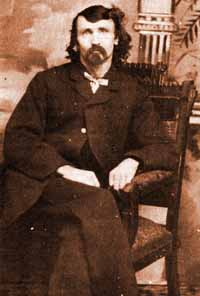
| One sure way to gain immortality -- no matter how hopeless your social and monetary strata -- is to eat somebody else. The man who did this best was Colorado's Alferd Packer, and the Centennial State has accordingly embraced Alferd to its mountainous bosom. He is celebrated in song, in musicals, and in a string of sights along Colorado's Cannibal Trail. California lobbyists howl that they, too, had a cannibal -- several, in fact -- but a quick visit to the Emigrant Trail Museum in Truckee will show you that these starving pioneers only ate people who were already dead. Alferd, on the other hand, was far from famished and preferred a hot lunch. Colorado shows its appreciation of its favorite son at the Alferd Packer Memorial Grill, which lies in the Memorial Center basement at the University of Colorado in Boulder, directly beneath the Glenn Miller lounge. A small, marble bust of Packer, unveiled by Colorado governor Roy Romer, sits on a pedestal at the hub of the grill. El Canibal is Boulder's biggest burrito, and the Calypso pork is a student favorite. The Alferd Packer Massacre Site, once a remote wilderness, is now only five minutes south of the Lake City miniature golf course, and a very popular spot with shutterbugs. A big sign directs visitors to the spot, complete with cartoon caricatures of two mountain men, mouths agape in horror and shock as (we are left to imagine) an axe is driven into their skulls. A small rock marks THE spot, complete with a plaque listing the victims. Five tiny white crosses form a defensive line in front of it. Free brochures fill a metal box adjacent to the site, chock full of juicy tidbits about Alferd's ghastly doings. In downtown Lake City stands the Hinsdale County Museum, which boasts the most extensive collection of Packerabilia known. Included is a skull fragment from one of his victims, a pair of shackles used on Alferd when he was in the Lake City jail, and a number of buttons from the clothes of the five men he eventually ate. Sadly, the butcher knife found sticking in the thigh of Frank Miller (a Packer entree), has disappeared. In 1874, Packer polished off five fellow prospectors in a mid-winter munchy fit. Alferd spent some time in the Colorado Territorial Prison, Canon City. After he was released -- on a technicality -- he became a vegetarian, made a modest living selling autographed photos of himself, and died. You can visit Alferd Packer's grave, complete with its original, tiny tombstone, in Littleton Cemetery. |
 |
 |
| Neanderthal man and Cannibalism |
 |
| Neanderthal man may have practiced cannibalism, due to hunger, or as some form of death ritual. One of the most controversial sites dealing with this issue is in Monte Circeo, Italy, where in 1939, a Neanderthal skull was discovered in an oval ring of stones. The hole where the spine connects to the head, known as the foramen magnum, had been enlarged and broken away, suggesting that the brains were extracted and consumed. However, the original position of the skull inside the ring of stones is doubtful, because the person who discovered it, did not remember if he replaced it in its proper position (Klein 1989). An analysis of the skull showed no cut or scrape marks, peeling or flaking, associated with cannibalistic practices (Bower 1991). Instead, gnaw marks consistent with carnivore chewing appear on various parts of the skull, especially at the base. From this evidence, it is probable that a cave hyena tampered with the skull, ate the brains, and shoved it upon an insignificant arrangement of stones. The mutilated remains of twenty Neanderthal men, women, and children were found at Krapina, Croatia, in 1899. It has been speculated that these individuals were ritually devoured since, judging from the great amount of animal bones in the cave, game was plentiful. Analysis done on these remains show that "Neanderthals made the same patterns of cut marks on their fellow humans as they did on their animal prey" (Gore 1996:27). Some scholars believe that this cannibalistic slaughter was not part of a ritual, since all of the bones were not torn open in the same manner. Only the limb bones, which contain an abundance of marrow, were severed. Cannibalism is therefore seen as "one of a variety of ways Neanderthals sustained themselves rather than an occasional act of desperation by starving humans" (Gore 1996:27). Other evidence, such as the Teshik-Tash site and the Neander Valley skull, point to the defleshing of the cadaver before burial. It is possible that Neanderthal man ritually ate his comrades, so that he could gain their strength and courage, as believed by many tribes of Bushmen today. Other Neanderthal death rituals may have been involved, such as a sacrifice to a god, as in the case of the European bog bodies. |