|
|
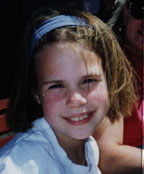
The first step - selecting the right photo from which the work develops. Since I don't mechanically copy the photo, as you'll see, it's very important to have a photo that truely represents the subject. This one was particularly good because not only was it clear and accurate but it shows some animation and, because it was taken outdoors in bright sun light, the shadows are quite evident. |
|
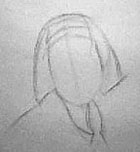
The charcoal quick sketch
on newsprint is intended to catch the action of the picture and set the
size. The tilt of this subject's head provides some action, (more than
posed photos usually do). Generally the size of the drawn head in a bust
like this is about as big as my hand - smaller and details get lost, larger
and there's too many details. . .
|
 |
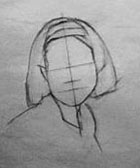 |
Refinement of the quick sketch - identifying landmarks, verifying size relationships. |
|
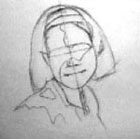
Identify the shadow pattern
- seperating the lights from darks. Withoutt getting into an art lesson
here - this is an important step towards producing a three dimensional
picture and capturing a likeness.
|
 |
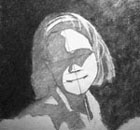 |
Value lay-in. All the dark areas are
one flat value and all the light areas another flat value - a third, darker
value for the background. I like to use darker backgrounds because the
subject seems to stand out more. I generally use a darker, earthtone pastel
paper for the final picture - depends . . .
Oh oh, starting to look like a person. . . . . |
|
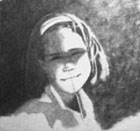
Starting to refine the
shadow pattern, working mostly in the dark - softening edges, adding
darker values.
Viola! Features are forming . . . . . |
 |
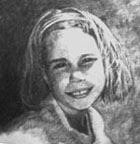 |
Refining continues
. . . . . This is just about the finished value study. The objective
is to have the complete portrait, solving all the issues of drawing, value,
edges, etc. - just without the color.
This is traced onto the pastel paper, ready for color. . . . |
| The color lay-in is like the value lay-in, cover the whole subject with approximate, flat colors. This is where experience with pastels pays off. If the colors of the lay-in are very close to final, the end result will be pure, sparkling color. If not - mud, pastels don't mix well. . . . < | 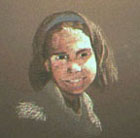 |
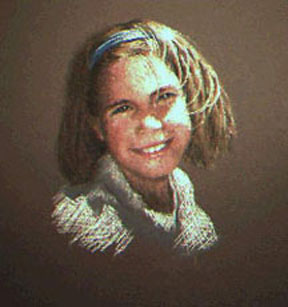 |
After much refinement - the completed
portrait.
(Click on the image for a larger view) |