To deepen
Antagonism (in english) The antispecists (in french) world
Protection
|
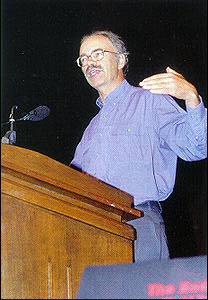
Animal Liberation This book constitutes a good introduction to the various aspects of the question: problems of ethics, exposure of the facts, consultings on the vegetarianism, short history of the specism and the movement of animal release. The facts exposed by Singer on the exploitation of the animal by the man, particularly in industry (dermatological tests, vivisection) and in the breeding (batteries) are eloquent, and its demonstration on the utility of the boycott, including in the form of the vegetarianism, rather effective. On this last point, it is necessary to insist on the fact that for Singer, the fact of not eating meat is well a form of boycott, conceived in relatively tolerant manner, and not an absolute refusal to nourish alive beings. Openly materialist, Singer seems to consider the concept to be alive like an abstraction of religious origin. It is a serious debate, on which it will be necessary to return in a later article, because it requires a clarification on the manner of approaching living it from the point of view materialist, which could lead to very divergent conclusions as of his. Moreover, the utilitarian of Singer, founded philosophy on the concept of pain and not of life, brings it to paradoxes, sometimes developed in the press antispecist. For example, after in the first edition, as he recalls it itself, constant that one could eat shells insofar as those, having deprived of nervous system, did not know the suffering, he ravise in this new version by admitting that on this point, science is not completely affirmative. It is true that the principal limit of the vegetarianism, it is precisely to push back the arbitrary barrier between human and other animals while bringing back it to a barrier between animals and other commands (vegetable essentially), which is hardly satisfactory. Alas, this type of arguments, rich in real debates of materialist ethic, is used often only to the not-vegetarians like a convenient cover for their refusal to examine the question seriously. That goes further. There is a true mistrust towards the antispecists militants : defamatory article in Reflexes [radical antifacsist review] , anti-antispecist motion suggested with the congress of Anarchist Federation [most important anarchist organization in France], physical attacks against militants, without counting the hatred maintained by certain left-side catholics (like the very anti-antispecist Paul Ariès, of the review Golias ). Misinformation on the theses of pleasing Singer to a climate of tension between libertarians and antispecists, although those generally claim anarchism, or as in the Anglo-Saxon countries, of the "veganarchism". Attacked by the Autonomists at the time of a round in Germany, Singer managed to dialogue with its attackers, showing them that they could have started by reading its texts before using violence... The reason officially called upon for this setting with the variation comes from the writings of Singer on the question of the handicaps. Specialist in ethics, Peter Singer largely worked on extremely significant subjects: the responsibility for the mental handicapped people, the abortion, handicaps heavy. Its conclusions in particular lead it to think that the abortion and the infanticide must be allowed for the not-viable handicaps or causing terrible sufferings. This theoretical position was comparable with eugenism, that of which it is defended. The reading of its texts published in French (Questions of pratical ethic) shows that it cannot in no case to be a question of eugenism, insofar as the central question is that of the right of the individual and not of the improvement of the race. The fact is that the theses of Singer on the antispecism are not easily dissociable those on the handicap, because of the deep internal coherence of its thought. That however does not mean that any antispecism must be singerien. As such, the idea according to which there is not superiority of the man on the other animal species, nor of rights in their connection, can be developed according to other prospects. One touches indeed with the principal
defect of the book of Singer. Although it is clearly "left-sided" (antiracist,
antisexist, antifascist) and that it quotes Marx on the occasion, the Australian
philosopher leaves it, in its work however more diffused, strictly on the
ground of the denunciation of the breeding out of battery and the tests
on the animals, without showing clearly how these practices are integrated
in the capitalist system. Of course, it shows how these practices are favoured
with an exclusive aim to make profit, but it does not go much further.
One can apply the idea of Haudricourt to the study of the industrialized world. In the absence of complete historical study on the question, one can think that the evolution of the "traditional" breeding to the breeding out of battery followed the same stages as the "rationalization" of industrial work, while taking as a starting point the the same diagrams productivists. In both cases, there is reification of the individual, reduced to the row of simple part in the chain of production. For the breeding, the node of this productivism being made up by the complete seizure on the reproduction and the application of a strict eugenism, whereas all the attempts on the man were denounced, and applied in manner relatively marginal apart from the Nazi mode. It is not a chance if the theorists of the eugenism drew their models in the animal husbandry. There still, there is a weakness in the current speech of the "radical" left, because one cannot affirm that "the world is not a merchandize" [famous slogan] without putting the question of the animal. One should not forget, as recalled by the archeozoologist Gauthier, that to domesticate a species, it is necessary to select the most flexible individuals, least savage, most resistant to the stress. As for the soldiers, it summarizes caustically, it is necessary to choose more the animals (And Man created the animal, Errance ed.). This selection by calms is repeated with each generation, since the zootechnicians seek this type of temperament precisely. In other words, one lets survive, since of the thousands of years, only the most flexible individuals inapt to refuse the exploitation. The class consciousness not being thus the fort of the bovines, it should not too much be counted that the emancipation of the cows of batteries will be the work of the cows of battery themselves. It is necessary thus that this release comes from outside. In this report/ratio of class, the anthropocentrism, doctrines preached in particular by the monotheists religions and which constitutes one of the pillars of Western philosophy, constitute an ideological justification of the domination. It allows human exploited to be located at the top of the animals, to place themselves in the role of dominant, even when they are in bottom of the social scale. This report/ratio can be purely intellectual, without applying to real animals: it is a manner of positioning within a scale of values. This type of analysis already was largely proposed by the radical feminists, who show how the woman are placed in a report/ratio of subordination which allows the man dominated within a report/ratio of exploitation in its work to be in situation of dominating in the private sphere. It is an assumption which could be the subject of others of developments. From this point of view anticapitalist, the book of Singer constitutes a useful base, but very insufficient because it does not show sufficiently this insoluble link, and at the same time lets think that the fight for the animal release is only one sectoral fight, which would not call into question the system itself, a form of "petty-bourgeois" sentimentalism without link with the class struggle. However, the analysis of current capitalism
shows the importance taken by the animal exploitation in two key sectors:
pharmaceutical industry (tests) and the agroalimentary one (breeding),
two sectors which are under fires of the critic anticapitalist. The fight
against the exploitation of the animals thus can without difficulty of
taking part in this combat, and to even constitute one of the central axes,
provided that the consequent anticapitalists agree to give up their prejudices
specists and draw some the consequences necessary. It is not a question
of a question of sentimentalism or to prefer to defend the animals rather
than the human ones, but to propose a total criticism of the system, at
the same time in its consequences and its ideology.
Several significant questions were not mentioned here : that of the savage animal and the complex relations between antispecism and radical ecologism, that of the relations between humanity and animal companies, that of the safeguarding or not of the threatened domestic species, that of the role of the religions monotheists in the anthropocentrism, the role of the stress in human or animal alienation, could also be the subject of fuller developments. Other articles will be there, I hope for it, devoted thereafter. This one constituted the continuation of an already committed reflexion previously [coming soon in english], by looking further into certain ideas. It is this type of theoretical work which proposes to undertake the Social circle, at a rate/rhythm which is that of the maturation of the ideas.
|