-
- The German
Shorthaired Pointer Breed Standard
General
Appearance
-
The German
Shorthaired Pointer is a versatile hunter, an all-purpose
gun dog capable of high performance in field and water.
The judgement of Shorthairs in the show ring reflects
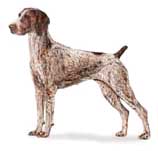
this basic characteristic. The overall picture which is
created in the observer's eye is that of an aristocratic,
well balanced, symmetrical animal with conformation indicating
power, endurance and agility and a look of intelligence
and animation. The dog is neither unduly small nor conspicuously
large. It gives the impression of medium size, but is
like the proper hunter, "with a short back, but standing
over plenty of ground." Symmetry and field quality
are most essential. A dog in hard and lean field condition
is not to be penalized; however, overly fat or poorly
muscled dogs are to be penalized. A dog well balanced
in all points is preferable to one with outstanding good
qualities and defects. Grace of outline, clean-cut head,
sloping shoulders, deep chest, powerful back, strong quarters,
good bone composition, adequate muscle, well carried tail
and taut coat produce a look of nobility and indicate
a heritage of purposefully conducted breeding. Further
evidence of this heritage is movement which is balanced,
alertly coordinated and without wasted motion.
-
-
-
Head
-
The head
is clean-cut, is neither too light nor too heavy, and
is in proper proportion to the body. The eyes are of medium
size, full of intelligence and expression, good-humored
and yet radiating energy, neither protruding nor sunken.
The eye is almond shaped, not circular. The preferred
color is dark brown. Light yellow eyes are not desirable
and are a fault. Closely set eyes are to be faulted. China
or wall eyes are to be disqualified. The ears are broad
and set fairly high, lie flat and never hang away from
the head. Their placement is just above eye level. The
ears when laid in front without being pulled, should extend
to the corner of the mouth. In the case of heavier dogs,
the ears are correspondingly longer. Ears too long or
fleshy are to be faulted. The skull is reasonably broad,
arched on the side and slightly round on top. Unlike the
Pointer, the median line between the eyes at the forehead
is not too deep and the occipital bone is not very conspicuous.
The foreface rises gradually from nose to forehead. The
rise is more strongly pronounced in the dog than in the
bitch. The jaw is powerful and the muscles well developed.
The line to the forehead rises gradually and never has
a definite stop as that of the Pointer, but rather a stop-effect
when viewed from the side, due to the position of the
eyebrows. The muzzle is sufficiently long to enable the
dog to seize game properly and be able to carry it for
a long time. A pointed muzzle is not desirable. The depth
is in the right proportion to the length, both in the
muzzle and in the skull proper. The length of the muzzle
should equal the length of skull. A dish-shaped muzzle
is a fault. A definite Pointer stop is a serious fault.
Too many wrinkles in the forehead is a fault. The nose
is brown, the larger the better, and with nostrils well
opened and broad. A spotted nose is not desirable. A flesh
colored nose disqualifies. The chops fall away from the
somewhat projecting nose. Lips are full and deep yet are
never flewy. The teeth are strong and healthy. The molars
intermesh properly. The bite is a true scissors bite.
A perfect level bite is not desirable and must be penalized.
Extreme overshot or undershot disqualifies.
-
-
Neck,
Topline, Body
The neck is of proper length
to permit the jaws reaching game to be retrieved, sloping
downwards on beautifully curving lines. The nape is
rather muscular, becoming gradually larger toward the
shoulders. Moderate throatiness is permitted. The skin
is close and tight. The chest in general gives the impression
of depth rather than breadth; for all that, it is in
correct proportion to the other parts of the body. The
chest reaches down to the elbows, the ribs forming the
thorax show a rib spring and are not flat or slabsided;
they are not perfectly round or barrel-shaped. The back
ribs reach well down. The circumference of the thorax
immediately behind the elbows is smaller than that of
the thorax about a hand's breadth behind elbows, so
that the upper arm has room for movement. Tuck-up is
apparent. The back is short, strong, and straight with
a slight rise from the root of the tail to the withers.
The loin is strong, is of moderate length, and is slightly
arched. An excessively long, roached or swayed back
must be penalized. The hips are broad with hip sockets
wide apart and fall slightly toward the tail in a graceful
curve. A steep croup is a fault. The tail is set high
and firm, and must be docked, leaving approximately
40% of its length. The tail hangs down when the dog
is quiet and is held horizontally when he is walking.
The tail must never be curved over the back toward the
head when the dog is moving. A tail curved or bent toward
the head is to be severely penalized.
Forequarters
The shoulders
are sloping, movable, and well covered with muscle.
The shoulder blades lie flat and are well laid back
nearing a 45 degree angle. The upper arm (the bones
between the shoulder and elbow joint) is as long as
possible, standing away somewhat from the trunk so that
the straight and closely muscled legs, when viewed from
the front, appear to be parallel. Elbows which stand
away from the body or are too close result in toes turning
inwards or outwards and must be faulted. Pasterns are
strong, short and nearly vertical with a slight spring.
Loose, short-bladed or straight shoulders must be faulted.
Knuckling over is to be faulted. Dewclaws on the forelegs
may be removed. The feet are compact, close-knit and
round to spoon-shaped. The toes are sufficiently arched
and heavily nailed. The pads are strong, hard and thick.
Hindquarters
Thighs are strong
and well muscled. Stifles are well bent. Hock joints
are well angulated and strong with straight bone structure
from hock to pad. Angulation of both stifle and hock
joint is such as to achieve the optimal balance of drive
and traction. Hocks turn neither in nor out. Cowhocked
legs are a serious fault.
Coat
The hair is
short and thick and feels tough to the hand; it is somewhat
longer on the underside of the tail and the back edges
of the haunches. The hair is softer, thinner and shorter
on the ears and the head. Any dog with long hair in
the body coat is to be severely penalized.
Color
The coat may be of solid
liver or a combination of liver and white such as liver
and white ticked, liver patched and white ticked, or
liver roan. A dog with any area of black, red, orange,
lemon or tan, or a dog solid white will be disqualified.
Gait
A smooth lithe
gait is essential. It is to be noted that as gait increases
from the walk to a faster speed, the legs converge beneath
the body. The tendency to single track is desirable.
The forelegs reach well ahead as if to pull in the ground
without giving the appearance of a hackney gait. The
hindquarters drive the back legs smoothly and with great
power.
Temperament
The Shorthair
is friendly, intelligent, and willing to please. The
first impression is that of a keen enthusiasm for work
without indication of nervous or flightly character.
-
Size,
Proportion, Substance
-
-
Size--height of dogs,
measured at the withers, 23 to 25 inches. Height of
bitches, measured at the withers, 21 to 23 inches. Deviations
of one inch above or below the described heights are
to be severely penalized. Weight of dogs 55 to 70 pounds.
Weight of bitches 45 to 60 pounds. Proportion--measuring
from the forechest to the rearmost projection of the
rump and from the withers to the ground, the Shorthair
is permissibly either square or slightly longer than
he is tall. Substance--thin and fine bones are by no
means desirable in a dog which must possess strength
and be able to work over any type of terrain. The main
importance is not laid so much on the size of bone,
but rather on the bone being in proper proportion to
the body. Bone structure
too heavy or too light is a fault. Tall and leggy dogs,
dogs which are ponderous because of excess substance,
doggy bitches, and bitchy dogs are to be faulted.
DISQUALIFICATIONS
China or wall
eyes.
Flesh colored nose.
Extreme overshot or undershot.
A dog with any area of black, red, orange, lemon, or tan,
or a dog solid white.
Approved August 11, 1992
Effective September 30, 1992
|