The
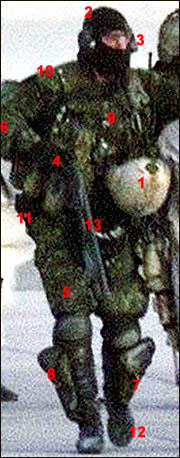
Canadian JTF 2 members photographed taking prisoners from a U.S. Air Force
Chinook helicopter at Kandahar airport appear to be burdened with clothing
and equipment.
Working
mainly on foot in isolated areas, they must carry everything they'll need
for several days. Soldiers can carry more than 45 kilograms in backpacks,
but the combat limit is about 32 kilograms. What's included is a
compromise between safety and weight. Here's an equipment list for the
elite soldier. The Department of National Defence considers information
about JTF 2 to be classified. Much of this material is from sources with
knowledge of the unit and other special forces:
1. Helmet: Nylon
and bullet-proof Kevlar, often covered for camouflage. Soldier in photo
has American-issue helmet, with brackets on front that hold night-vision
binoculars. They might also have equipment to relay images back behind the
lines. Bulges over ears are devices to protect against aircraft noise and
concussion from gunfire or explosives. Also have headphones, hands-free
microphone and "talk" button on vest, for communication among
immediate group.
<>Made of Nomex, to
protect against fire. Also provides camouflage and warmth, and obscures
the face to prevent identification „ special forces members never want
to be identified.
3.
Eyewear: Latest version protects from sunlight and shrapnel, and can
accommodate a laser-blocking lens.
4.
Gloves: Possibly a thin layer of Kevlar between leather, to protect
against knives and other cutting weapons. Canadian standard issue, for
combat in temperatures from 10 to 35 Celsius, is one-piece leather gloves.
Also, lightweight thermal handwear, for -30 to -10 C.
5,6,7.
Knee pads, elbow pads, shinguards: Hard plastic, protect against
"blunt trauma" or damage from sharp objects when crawling,
jumping around rocks or rappelling down walls or cliffs. Also ward off
blows in combat. Bullet-proof versions available, but not a priority.
8.
Shinguard holsters: One per leg; carry handguns. Standard issue are
Browning or Steyr 9 mm. automatic pistols; some members opt for slower but
more powerful .45 calibre gun.
9.
Flack vest: Protects from small arms and shrapnel. Standard Kevlar
version slows down a pistol bullet, shotgun pellet or grenade fragment.
Heavy ballistic plates can be inserted in front and back pockets. Metal
plate will stop armour-piercing assault rifle bullet at point-blank range
„ although target will be knocked off his feet. Lighter ceramic model is
a compromise.
10.
Packs: Load-bearing vest carries ammunition and other combat stores.
The system also includes 24-litre small pack, 85-litre backpack,
waterproof compression sack for sleeping bag. Apart from what's in large
backpack, special operations troops carry ammunition, global positioning
devices, food, medical supplies, and tools such as wedges for holding
doors open. Each member is specialist in area like explosives,
sharpshooting or communications, and carries extra gear for that.
11.
Pouches: Attached to belt, carry items such as a radio, spare
ammunition, grenades.
12.
Boots: Heavy leather boots, or leather-nylon combination more like
running shoes. May have steel toe caps or instep guards. Latest version
has water-resistent lining, shock-absorbing sole, and limited infrared
reduction.
Clothing:
Improved Environmental Clothing system, made with plenty of Rip-Stop nylon
and Gore-Tex waterproof material; good in temperatures from -57 to 10 C.
Camouflaged with "forest-green" Canadian Disruptive Pattern, or
CADPAT. Similar to clothing at outdoor stores, but more and bigger
pockets; more reinforcement, and easier to wash. Also, secret technique to
reduce infrared visibility „ important in Afghanistan where Taliban and
Al Qaeda use Soviet-era infrared sights that rely on picking up body heat.
Underwear:
Unisex drawers made from Coolmax fabric that's warm and wicks off
moisture. Coolmax thermal underwear, two-piece unisex design, worn in
temperatures from -57 to 10 C.
Jockstrap:
Extra-strong, even bullet-proof versions are available. Not issued since
groin area is rarely injured. Members buy them personally, mainly as
confidence booster.
13.
Long Weapon:
Experts say poor photo makes it difficult to identify weapon being
carried. Most Canadian troops use C-7 assault rifle, but JTF 2 member
appears to have pump-action shotgun, possibly compact version of Mossberg
M590. The Mossberg, developed for U.S. Marines, is powerful, relatively
cheap, unlikely to jam, and reliable in dirt or wet. Full-size version
holds nine 70-mm slugs; the compact version, six. Can fire solid, or
shot-filled shells, with effective range of 15 to 70 metres, depending on
gun version and ammunition. Compact model easy to conceal and handle; with
its power and short range ideal for use inside caves and buildings. Gun in
photo appears to have laser sight at tip of barrel: Might also include
flashlight sight, for caves.