
Specialists In Astrophotography
Specialists In Astrophotography
Discover the
Ultimate in
Creative Control
Continuous drive with 5.5
frames per second • World's fastest 1/12000 sec. high-speed shutter with
1/300 sec. flash sync • Rugged, rigid metal cover • Multiple power sources
• Viewfinder with newly developed screens offers 100% field of view.
The Maxxum 9, from
Minolta. Our finest photographic tool, designed to meet - and exceed -
the demands of professionals. Featuring extraordinary toughness, for true
reliability even in difficult situations. Superior speed & precision,
for creating the shots you've envisioned in your mind's eye. And the flexibility
to individualize its operations to best match your unique shooting style.
An ergonomic design ensures that the Maxxum 9 rests comfortably in your
hands. And control dials yield to your command with maximum ease of handling.
It all amounts to an unprecedented level of responsiveness from an SLR,
so that you may enjoy an unprecedented degree of creative control.
Features
Speed and precision combine
for superior performance
High-speed film drive: 5.5 frames per second.
The Maxxum 9's powerful coreless motor boosts film drive speed and reduces mirror drive time to allow for continuous shooting at 5.5 frames per second*. Speed which is all the more impressive because it is achieved without the aid of an external power booster. So you're assured of capturing even subtle changes in your subject. Combined with Minolta's Omni-Dimensional Predictive Focus Control, this high firing speed lets you shoot sports and fast-moving objects confidently.
*4.5 fps in Continuous AF mode.
World's fastest 1/12000 sec.
shutter.
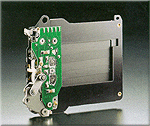
The ultra-high shutter speed
of 1/12000 sec. is capable of freezing almost any action and enables you
to shoot with wider apertures in bright lighting. This is a big advantage
when shooting daylight portraits and when using high-speed film. Carbon-fiber-reinforced
epoxy is used for eight of the ten shutter blades, resulting in a shutter
curtain that is 30% lighter yet stronger than conventional blades. This
shutter screen lessens the burden on the drive mechanism and effectively
suppresses vibration. To ensure precise performance at all times, shutter
endurance has been tested to 100,000 cycles. Flash sync speed is also fast;
up to 1/300 sec. This allows you to use wider apertures for daylight sync
shots of objects at a distance. In addition, ghosting and blurring are
reduced, and the influence of strong illumination is minimized when shooting
moving scenes indoors. Aperture and shutter speeds are selectable in 1/2
and 1/3EV increments.
Viewfinder offers 100% field
of view.
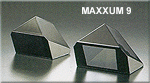
For truly precise framing,
only what you see through the viewfinder should be captured on the film.
The Maxxum 9 achieves this with an approx. 100% field of view*, while maintaining
a large magnification ratio of 0.73X. This was made possible by precisely
aligning the viewfinder frame with the image area in the film plane and
enlarging the main mirror viewfinder optical components such as the pentaprism.
A new Spherical Acute Matte screen offers an extra-clear viewfinder image,
even when a slower telephoto lens is used. For pinpoint manual focus control
when using faster lenses, an interchangeable Super-Spherical Acute Matte
screen is also available. Exposure compensation values are displayed on
the right side of the viewfinder, with shooting data underneath - locations
that won't distract you while framing. Further viewing ease is provided
by a high 7/8 in. **eyepoint for long eye-relief and by diopter adjustment.
*With 50mm lens focused on
infinity.
**Measured from eyepiece
protection glass.
Designed and built for superior durability.
Extra-tough, rigid metal cover.
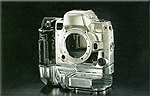
The Maxxum 9's top, front,
rear and flash housing are sheathed with a rigid, corrosion-resistant steel
compound (SUS304). The bottom and sides employ zinc diecast. The base is
padded with rubber to absorb shocks, prevent damage, and provide a more
secure left-hand grip. We haven't neglected the appearance either: the
steel areas have an elegant satin black finish, while the zinc diecast
sections are matte black. 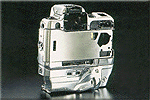 Finally,
all plastic parts are coated with a scratch-resistant UV-hardened polymer.
All this care ensures that the Maxxum 9 will remain in pristine condition
through long years of use.
Finally,
all plastic parts are coated with a scratch-resistant UV-hardened polymer.
All this care ensures that the Maxxum 9 will remain in pristine condition
through long years of use.
Dust- and moisture resistant
construction*.
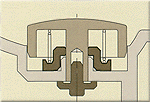
Adverse conditions won't
affect your shooting with the Maxxum 9. The inside of the shutter-release
button is sealed with a rubber gasket, the viewfinder is sealed with resin,
and channels from dials to the inner control circuitry are longer to prevent
moisture from entering.
*This camera is not waterproof.
Careful consideration to every detail.
Sprocket and film guide
Because of the extremely
fast film advance, the sprocket and film guides have an improved design
to prevent friction that could damage the film surface.
Mirror box 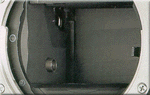
A special sheet to prevent
inner reflection and a black finish on the box surface contribute to sharper
pictures with reduced flare.
Vertical Control Grip contacts 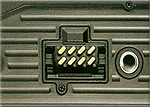
The contacts on the camera
base are covered for protection against dust. When the Grip is mounted,
the cover slides into the body.
Four-layer flexible circuit
board 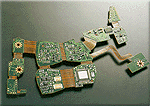
Concentrating the circuitry
improves reliability, so we have designed the main circuit board with a
high-density, four-layer configuration.
Sure handling with satisfying responsiveness
Straightforward, flexible control of all functions.
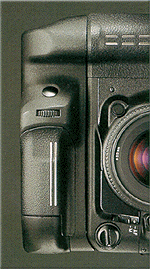 This
is a camera that is wholly responsive to your intentions, offering the
kind of intuitive control that allows you to give full rein to your creativity.
You can confidently make fine adjustments to the automatic settings, or
comprehensive changes to the individual systems. Extensive research has
resulted in a design in which each dial is logically positioned for quick
recognition and ergonomically shaped for optimum control. Exposure compensation,
for example, can be set with the rear control dial (when customized so
you can control the exposure with your thumb without taking your eye from
the viewfinder. All dials are rubberized for a comfortable, positive feel.
Fluorescent indications on the exposure mode and compensation dials, and
the bright LCD panel make nighttime operation easier. Even the Vertical
Control Grip is convenient: it offers the same major dials and buttons
as the camera body, so you don't lose any functionality when operating
the camera vertically.
This
is a camera that is wholly responsive to your intentions, offering the
kind of intuitive control that allows you to give full rein to your creativity.
You can confidently make fine adjustments to the automatic settings, or
comprehensive changes to the individual systems. Extensive research has
resulted in a design in which each dial is logically positioned for quick
recognition and ergonomically shaped for optimum control. Exposure compensation,
for example, can be set with the rear control dial (when customized so
you can control the exposure with your thumb without taking your eye from
the viewfinder. All dials are rubberized for a comfortable, positive feel.
Fluorescent indications on the exposure mode and compensation dials, and
the bright LCD panel make nighttime operation easier. Even the Vertical
Control Grip is convenient: it offers the same major dials and buttons
as the camera body, so you don't lose any functionality when operating
the camera vertically.
Ergonomically designed grip.
The grip is covered with
non-slip rubber, giving you a comfortable and secure hold. In addition,
the distance between the bottom of the lens mount and the bottom of the
camera has been lengthened so even a large diameter lens barrel won't touch
the tripod head.
Multiple power sources.
The camera body and Vertical
Control Grip (VC-9) accept CR123A lithium batteries. The VC-9 also accepts
three other types: 2CR5 lithium, AA alkaline-manganese, and AA Ni-Cd, one
of which can be installed at the same time as the CR123A cells. Combined
with the batteries in the camera body, this configuration gives you three
power sources selectable at the twist of a dial. Even when power in the
camera body is getting low, you can continue to concentrate on your photography
without having to think about replacing batteries.
Autofocus
Advanced focus controls for
confident shooting in every situation.
Eye-Start Automation
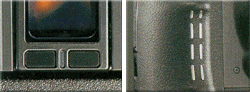
When you bring the Maxxum
9 to your eye, an electrode sensor in the grip and an eye sensor in the
eyepiece instantly activate the AF and AE systems, to the camera is ready
to capture just the shot you want. Because AF is activated without having
to push the shutter release button halfway down, there's hardly any time
lag in focusing, ensuring that you won't miss those exciting shots that
sudden chance presents. Naturally, Eye-Start can be switched off if desired.
3-Point AF system
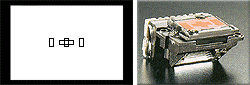
The wide focusing area is
covered by three AF sensors; left, right, and a crosscut sensor in the
center that tracks subjects in both vertical and horizontal directions.
These three sensors are ideally balanced to cover the whole viewfinder
area, and the AF system automatically selects the one where the subject
is most likely to be. Accurate focusing is achieved regardless of the subject's
brightness, thus ensuring effective subject tracking. Even in low-light
conditions, the highly sensitive AF sensors can perform down to as low
as -1EV (ISO 100) illumination where the human eye cannot focus properly,
so no additional light is needed for focusing.
Projected local focus area
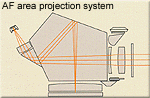
When the shutter release
button is pressed partway down, the selected local focus area is indicated
in the viewfinder by three LEDs projected through the pentaprism. This
ensures that you see the necessary focusing information to track your subject
even in low-light conditions, a difficult task with conventional transparent
LCD display systems. The luminance level of the LEDs varies according to
the exposure values.
Focus area selection
Local area selection
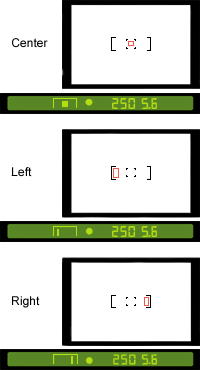
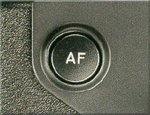 When
the AF button is pushed, AF/AE Lock is activated and red illumination indicates
which of the three local areas in the wide focus area is focusing the subject.
Operating the front dial while the AF button is depressed will switch focusing
among the local areas, with the currently selected area illuminated.
When
the AF button is pushed, AF/AE Lock is activated and red illumination indicates
which of the three local areas in the wide focus area is focusing the subject.
Operating the front dial while the AF button is depressed will switch focusing
among the local areas, with the currently selected area illuminated.
Three AF modes
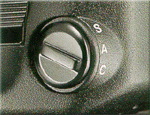
According to the subject
and situation, you can choose from among three AF modes. By selecting the
one that is best suited for your purpose, you can be sure of achieving
effective AF control for optimum photographic expression.
Automatic AF mode (A)
According to the movement
of the subject, the camera automatically switches between Continuous AF
and Single-shot AF modes. Focusing continues while the subject moves. With
still subjects, focus is locked when the shutter-release button is pressed
halfway down.
Continuous AF mode (C)
With the shutter release
button depressed halfway, the AF system keeps focusing according to the
movement of the subject, and focus-lock does not engage even when the subject
is focused. Ideal for sports and other fast-action photography.
Single-shot AF mode (S)
When the shutter-release
button is depressed halfway in Single-shot AF mode, the AF system focuses
and locks on the subject. You'll want to use it for portraits and other
still subjects.
Omni-Dimensional Predictive
Focus Control
By performing high-speed
calculation of the metered data, the AF system analyzes the speed and direction
of the subject, and predicts its movement during the time lag from shutter
release to the instant of exposure. The system is capable of tracking abrupt
changes in speed and direction - even U-turns - while maintaining perfect
focus. For example, with a 300mm telephoto lens attached, this function
can accurately follow an object moving as fast as 24.8 miles/hour to within
26-1/4 feet.
Timed AF drive control
The Maxxum 9 uses a new AF
drive system that controls lens movements until the completion of focusing.
Operation is extremely smooth, with precise control of subtle shutter and
lens movements during focusing. In most conventional cameras, smooth AF
drive is difficult due to the use of multi-step AF drive with repeated
lens-drive stops. Minolta's improved Timed AF Drive system increases the
focusing frequency and constantly updates the data, resulting in much smoother
and faster focusing.
Selectable AF drive speed
(customized setting)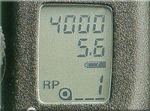
The ideal AF speed varies
according to the shooting situation and the photographer's intention. With
the Maxxum 9, you can select high speed (default setting) or low sped,
for more effective focusing and easier AF control to match specific purposes.
High-speed AF (speed priority)
Useful when taking consecutive
shots in a short time span, such as for sports or fashion.
Low-speed AF (silence priority)
Ideal for shooting in dim
light, for macro shots, or when silence is required.
Selectable AF Priority/Release
Priority modes
(customized setting)
At different times you have
different priorities: focusing or shutter release. With the Maxxum 9, you
can choose either AF Priority mode or Release Priority mode.
AF Priority
Focusing is given priority;
the shutter is released only when the camera has completed focusing.
Release Priority
When shutter release timing
is important, use this mode to release the shutter even when the camera
has not finished focusing.
Built-in AF Illuminator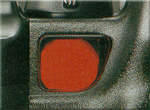
Using three beams aligned
with the three AF sensors in the wide focus area, this supplementary AF
light makes it easier to focus in low light conditions, and to shoot in
low contrast situations with the built-in flash. The three-beam AF illuminator
optimizes the metering over the entire focus area.
Sliding focus mode switch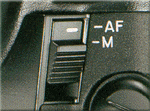
A large sliding switch is
used for switching between auto and manual focusing modes. This new design
prevents accidental switching between modes.
Extensive exposure control
enables you to precisely realize your vision on film.
Three metering modes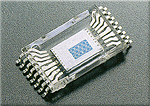
In order to come as close
as possible to the "Ideal photo" every time you shoot, you need precise
control of exposure in response to the subtleties of light on the scene.
Maxxum 9 gives you this control with three metering modes: 14-Segment Honeycomb-Pattern
Metering, Center-Weighted Average Metering, and Spot Metering.
14-Segment Honeycomb-Pattern
Metering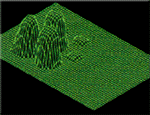
To provide precise exposure
for the main subject, the frame is divided into 14 zones in a honeycomb
pattern. The system collects a variety of data, including brightness of
the main subject, subject distance (even when off-center), distance between
subject and background, and focal length. The data is analyzed to determine 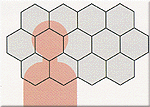 whether
the scene has normal or back lighting, is a portrait or landscape, etc.,
and based on this analysis, the optimum exposure is set. The borders between
normal, half-back, and back lighting can be smoothly controlled to achieve
extra fine images.
whether
the scene has normal or back lighting, is a portrait or landscape, etc.,
and based on this analysis, the optimum exposure is set. The borders between
normal, half-back, and back lighting can be smoothly controlled to achieve
extra fine images.
Center-Weighted Average Metering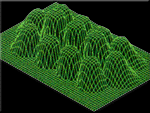
Independent from the AF system,
80% of the metering sensitivity is concentrated in the central area where
the main element of the subject is most likely to be. This is the most
common metering method, allowing you to take full advantage of your expertise.
Spot Metering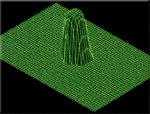
This mode concentrates metering
sensitivity onto an area with a diameter of 3/16 in., 2.7% of the total
frame area. This allows accurate metering of specific subject areas for
delicate exposure settings, and is effective for shooting subjects that
are backlit or have high contrast.
Six exposure control modes
For maximum exposure control
convenience in any photographic situation, the camera provides six exposure
modes. In addition to the four basic modes - P, A, S, and M - you can shift
directly to PA or PS (customized settings) when the P mode is selected.
1. P Mode (Programmed AE)
To allow you to quickly respond
to any photo opportunity, this mode automatically determines the optimum
aperture settings and shutter speed according to the situation. Analyzing
data such as focal length and magnification ratio of the lens, AF metering
data, and the AE sensors' brightness data, the camera judges whether the
current situation is Sports, Portrait, Landscape, or Macro, and sets the
most appropriate exposure.
2. PA Mode (customized setting)
Once customized, you can
adjust the aperture setting instantly with the rear dial while in P mode,
to control depth of field. As the setting is adjusted, shutter speed changes
in response to the incoming light, maintaining optimum exposure.
3. PS Mode (customized setting)
This customized setting lets
you vary the shutter speed using the front dial while in P mode. The aperture
setting changes automatically to maintain optimum exposure.
4. A Mode (Aperture Priority)
With its superior command
of depth of field, this mode offers excellent results when shooting portraits,
landscapes, or macro images, especially when combined with the Maxxum 9's
ultra-fast 1/12000-sec. shutter. Aperture setting is selectable in two
steps - 1/2EV or 1/3Ev - and step switching is linked to the exposure compensation
dial. Settings can be made with either the front or rear dial.
5. S Mode (Shutter Priority)
Shutter speed is selectable
from 1/12000 to 30 seconds. 1/2Ev and 1/3Ev steps are selectable, and step
switching is linked to the exposure compensation dial. Settings can be
made with either the front or rear dial.
6. M Mode (Manual)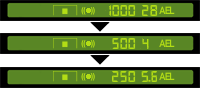
In this mode, you can make
fine adjustments to the aperture (rear dial) and shutter speed (front dial).
Both settings can be modified in either of two steps, 1/2EV or 1/3EV, linked
to the exposure compensation dial. The viewfinder's metering index lets
you compare the values you set and the ones set by the camera. An additional
unique and useful function is Manual Shift: by turning the front dial while
pressing the AE Lock button, you can instantly change the aperture/shutter
speed combination, while maintaining the same exposure value.
Metering index
The Maxxum 9's metering index
lets you monitor exposure just as you would with a spot meter. It offers
extensive information in an easily visible location at the right side of
the viewfinder, with plus values higher and minus values lower. Values
are displayed in 1/2EV or 1/3EV steps, in accordance with the EV increment
selected with the exposure compensation dial.
In P/PA/PS/A/S modes
1) When you shoot in normal
conditions, the exposure compensation values are displayed.
2) When shooting with the
AE Lock button pressed, the locked value is indicated as 0. When the spot-metering
circle is moved to the spot you want to meter, the index shows the difference
from the 0 value. This is very effective for determining exposure under
complicated lighting conditions or when shooting subjects with high contrast.
AE Lock On
The metered value locked
by the selected metering method is indicated as 0.
When the composition changes.
The spot-metering circle
moves according to the changed composition, with the AE Lock button pressed.
The index shows that the newly measured spot is 2EV over the 0 value.
In M mode
The exposure value measured
by the selected metering method is indicated as 0. The index shows the
difference between 0 and the metered value determined by the manually selected
shutter-speed and aperture settings. A useful reference for checking your
intended exposure.
Exposure compensation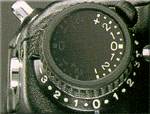
According to the subject
or your preferences, you can set exposure compensation in 1/2EV or 1/3EV
increments*. Depending on which is selected, the metering index and shutter
and aperture settings are automatically switched. Compensation is adjusted
via the exposure compensation dial on the top of the camera. A custom function
also allows you to do it with the rear dial, so you can use your right
hand while your left hand holds the camera, without taking your eye from
the viewfinder. A lock prevents the set value from being accidentally changed.
*Compensation range is +3 steps with 1/2EV increments, +2 steps with 1/3
EV increments, and +3 steps with the rear dial when customized.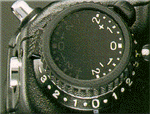
Exposure bracketing
The Maxxum 9 gives you a
choice of two types of bracketing. With continuous advance bracketing,
the selected number of frames (3, 5, or 7) are shot while the shutter-release
button is held down. Single-frame bracketing allows you to shoot with intermittent
bracketing, useful for such occasions as a subject swinging in the wind
which stops from time to time, or for night-time shooting where shutter
speed is prolonged. Four bracketing steps are available: 0.3, 0.5, 0.7,
and 1.0EV.
Multiple exposure
With the Maxxum 9, you can
take as many multiple exposures as you want. Just set to ME (Multiple Exposure)
and keep shooting.
Comprehensive flash control lets you use light to fully attain your creative goals.
4-Segment flash metering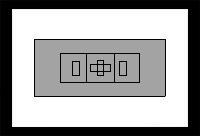
A 4-segment TTL direct flash
metering system allows the Maxxum 9 to detect subject position with high
accuracy. Three of the segments cover the wide focus area, aligned with
the 3-point AF sensors, while the fourth covers a broader outer area. Based
on the subject's magnification, position, and distance from the background,
the Maxxum 9 selects the segment that detects where the subject is most
likely to be and puts most of the metering emphasis on that segment, thus
optimizing meter sensitivity distribution. As a result, correct flash exposure
is assured regardless of the subject's position or distance from the background,
even if the background is brighter than the subject.
Pre-flash metering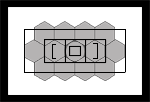
With the Minolta Program
Flash 5400HS (GN 177 ft., ISO 100) attached, the camera fires a pre-flash
when you press the shutter-release button, right before actual exposure
starts. The 14-segment honeycomb pattern cell interprets the light reflected
from the subject and provides this data so the Maxxum 9 can determine the
optimum final exposure with even greater precision.
Rugged, built-in flash for
supplementary light source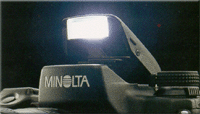
The Maxxum 9 includes a built-in,
steel-encased flash with a coverage of 24mm focal length, a guide number
of 39 ft. (ISO 100) and red-eye reduction. In addition to supporting daylight
sync or portrait shots, the flash functions as the signal for wireless
flash shooting. Sturdy construction and manual lift-up/push-down operation
give you full control over the built-in flash function.
Wireless Off-camera TTL Flash
Control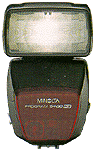
By combining additional Program
Flash units (5400HS/xi, 3500xi) with the built-in flash, you can easily
configure a wireless flash shooting system* to expand flash photography
possibilities. To control the subject's shadow balance as you wish, the
power output of the two units can be set to 2:1 lighting ratio manually
or automatically. **
*With sync speed slower than
1/60 sec.
**With sync speed faster
than 1/30 sec.
TTL High Speed Sync (HSS)
up to 1/12000 sec.
With the Program Flash 5400HS,
fully automatic TTL flash sync is possible with flash sync speeds all the
way up to 1/12000 sec. The advantages are evident in daylight sync shooting
at wide apertures of subjects that are darker than the background.
Rear Flash Sync*
When shooting moving subjects
with flash at slow shutter speeds, Rear Flash Sync is a must. Rather than
illuminating the subject at the beginning of the movement, as with a conventional
flash, it illuminates the subject before the rear screen is driven. This
causes the trails of light to follow instead of precede the image, so the
movement looks natural.
*Not possible in wireless flash shooting
Flash compensation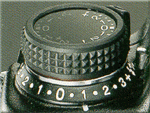
The flash compensation range
is -3EV to +3EV in 1/2EV increments. Compensation is done directly with
the flash compensation dial on top of the body. It is linked to the exposure
compensation dial, so you are able to fine-tune exposure control.
Example: To compensate normal light at +1EV with flashlight at -2EV, the exposure compensation dial is set to +1.0EV (exposure compensation control value is +1.0), and the flash compensation dial is set to -3.0EV (flash compensation control value is +1.0 minus 3.0 = -2.0).
Sync terminal for flash cable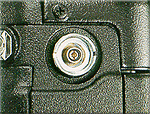
When you need to use large
external flash units in studios, a PC terminal allows easy connection of
flash-sync cables. The terminal features universal polarity, and its screw-type
design ensures reliable connection.
Additional assistance for achieving your photographic goals.
Data memory function
Every time you take a photo,
the camera memorizes seven types of photographic data: shutter speed, aperture
setting, focal length, exposure compensation value, exposure mode, flash
compensation value, and metering mode. For quick confirmation, the data
can be called up on the LCD display. Data for up to seven rolls of film
(36 exposures/roll) can be stored.
Mid-Roll Reload (customized
setting)
When a partially exposed
film is relocated, it is automatically advanced to the selected frame,
preventing light from entering and avoiding double imprinting of time/date.
In addition to saving considerable time, this will prove convenient when
several films (such as negative/positive or with different sensitivity)
are used in one shooting session.
Diopter adjustment
For comfortable viewing of
the viewfinder image and display, a dial next to the eyepiece cup adjusts
the diopter setting throughout a range of -3 to +1 diopter. A pointer marks
the location of the standard value (-1 diopter). With the Diopter Adjustment
Attachment 1000 (optional), a wider range of adjustment is possible: from
-5.6 to +5.4 diopters.
Eyepiece shutter
An eyepiece shutter is built
into the viewfinder. This is useful when shooting with a tripod or when
you cannot look into the viewfinder, because it prevents light from entering
the viewfinder, which could cause inaccurate exposure control.
Long eye-relief viewfinder
You can get a full view from
up to 7/8 in. away from the surface of the eyepiece protection glass. Useful
for shooting with glasses or for confirming the composition while taking
action shots.
Viewfinder Screen
The Maxxum 9 adopts a new
spherical acute matte screen with a cone shaped surface texture. It provides
a brighter viewfinder image and also minimizes shadows in the center of
the image when a slow telephoto lens is used.
Remote shutter-release terminal
The remote release terminal
on the lower side of the grip has a sliding cover, which protects the cable
contact and eliminates accidental loss of the cap.
Illuminate LCD data panel
The data panel is backlit
to aid nighttime and low-light operation. The light is switched on by sliding
the switch located next to the panel. It will illuminate for five seconds,
and the time is extended as long as you continue operation.
Delayed shutter mirror lock-up
When the shutter-release
button is pressed with the two-second self-time mode selected, the mirror
moves up and the shutter is released after two seconds*. This delayed shutter
movement greatly minimizes the vibration produced by pushing the button
and by the movement of the mirror. It's especially useful when you shoot
long exposures with the camera on a tripod.
*In Manual mode. In AF mode,
the shutter moves
after the completion of focusing.
Back-cover release
A rigid metal release unit
prevents accidental opening of the back cover, which tends to happen with
conventional sliding-type switches.
Shutter release lock (customized
setting)
If the shutter release button is pressed when no film is loaded, the shutter is locked. At the same time, the two film counter displays - on the data panel and in the viewfinder - blink to alert you.
Triangular shoulder-strap
eyelet
The eyelet is triangular
in shape so you can hang the camera in either a horizontal or vertical
position. Its location prevents the strap from disturbing your monitoring
of the viewfinder when the camera is positioned vertically. To prevent
any damage when the eyelet hits the body, the area is covered in leather.
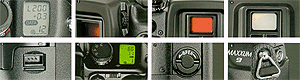
Customized Settings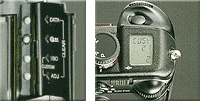
What are the ideal settings
for your camera? That depends on your preferences, subjects, conditions,
objectives, and other factors. You may change them each month, or even
each day. Fortunately, the Maxxum 9 makes this very easy, and gives you
a wide selection as well. 21 settings can be customized so the camera performs
exactly the way you want it to. For example, with Custom Function 18, you
can select three different variations for the functions of the front and
rear control dials in P, A, and S modes, and with 19 , you can reverse
front and rear dial operation.
AF priority/Shutter release
priority
Film rewind: auto/manual
Film leader: rewound into
cartridge/left out/left out with mid-reload
DX memory: off/on
Shutter-release lock (with
no film in chamber): off/on
Lens focus-hold button: focus-hold/center-area/continuous
AF
Eyepiece sensor activation:
with grip hold/without grip hold
Frame counter: normal/count
down
AF area selection: wide or
local/center only
AE-Lock activation: while
button is pressed/after button is pressed
Bracketing sequence: metered
exposure, _, +/-, metered exposure, +
Film rewind speed: fast/slow
Exposure setting display
duration: 5/10/30 sec.
Local focus area display
(approx. 0.1 sec.): always on at focus lock (0.4 sec.)/on only when AF
button is pressed.
Eye start switch function:
eye-start on, off/dial-lock on-off with eye-start on/dial-lock on-off with
eye-start off
Shutter-release lock when
lens is not attached: locked/released
AF drive speed: fast/low
Front & rear dial function
in P/A/S modes (3 variations)
Front & rear dial operation:
as set by 18/ reversed
Flash metering: 4-segment/average/spot
Exposure compensation display
on LCD data panel: no/yes
Vertical Control Grip VC-9
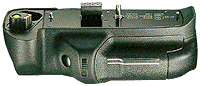
This grip features the same
rigid finish as the Maxxum 9, employing zinc diecast covered with a special
steel compound (SUS430). Its design and rubber pad ensure that you can
hold it securely. The shutter-release button is positioned to allow a natural
shooting posture with your elbow close to your side, while other buttons
such as the vertical on/off switch, front/rear dial, AE-Lock button and
AF button are located to offer the same comfort as when you operate the
camera horizontally. For extra reliability, the sensitive signal contact
is exposed only when the grip is actually mounted, protecting it from dust
and damage.
Multiple 4-type 2-2ay power
source
The Vertical Control Grip
accepts four types of batteries, giving you flexible, reliable power. When
the battery in the camera gets low, and there's no time to change to another,
you can continue shooting by simply switching to the battery in the grip
with the grip's battery select button.
Data Memory Back DM-9
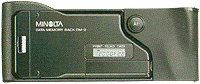
This optional accessory stores
up to 18 items* of photographic data for 400 rolls of 36-exposure film.
The data is saved on a 2MB SmartMedia card** (supplied) and can be viewed
on the camera's LCD data panel or accessed via a personal computer. In
addition, one of seven items, such as shutter speed/aperture, count-up
number, or month/day/year, can be imprinted outside the frame. For easy
identification, the Data number is imprinted at the beginning of the film
upon loading. The exterior of the Data Memory Back uses a special steel
compound, giving it the same rigidity and appearance as the camera.
*Shutter speed, aperture, lens focal length/smallest f-No., exposure compensation, exposure mode, metering mode, AF mode, focus area, AF priority/release priority, film drive mode, flash mode, flash compensation, flash metering mode, ISO count-up number, fixed number, year/month/date, hour/minute.
**Available in 5V/3.3V.
4/8/16MB cards also available.
A broad lens selection for
the professional versatility you require.
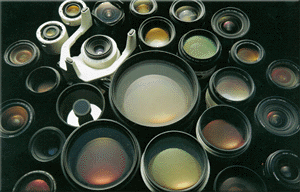
Minolta offers every type
of lens you will need, all offering exceptional image quality and performance.
Our AF zoom lenses are compact and lightweight, giving you the capabilities
of several lenses in one. Wide-angle, standard, and telephoto lenses give
you the flexibility to adapt to varied objectives and situations. Special
purpose lenses meet specific needs.
And our G lenses are large-aperture,
high performance lenses that enable photographic expression of the highest
levels. They benefit from Minolta's most advanced optical technology, including
high-quality, compact aspherical lenses, AD (Anomalous Dispersion) glass
that holds color aberration to an extreme minimum, and round lens apertures
that provide fine shading.
Specifications
Camera Type:
35mm SLR with built-in
flash, autoexposure (AE) and omni-dimensional predictive autofocus (AF).
Lens Mount:
Minolta A-type bayonet mount
Film Type:
35mm film
Eye-start Automation
AF and AE automatically activated/deactivated
by combination of eyepiece and grip sensors. Eye-start is turned on/off
by eye-start switch.
AF System
Type: Minolta's through-the-lens
(TTL) phase-detection system with 3 CCD sensors. Activated by pressing
the AF button or shutter-release button partway down, auto/manual focus
switchable manually. Omni-Dimensional Predictive Focus Control for moving
subjects.
AF Modes: Single-shot, continuous,
automatic autofocus mode
Focus area: Wide focus area
AF sensitivity: EV -1 to
18 (at ISO 100)
AF illuminator: Built-in
3 beam LED; automatically activated in low-light/low contrast situations;
range: 2-5/16 - 22-15/16 ft. (based on Minolta test methods with standard
50mm lens)
Manual Focusing:
By monitoring focus signals
in viewfinder screen.
Metering:
Type: Ambient: 14-segment
honeycomb pattern metering.
Flash: 4-segment flash metering,
average metering and local focus area aligned spot metering selectable
in Custom Function; automatically activated by pressing the AE-lock button,
AF button, or the shutter-release button partway down.
Metering cell: 14-segment
honeycomb pattern SPC (silicon photocell), 4-segment flash-metering SPC.
Metering range: 14-segment
honeycomb pattern metering: EV -20; Center-weighted average metering: EV
0 - 20; Spot metering (3/16 in.): EV 3 - 20 (based on Minolta standard
test method at ISO 100 with f/1.4 lens).
Exposure Modes:
Programmed AE (P mode): Programmed
control of aperture and shutter speed based on lens specifications and
scene characteristics; PA and Ps mode selectable in Custom Function.
Aperture Priority (A mode):
Aperture selectable in 1/2 EV or 1/3 EV increments, shutter speed from
1/12000 to 30 sec. set by autoexposure program.
Shutter Priority (S mode):
Shutter speed from 1/12000 to 30 sec. manually selectable in 1/2 EV or
1/3 EV increments, aperture set by autoexposure program.
Manual Exposure (M mode):
Any shutter speed/aperture selectable in 1/2 EV or 1/3 EV increments; correct,
over-/under-exposure indicated in viewfinder; BULB also selectable.
Exposure Compensation:
Exposure compensation dial
control:
-/+ 3 EV in 1/2 EV increments
-/+ 2 EV in 1/3 EV increments
Rear dial control:
-/+ 3 EV in 1/2 EV increments
-/+ 3 EV in 1/3 EV increments
Flash Compensation
-/+ 3 EV in 1/2 EV increments
Exposure Lock
Exposure locked automatically
with AF lock (available only in 14segment honeycomb-pattern metering),
or with AE-lock button.
Shutter:
Electronically-controlled,
vertical-traverse, focal-plane type
Range: 1/12000 - 30 sec.
plus BULB; Flash sync: 1/300 sec. or slower. With shutter speeds faster
than 1/300 sec., camera will automatically switch to HSS mode (only with
Program Flash 5400HS).
Flash:
Type: Built-in
Guide number: 39 (in feet
at ISO 100); flash coverage for 24mm angle of view Recycling time: Approx.
2.5 sec.
Control: Manual switchover;
lift-up for fill flash, push down for flash cancel
Flash modes: Fill-flash,
fill-flash with red-eye reduction (pre-flash), flash cancel, wireless off-camera
flash (with or without 2:1 ratio), slow sync, rear-flash sync; High Speed
Sync (HSS) flash available with Program Flash 5400HS.
ISO Setting
Automatic setting for DX
coded films: ISO 25 - 5000 (in 1/3 EV increments) DX-coded ISO range with
flash: ISO 25-1000; non DX-coded fill is set to the previous ISO.
Manual setting: ISO 6 - 6400
(in 1/3 EV increments)
Film Transport:
Automatic with build-in motor
drive; auto threading, auto advance to first frame; auto rewind, manual
start of rewind.
Mid reload: Available in
Custom Function
Rewind time (24 exposures):
High-speed rewind; approx. 5 sec.; low-speed (silent) rewind: available
in Custom Function.
Drive modes: Single-frame
advance, continuous advance selectable from 5.5 frames/sec. (4.5 frames/sec.
in continuous AF mode), or 2 frames/sec., single-frame advance exposure-bracketing
selectable from 3-, 5-, or 7-exposure series in either 0.3, 0.5, 0.7, or
1.0 EV increments, continuous advance exposure-bracketing selectable from
3-, 5-, or 7-exposure series in either 0.3, 0.5, 0.7, or 1.0 EV increments.
Self-timer: Electronic with
approx. 10 sec. delay, cancelable, or 2 sec. delay with delayed shutter
mirror lock-up function.
Multiple exposure: 2 or more
exposures.
Viewfinder:
Type: Eye-level fixed pentaprism
Focusing screen: Spherical
acute matte, user-interchangeable screens available.
Field of View: Approx. 100%
x 100% of film frame; magnification: 0.73X (with 50mm lens focused at infinity)
Diopter: -1 diopter adjustable
from -3 to +1
Eye-relief: High-eyepoint
(7/8 in. from the eyepiece, 3/4 in. from the eyepiece frame); eyepiece
shutter available; eyepiece cup removable.
Data Memory:
Stores photographic data
of up to 7 rolls of 36 exposures on aperture, lens focal length, exposure
compensation/exposure bracketing increments, shutter speed, flash compensation/flash
bracketing increments (including flash on/off status), exposure mode, and
metering mode.
Others:
Remote-control terminal (with
a sliding lid). 21 Custom Functions, depth-of-field preview, backlit data
panel, screw-type PC terminal (available to both center-positive and center-negative
polarities).
Power Source:
Two 3-volt CR123A/DL123A
lithium batteries, 4-stage indicator appears when camera is tuned on.
Battery Performance:
Approximately 20 rolls (based
on Minolta’s standard test method using 24-exposure rolls and flash on
50% of the exposures).
24 exposure rolls
36 exposure rolls
Flash use +20
C -20 C
+20 C -20 C
0 %
45 rolls 40 rolls
30 rolls 28 rolls
50 %
23 rolls 15 rolls
15 rolls 10 rolls
100%
14 rolls 9 rolls
9 rolls
6 rolls
Test Conditions: Lens (24 - 85mm f/3.5 - 4.5) is focused from infinity to 6-9/16 ft. three times, and the shutter-release button held partway down for ten seconds before each exposure.
Battery performance will vary with usage conditions
Exposures taken at a rate of 3 rolls/month for 24 exposure (starting with fresh batteries).
Dimensions (WxHxD)
6-1/8 x 4-3/8 x 2-15/16 in.
Weight (without camera batteries)
32-1/8 oz.
*Specifications subject to
change without notice.