
Specialists In Astrophotography
Specialists In Astrophotography
Precision Performance and Complete Control
Unique, 9-point, wide area dual crosscut autofocusing system • Large total information LCD "Navigation Display" • Easy-to-operate, conveniently located lever and dial controls • Most compact and lightweight body in its class • Versatile direct manual focus mode for focus fine tuning • 1/8,000 second shutter speed • Built-in flash with wireless remote flash control and high speed sync • Advanced Distance Integration flash metering • 35 custom settings, data memory, and film chamber lock
You have a vision. You know what you want to achieve. And the Maxxum 7 makes it possible, faster and easier than ever before. An advanced focusing system with an ultra-fast AF speed puts this SLR at the top of its class. The new integrated operation system features familiar dial controls, extensive customization capabilities, and a revolutionary dot matrix navigation display that gives you the camera's status at a glance. The Maxxum 7's improved capability is everything you've been looking for in an SLR. At last, the vision is clear.
Features
Complete Focus Control System
Minolta’s unique nine-point
AF system with center dual cross-hair sensors covers a wide focus area
providing more flexibility and greater focusing precision. The new AF module
incorporates eight line sensors and Minolta’s unique Center Dual Cross-hair
Sensors. The x type sensors overlapping the + type sensors in the center
boasts pinpoint AF precision, taking full advantage of large-diameter lenses
with the maximum aperture of f/2.8 or faster. The 9-point sensors cover
the central area of the viewfinder frame divided by imaginary lines into
thirds, horizontally and vertically, forming the "rule of thirds." Placing
the main subject near the intersections of the lines produces a balanced
composition. By efficiently covering the super-wide focus area, all the
9-point sensors assure great flexibility when composing pictures and precisely
capture moving subjects. The focus-area selector allows easy and direct
access to the desired local focus area. Pressing the eight-way ring key
on the back of the grip activates one of the eight local focus areas, quickly
shifts it, vertically, horizontally, or even diagonally within the super-wide
focus area.
World’s Fastest AF Speed*
(* w/50mm lens: as of June
30, 2000)
Due to refinements in the algorithm and CCD control, the Maxxum 7’s central processing unit has a data processing speed of about five times faster than earlier AF SLR models. In addition, the camera’s powerful lens driving motor promises quick accelerations and decelerations of lens movement. As a result, the Maxxum 7 provides the world’s fastest AF speed in spite of the greater volume of data received from the wide focus area. With the Multi-dimensional Predictive Focus Control, the Maxxum 7 is able to track abrupt changes in speed or direction - even a U-turn - perfectly. With a 300mm lens attached, for example, the Maxxum 7 can accurately follow an object moving as fast as 31 miles per hour to within 26 feet.
Flexible Control of Auto and
Manual Focus Modes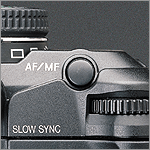
The functional balance of
autofocus and manual focus control is enhanced by the Maxxum 7’s unique
AF/MF control button. This allows photographers to instantly switch control
between autofocus (AF) and manual focus (MF). Simply pressing the button,
conveniently located on the back of the grip - a perfect place for quick
switching of focus control - quickly allows for manual focus (MF). This
versatile control was made possible by utilizing a newly incorporated built-in
clutch that electrically controls the AF/MF switching operation.
Versatile DMF Mode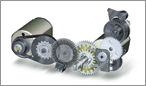
Direct Manual Focus mode
allows photographers to "fine-tune" focus with most Minolta AF lenses.
The new clutch mechanism incorporated in the Maxxum 7 focusing system allows
the focusing ring to be manually operated once the focus is locked by autofocus.
Easy-to-Operate Lever and
Dial Controls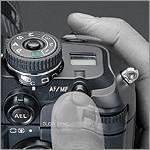
The lever and dial controls
of the Maxxum 7 ensure clear and easy operation at a glance. Full-auto
and Memory functions have been added to the exposure-mode dial in addition
to the conventional positions (P, A, S and M). In combination with the
advanced Navigation display, the lever and dial controls achieve extremely
flexible operation, including an instant reset to Full-auto mode and recall
from any of three Memories of settings programmed in the Navigation display.
Clear and Flexible Operational
Displays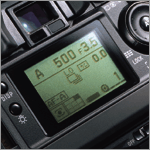
The Maxxum 7 is the first
camera of its class to incorporate a "Navigation Display" providing users
with unequalled clarity in camera operation. The large 1.5 x 1 inch, easy-to-see
LCD panel with dot-matrix presentation, positioned on the Maxxum 7’s back
cover, provides a variety of information to meet users’ specific preferences
or skills. These include camera settings, custom functions, exposure history,
meter index, brightness distribution, depth-of-field, and data memory (selectable
in five different languages). It saves photographers from changing their
holding position each time they check the data panel which is typically
placed at the top of the camera. This position also facilitates high-angle
shooting using a tripod.
Power Performance in the Most
Compact Body in its Class*
(* in volume - as of June
30, 2000)
The Maxxum 7 sets a new standard for performance and compactness. The camera boasts power performance features such as a top shutter speed of 1/8000 second and maximum drive speed of 4 frames per second in a body smaller than any other 35 mm AF SLR's with the same shutter speeds and film drive speeds, based on Minolta’s standard test methods. Relatively small (5.6 x 3.8 x 2.6 inches) and lightweight (20.3 oz.), its compact body with the ultra-compact AF 24-105mm f/3.5-4.5(D) standard lens assures greater handling and carrying comfort.
.8x Viewfinder Magnification
In its compact body, the
Maxxum 7 provides a generous viewfinder magnification of 0.8X. Combined
with a diopter-adjustment function and the Spherical Acute Matte, the viewfinder
presents a bright clear view for maximum ease of operation.
ADI Flash Metering
When used with Minolta’s
new AF lenses incorporating distance encoders, Advanced Distance Integration
(ADI) flash metering provides greater accuracy of the Maxxum 7’s flash
exposure. Guide number control and 4-segment Pre-flash metering work together
to virtually eliminate any influence of background or subject reflectance.
In combination with the 5600HS(D) or 3600HS(D), pre-flash data is interpreted
by the 14-segment Honeycomb-pattern cell and factored into the final exposure.
Wireless Remote High-speed
Sync
When the Maxxum 7 is combined
with Minolta’s new Program Flash 5600HS(D) or 3600HS(D), it provides flat
pulse flash to achieve sync speeds of up to 1/8000 second in wireless/remote
photography. This optimizes the advantages of a large aperture lens with
a shallow depth of field in daylight wireless flash photography.
Rear-flash Sync
With slow shutter speeds
(below 1/60), rear-flash sync creates a natural and pleasing effect with
moving subjects by producing traces behind the subject (exposed by the
ambient light), and sharply exposing the subject itself. When the shutter
speed is over 1/60, the flash fires at the front-flash sync even if rear-flash
sync is selected. Rear-flash sync is not available with red-eye reduction
or wireless flash operation.
Versatile Built-In Flash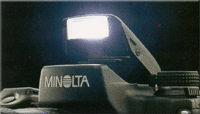
For optimum versatility,
the Maxxum 7 includes a built-in flash. The flash is a manual switchover
type with lift-up and push-down operation, and covers a 24 mm lens with
a guide number of 39 in feet (12 in meters) at ISO 100.
Depth-of-field Preview
With the Maxxum 7, an independent
aperture control motor allows the aperture to be changed during the depth-of-field
preview, so depth-of-field can be continuously monitored. In addition,
a depth-of-field display appears on the Navigation display when a lens
with distance encoder is attached. The magnification ratio appears aligned
with the depth-of-field if it is 1:10 or larger.
Two Phase Distance Encoder
The Maxxum 7 has a two-phase
distance encoder system that reads both the amount and direction of the
lens drive. This allows the photographer to use subject distance information
in manual focus for improved accuracy of multi-segment metering and multi-segment
flash metering.
Continuous Film Advance of
4 fps
Improvements in the sequence
of shutter charge, aperture/mirror charge, and film advance enable the
Maxxum 7 to achieve an action-catching film advance speed of 4 frames per
second. The drive speed changes according to the selected focus mode or
autofocus mode: manual focus - 4 fps, and continuous and automatic AF -
3.7 fps.
Three Auto Focus Modes
The Maxxum 7 allows the photographer
to select the AF mode that best suits the subject. Continuous AF maintains
focus on a moving subject until the picture is taken. With Automatic AF
Selection, the camera continues to focus when the subject is moving and
locks focus when the subject is still. Single-shot AF brings the subject
into focus and locks the focus when the shutter-release button is pressed
partway down.
14-Segment Honeycomb-Pattern
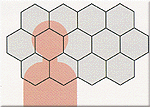
Metering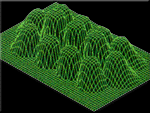
The Maxxum 7’s silicon photocell
is divided into 14 segments — thirteen in a honeycomb array, plus the background.
The metering system uses autofocus information to determine the subject’s
location, and constructs an appropriate metering pattern around it. The
uniform size, shape, and distribution of each segment results in precise
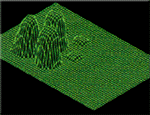
control of the metering pattern and therefore, the exposure. Slight subject
movement results in slight adjustments to the weighting of segments within
the pattern. If subject movement become great enough to affect the exposure,
the metering pattern shifts smoothly to compensate. As a result, the Maxxum
7 is able to set the correct exposure even in very tricky lighting.
Metering Index
A sophisticated metering
index in the viewfinder display makes checking exposure quick and easy,
even in the dark. The index reads from -3EV to +3 EV, in 1/2 or 1/3 increments,
and shows the exposure compensation setting in P, A and S modes. In M mode,
it indicates the difference between the metered value and the value that
has been set. In AE lock, the metering index shows the difference between
the locked value and the value of the currently centered area.
1/2 or 1/3 EV Exposure Compensation
Increment
For more flexible exposure
control, the Maxxum 7 provides exposure compensation increment options:
1/2 EV and 1/3 EV increments.
Manual Shift
This time-saving feature
allows the photographer to quickly change aperture and shutter settings
in Manual Mode without affecting the original exposure selected by the
photographer.
Select-Frame Film Transport
(Mid Reload)
The Maxxum 7’s Select-frame
Film Transport (Mid Reload Function) provides significant convenience when
using several rolls of film in parallel or when making multiple exposures
with bracketing. Photographers can unload and reload a partially exposed
roll of film, or advance or rewind the film to a desired frame. This function
not only minimizes the time and aggravation inherent to the reloading procedure
but also greatly facilitates multiple-exposure photography with bracketing.
Data Memory
Once a spectacular photograph
is taken, the Maxxum 7 remembers how it was achieved so the photographer
can duplicate the effect again. The Maxxum 7’s data memory function can
store up to 11 items of photographic data, such as aperture value, shutter
speed, exposure and flash compensation increments and lens smallest f-number,
from as many as seven rolls of 36-exposure film. The photographer can then
access the photographic data using the Navigation display.
Film Chamber Lock
The Maxxum 7 is the first
35mm SLR model in the world to adopt the Film Chamber Lock feature. Once
loaded, the back cover is locked until the film is completely rewound to
prevent accidental opening.
35 Custom Settings
The Maxxum 7 provides a wide
selection of custom settings to enable you to truly personalize the camera
for your particular style. Functions include:
1. AF/Release priority
2. Film rewind: auto or manual
3. Film leader: rewound into cartridge/left out for Select-frame film transport function
4. DX memory: On/Off
5. Shutter-release lock (with no film in chamber): On/Off
6. Lens focus-hold button: focus hold/continuous advance bracketing/depth-of-field preview
7. Eyepiece sensor activation: with grip sensor on/without grip sensor on
8. Frame counter: counts up/count down
9. AF/MF control button: while button is pressed/after button is pressed
10. AE-lock button: while button is press/after button is pressed
11. Exposure/Flash-bracketing sequence: metered exposure/ +/- or -/metered exposure
12. Film rewind speed: fast/slow (silent)
13. Shutter-speed and aperture display duration: 5/10/30 sec.
14. Local focus area display: 0.3 sec. at focus lock/0.6 sec. at focus lock/on only when Focus area selector or Spot AF button is pressed
15. Front and rear control dial lock: always active/always inactive/locked when camera is not metering
16. Shutter-release lock when lens is not attached: locked/released
17. AF drive speed: fast/slow
18. Exposure compensation with Front/Rear control dial in P, A, and S mode
19. Front and Rear Control dial operation as set by #18/reversed
20. Flash-metering: AD 14-segment/TTL 4-segment/TTL average
21. AF Illuminator: On/Off
22. Tasking on Focus-mode switch - AF-A position: Automatic AF/DMF
23. Shutter-release button: On/Off
24. Full-auto mode of exposure-mode dial: Not acceptable/Acceptable
25. Tasking on exposure-mode dial - position ‘3’: Memory 3/STF mode
26. Factoring exposure compensation on flash metering: Factored/Not Factored
27. Detailed display: show all settings/show changes from standard settings only
28. Operation display: On/Off
29. Large-icon display: On/Off
30. Meter-index display: On/Off
31. Exposure-history display: On/Off
32. Vertical display: On/Off
33. Imprint intensity control: Off/Low Intensity/Standard/High Intensity
34. Body ID number for Data number: imprinted to DN1/imprinted from DN2 to DN9
35. Language selection: Japanese/English/German/French/Spanish
Eye-Start Automation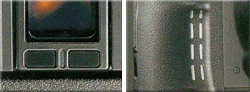
Eye-Start Operation provides
an instant response to any photographic situation, saving precious seconds
and allowing the photographer to capture moments that might otherwise be
missed. When the camera is brought to the eye, an infrared emitter/detector
beneath the viewfinder eyepiece activates the autofocus and autoexposure
systems automatically, without the need to touch the shutter-release button
or any other control. Eye-Start Operation can be turned on or off as desired,
or activated with or without the camera’s grip sensor.
Beautiful Defocused Images
in STF Mode
The Smooth Trans Focus (STF)
mode enables almost all the Minolta AF lenses to produce a beautiful appearance
of a defocused image similar to that provided by the Minolta STF 135mm
F/2.8. With the STF mode, the shape of defocused areas is faithfully reproduced.
This mode sets the camera’s film drive to multiple exposures, and stops
down the aperture settings sequentially during the exposures to reduce
the light transmittance in the lens periphery. The result is a stunning
effect with virtually the same appearance as that of the STF 135mm lens,
which filters the light through optical apodization elements.
Screw type PC Terminal -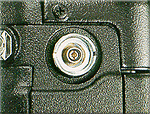
Securely attaches the flash
cord when operating external flash units. Conveniently located on the film
chamber side so the camera can be held with a flash connected.
Diopter Adjustment - Allows viewfinder diopter adjustment within -2.5 to +.5 diopters. If additional correction is required, a Maxxum Eyepiece Corrector can be attached to the viewfinder eyepiece.
Exposure Bracketing - Can be performed with continuous or single frame advance. A three, five, or seven frame bracketing series can be exposed in 0.3, 0.5, or 1.0EV increments.
Built-in AF Illuminator - Aligned with the central AF sensors to assist focusing in low light and low contrast situations.
Exposure Compensation - Can
be set within a range of +/- 3 EV in ½ or 1/3 EV increments.
Flash Compensation - Can
be set within a range of +/- 3 EV in ½ EV increments.
Multiple Exposure - Any number
of exposures can be made on one film frame in multiple exposure mode.
Remote Shutter-Release Terminal
- Allows the shutter to be released from a distance using an optional Maxxum
Remote Cord.
The Lens System That Evolved
with the Body
Minolta is introducing four
new lenses that were developed alongside the Maxxum 7: the AF 24-105mm
f/3.5-4.5(D), AF 100-300mm f/4.5-5.6(D) APO, AF 100mm f/2.8(D) Macro, and
AF 85mm f/1.4G (D). All offer superior focusing operability and high-quality
images. The new widened focusing rings do not rotate during AF drive for
stable holding. In manual focusing, the focusing rings rotate smoothly.
In combination with the Maxxum 7, these lenses support the ADI flash metering
utilizing built-in distance encoders.
Compact and High Power Flash
5600HS(D) and 3600HS(D)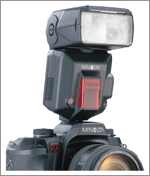
The compact Maxxum Flash
5600HS(D) and 3600HS(D) broaden the horizon of photographic lighting with
high power and functionality. The flash units provide the maximum guide
number of 184 and 118 (ISO 100, in feet) respectively. Newly incorporated
Wireless/Remote High-speed Sync enables photographers to enjoy high-speed
sync in wireless/remote photography. Furthermore, when used with the Maxxum
7 and the new lenses with distance encoders, both flash units provide ADI
flash metering with pre-flash metering.
Data Saver DS-100
The DS-100 allows photographers
to take full advantage of the Maxxum 7’s Data Memory function by storing
the camera’s photographic data to a SmartMedia card. Photographic data
of up to 400 rolls of 36-exposure film can be saved on the 4-megabyte removable
media. The device saves up to 1,900 rolls of 36-exposure film to a 32-megabyte
card. The saved data can be viewed on the Maxxum 7’s Navigation display
and can also be accessed on a personal computer and processed for organized
data review.
Vertical Control Grip VC-7
Designed exclusively for
use with the Maxxum 7, the Vertical Control Grip VC-7 allows a natural
shooting posture when taking vertically framed pictures. Many Maxxum 7
controls: front and rear control dials, grip sensor, AE-lock button, and
AF/MF control button, have been duplicated on the VC-7 to enhance handling
comfort. In addition the VC-7’s shutter-release button has a comfortable
lower position for better vertical control and balanced holding. The grip
also accepts three types of batteries including AA batteries, providing
flexible, reliable power. When the battery in the camera gets low and there’s
no time to change to another, you can continue shooting by simply switching
to the battery in the grip with the grip’s Power Source Changeover Button.
Four Interchangeable Focusing
Screens
Four newly developed, user-interchangeable,
Spherical Matte focusing screens are now available for the Maxxum 7. In
addition to the Focusing Screen 7 II type G (all matte) supplied with the
camera, Minolta is offering additional types including: type L (matte field
with grid), type S (matte field with vertical/horizontal scales), the super
spherical matte type M (for users who frequently use fast lenses with maximum
apertures of f/1.4 - 2.8 in manual focus mode; type M makes it easier to
find the focus point when using fast lenses), and type ML (matte with grids).
The application of spherical matte produces less shade in the center of
the screen even when using a slow telephoto lens.
Specifications
Type:
35mm SLR with built-in flash,
autofocus (AF) and autoexposure (AE)
Lens Mount:
Minolta A-type bayonet mount
Film Type:
35mm film
Eye-Start Automation:
AF and AE automatically activated/deactivated
by combination of eyepiece and grip sensors. Eye-start is turned on/off
by eye-start switch.
AF System:
Type:
Minolta’s through-the-lens
(TTL) phase-detection system with CCD line sensors (9-point AF System with
Center Dual Cross Hair Sensors (CDC912)). Activated by Eye-start Automation,
by pressing the focus-area selector, spot-AF button, AF/MF control button
(in manual focus mode), or shutter-release button partway down. Multi-dimensional
Predictive Focus Control for moving objects
Focus Area:
Wide focus area; any local
focus area can be selected from the 9-point sensors
AF Modes:
Single-shot, Continuous,
Automatic Autofocus
Focus Modes:
Auto/manual focus can be
selected
DMF Mode (available with a
Custom Function):
Allows manual focusing without
switching from autofocus mode after focus is locked
AF Sensitivity:
EV -1 to 18 (at ISO 100)
AF Illuminator:
Built-in LED aligned with
Center Dual Cross-hair Sensors. Automatically activated in low-light/low-contrast
situations; range: 2.3 - 23 ft. (based on Minolta’s standard test methods
with 50mm lens)
Manual Focusing:
By visually monitoring the
focus on the spherical acute-matte viewfinder screen and/or by observing
the focus signals in the viewfinder data panel
Metering System:
Ambient:
14-segment honeycomb-pattern
metering, Center-weighted average metering, Spot metering
Flash Metering:
ADI, TTL 4-segment, or TTL
Average can be selected (available with a Custom Function). Activated by
pressing the AE-lock button, spot-AF button, focus-area selector, AF/MF
control button, shutter-release button partway down, or by Eye-start Automation
Metering Cell:
14-segment honeycomb-pattern
SPC (silicon photo cell), 4-segment flash-metering SPC
Metering Range:
14-segment honeycomb-pattern
metering: EV 0-20; Center-weighed Average: EV 0 - 20; Spot: EV 3 - 20 (based
on Minolta’s standard test method at ISO 100 with f/1.4 lens)
Exposure Modes:
Programmed AE (P mode):
Programmed control of aperture
and shutter speed based on lens specifications and scene characteristics;
PA and PS modes are available
Aperture Priority (A mode):
Aperture selectable in 1/2
EV or 1/3 EV increments; shutter speed from 1/8,000 to 30 sec. set by autoexposure
program
Shutter Priority (S mode):
Shutter speed from 1/8,000
to 30 sec. manually selectable in 1/2 EV or 1/3 EV increments; aperture
set by autoexposure program
Manual Exposure (M mode):
Any available shutter speed/aperture
selectable in 1/2 EV or 1/3 EV increments; correct, over-/under-exposure
indicated in viewfinder and Navigation Display. BULB can be selected
Full-auto [P] Mode:
Operation is reset to registered
settings in full-auto mode
1, 2, 3 Memory Zones:
Operation is set to settings
programmed to each memory zone
Exposure Compensation Dial
Control:
+/- 3 EV in 1/2 EV increments;
+/- 2 EV in 1/3 EV increments (+/-3 EV with a Custom Function)
Flash Compensation:
+/- 2 EV in 1/2 EV increments
AE Lock:
Exposure locked automatically
with AE-lock button (Can also be locked with Focus Lock)
Shutter:
Electronically-controlled,
vertical-traverse, focal-plane type; range: 1/8,000 - 30 sec. plus BULB
(Time count up function available, approximately 7 hours with fresh battery);
Flash sync: 1/200 sec. or slower. Syncs at all speeds in HSS mode (only
available with Program Flash 5400HS, 5600HS(D) and 3600HS(D).
Built-in Flash:
Guide Number:
39 (in feet at ISO 100);
flash coverage for 24mm lens
Recycling Time:
Approx. 2 seconds (approx.
3.5 sec. with red-eye reduction or wireless/remote off-camera flash. Based
on Minolta’s standard test method)
Control:
Manual switchover; lift-up
for fill flash, push down for flash cancel. When lifted up in Full-auto
mode, autoflash is available.
Flash Modes:
Fill flash, fill flash with
red-eye reduction (pre flash), flash cancel, wireless/remote off-camera
flash (with or without 2:1 ratio), rear-flash sync, High-speed sync (HSS)
flash available with Program Flash 5400HS, 5600HS(D) and 3600HS(D).
ISO Setting:
Automatic setting for DX-coded
films, ISO 25-5000 (in 1/3 EV increments)
DX-coded ISO Range with Flash:
ISO 25 - 1000; non DX-coded
film is set to the previous ISO
Manual ISO Setting:
ISO 6-6400 (in 1/3 EV increments)
Film Transport:
Type:
Automatic with built-in motor
drive; auto threading, auto advance to first frame, auto rewind, manual
start of rewind
Mid Reload (Select Frame Film
Transport):
Available in Custom Function
Rewind Time:
(24 exposures): High-speed
rewind: approx. 5.5 sec.; low-speed (silent) rewind: approx. 12 sec., available
in Custom Function, (36 exposures): High-speed rewind: approx.7 sec.; low-speed
(silent) rewind: approx. 15.5 sec., available in Custom Function
Drive Modes:
Single-frame advance; continuous
advance selectable from 4.0 frames/sec., (3.7 frames/sec., in continuous
AF mode), or 2 frames/sec.; single-frame advance exposure bracketing: selectable
from 3, 5, or 7-exposure series in either 0.3, 0.5, 0.7, or 1.0 EV increments;
continuous advance exposure bracketing selectable from 3-, 5-, or 7-exposure
series in either 0.3, 0.5, 0.7, or 1.0 EV increments
Self-Timer:
Electronic with approx. 10-sec.
delay, cancelable, or 2-sec delay with delayed shutter mirror lock-up function
Multiple Exposure:
2 or more exposures
Viewfinder:
Type:
Eye-level fixed pentaprism
Focusing Screen:
Spherical acute matte
Field of View:
Approx. 92% x 94% of film
frame
Magnification:
0.8X (with 50mm lens at infinity)
Diopter:
-1; eyepiece diopter adjustable
from -2.5 to +0.5
Eye Relief:
High-eyepoint (22.5 mm from
the eyepiece, 18.5 mm from the eyepiece frame); eyepiece cup removable
Data Memory:
Stores photographic data
of up to 7 rolls of 36 exposures; Every roll of film: data number, ISO
value. Every frame: aperture, lens focal length, lens minimum aperture,
exposure compensation/exposure bracketing increments, shutter speed, flash
compensation/flash bracketing increments (including flash on/off status),
exposure mode, metering mode, and date/time (year/month/date/hour/minute)
Special Features:
Remote control terminal (with
sliding lid), 35 Custom Functions, depth-of-field preview, screw-type PC
terminal (available to both center-positive and center-negative polarities)
Audio:
Available during self-timer
count down or when focus is locked
Power Source:
Two 3-volt CR123A/DL 123A
lithium batteries, 4-stage indicator appears when camera is turned on
Battery Performance (with
new batteries):
24 exposure rolls
36 exposure rolls
Flash use
+20° C(+68° F) -20° C(-4° F)
+20° C(+68° F) -20°
C(-4° F)
0 %
45 rolls
13 rolls
30 rolls
9 rolls
50 %
21 rolls
6 rolls
14 rolls
4 rolls
100%
13 rolls
4 rolls
9 rolls
2 rolls
Dimensions:
5.6 x 3.8 x 2.6 inches
Weight:
20.3 oz.
Specifications are based on
the latest information available at the time of posting and are subject
to change without notice.