 |
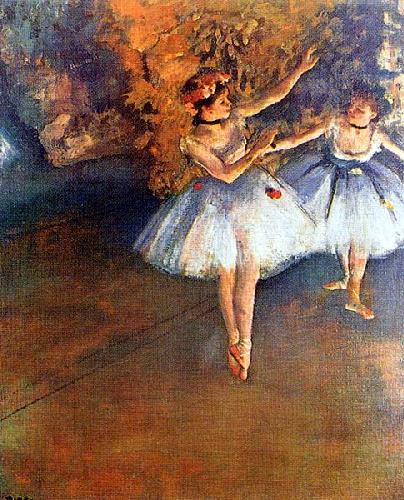
| Edgar Degas by Lara Grieve Degas (1834-1917) was born into a smart Parisian family. He attended the elite Lyc�e Louis-Le-Grand and subsequently the �cole des Beaux-Arts where he studied under a disciple of Ingres. His classical artistic training encouraged an interest in the paintings of the Old Masters, and especially the Italian Renaissance and the Dutch seventeenth century. Unlike the younger Impressionist painters, Monet and Renoir, he stood in opposition to the adoption of plein-air painting, declaring radically that the followers of such a tradition should be lined up and shot! Instead, like fellow painter Edouard Manet (1832-83), he was to record scenes of contemporary Parisian life. But it was not just his subject matter and disagreement with plein-air painting that distanced Degas from the core group of Impressionists. He rejected their technique of using small brushstrokes of juxtaposed colour. Instead of recording an overall impression, his compositions were carefully staged. He focused on human movement rather than the effects of light and colour. He commented, No art is less spontaneous than mine. What I do is the result of reflection and study of the great masters; of inspiration, spontaneity, temperament, I know nothing. Although Degas was constantly critical of the Impressionists, commenting that Monet's art was that of a very skilful but short-lived decorator, he did exhibit regularly with the group and met frequently with members at the Caf� Guerbois. In a different way from his contemporaries his work was breaking the mould of the classical traditions that he so admired. His interests in Japanese prints and photography led him to develop unexpected angles of view and construct compositions that, in some cases, cut off figures at the edges of the works. His depictions of dancers, bathers and horse racing allowed him to explore and demonstrate these ideas. It was Degas' images of Parisian dancers, some sculpted, and delicate pastel studies of bathers that have gained him the perhaps unfair reputation of a misogynist. His depictions of prostitutes and commentary on the female form as a human animal have not helped to dispel such an idea. However, although his work incorporates ideas of social and, in some cases, political commentary it is primarily admired for his radical compositions and innovations in methods of printing and use of pastel. It is in his works in pastel that associations with the Impressionists can be most clearly seen. Here his sense of heightened colour and light merge with a technique of suggestion in the portrayal of form for which Impressionists are known and admired. However, Degas would have rejected such a close comparison. His insistence on artifice over nature is demonstrated by his idea that the planning of a painting, requires as much cunning as the perpetration of a crime, and that nothing in art should seem accidental, not even movement. |
|
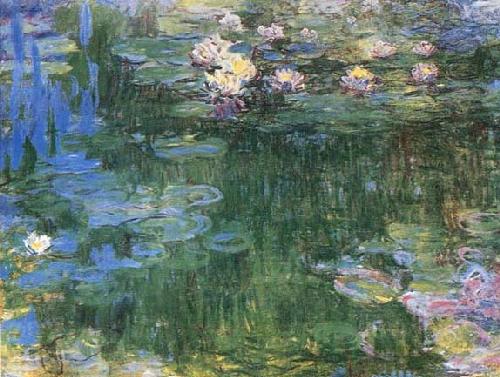
| Claude Monet by Lara Grieve Claude Monet was born in Paris on 14th November 1840. Five years later his family moved to Le Havre where, subsequently, his adolescent caricatures were exhibited next to the work of his future mentor Eug�ne Boudin (1824-1897). The elder artist encouraged Monet to paint directly from nature: It was as if a veil had suddenly been torn from my eyes. I understood. I grasped what painting was capable of being. Monet studied for one year at the Acad�mie Suisse in Paris before he was posted on a years military service in Algeria. He would later place great emphasis on this time spent abroad, I did not realise it at first; it was not until later that the impressions of colour and light which I had received sorted themselves out; but the germ of my future research was there. During the 1860s Monet had already begun to use ideas that were to become his trademarks; painting directly from nature and using quick brush stokes to record overall effect rather than detail. These paintings were often partly contrived: in Women in the Garden (1866) Monets mistress Camille posed for all four figures and Monet would often also finish canvases in his studio. However, it was this painting that began to identify him as the leader of an emerging school of painters referred to as Actualists by Emile Zola. Monet began to spend more time painting outside, particularly at La Grenouill�re with fellow artist, Renoir, whom he had met while studying at Charles Gleyres studio in the early 1860s. Both began to develop theories regarding the effects of light and colour. For example, they no longer used black or brown to describe shadows but instead contrasts of juxtapositioned colours. Although all of the artists, later known as the Impressionists, were already meeting regularly at the Caf� Guerbois by the end of the 1860s, they were not to hold an exhibition of their works until 1874. It was Monets work, Impression: Sunrise (1872), included in this exhibition, that led to the groups naming. Most critics initially derided the Impressionists new techniques and motifs and Monet did not begin to receive a comfortable income until the 1890s. Monet is perhaps best known for his later, series paintings. He had already painted 12 views of the St-Lazare station in 1877 and had spent the winter of 1875 painting snow scenes in Argenteuil. However, in the 1890s he worked hard on several series of paintings depicting haystacks, poplars on the Epte and the fa�ade of Rouen Cathedral. Later, in 1900, when Monet was 60 years old, he embarked on his two most ambitious projects, the series depicting the Thames (producing over 100 canvases on this theme by 1904) and the series depicting his beloved water garden at Giverny, which he continued to work on until his death in 1926. Although he withdrew from the group exhibitions in 1880, Monet would assert throughout his life that his aim was,to paint directly from nature, striving to render my impression in the face of the most fugitive effects. |
 |
| Jean Renoir Jean Renoir was born in Montmartre, in 1894, second son of Impressionist painter, Auguste Renoir, and his wife Aline Victorine Charigot. Aline was 18 years Auguste's junior and had been a seamstress before becoming his model. Jean spent much of his childhood in the countryside at Essoyes, developing the love of nature which is a constant feature of his work. It was here that his view of women was derived directly from his father's influence. His family circle and the friends and models who surrounded his father also had a lasting effect of him. He was devoted to his nurse, Gabrielle Renard, who first taught him to adore melodrama. In 1901, on the birth of his younger brother Claude (Coco), Jean was sent to school at the College de Sainte-Croix, Neuilly. He found it difficult to understand why the other boys were so obsessed with nudes - as the son of an artist, he had been brought up with them! In 1913, Jean enlisted in a Dragoon regiment for three years and served as both a cavalry officer and a pilot. In the War he was wounded several times, including a serious leg injury. His mother hastened to his side and forbade amputation (which would have killed him), however, the journey in her poor state of health (she had diabetes) led to her death a short time later. His injury left him with a permanent limp and pain. Even 40 years later the wound could suddenly start bleeding. When he left the army, he worked as a ceramic artist but was fascinated by the cinema, particularly D W Griffiths and Chaplin. In 1917, Auguste Renoir had a lively, red-headed sixteen-year-old called Andree Heuchling model for him. Jean was attracted to her and a month after his father's death, he married her (January 1920). In 1921, their son, Alain was born. Jean Renoir's chief passions were cinema and motor cars. In 1924, he decided to go into films to make his wife - under the professional name of Catherine Hessling - a star. Catherine starred in La Fille De L'Eau (1924), Nana (1926) and The Little Match Girl (1928). In Nana, an adaptation of Zola's novel, Renoir was influenced by Stroheim and German Expressionism. In the early 30s, Renoir met Marguerite Heulle, who became his film editor and later his mistress, changing her surname to Renoir. She was involved with the trades union, the communists and women's suffrage movements (women did not have the vote in France until 1944.) From this time, Renoir's films show strong social and political sensitivity to the inequality of the French class structure and sympathy for the working class. The bleak pessimism and anarchic escapes from bourgeois conventions depicted in his films, are partly a response to the depression of the early 30s. Toni (1934) is a tragedy that stems from the poverty and hopelessness of its characters. It introduced a new social concern into Renoir's work. In 1935, The Crime of M. Lange was made by Renoir and the left-wing theatre company Groupe Octobre. It is the first of his films to convey optimism of the rise of the Popular Front. He went on to direct a campaign film for the French Communist Party. The film which brought him international recognition was La Grande Illusion (1937), an anti-war film set in the Great War. Goebbels called him "Cinematographic Enemy Number One" and the film was banned in Germany and the negatives destroyed. Regle Du Jeu (1939) is now regarded as Renoir' s masterpiece, but at the time it provoked public hostility and abuse and was banned by the government for being "demoralising". Renoir, who had himself appeared in the film as one of the central characters, never recovered from this reaction to the film. By 1939, Renoir's affair with Marguerite was over and he had become close to Dido Freire, a Brazilian family friend. They were to marry in 1944. In 1940, Renoir was working on a film in Italy when the Italian government joined the Axis. He and Dido managed to get an exit visa and travelled via Marseilles, Casablanca and Lisbon to the USA where he was welcomed in Hollywood. Here, however, he became subject to the studio system and could not work as a writer-director without having key decisions - such as casting - made for him. Every idea Renoir put forward for a film was rejected by Darryl F Zanuck. Renoir wrote: " Hollywood is an immense machine, an admirable mechanism without a soul." Zanuck said: " Renoir has a lot of talent, but he isn't one of us." Renoir left Hollywood. Renoir worked in India on The River (1950), his first colour film. Here, he inspired Satyajit Ray to become a film director. He then returned to work in Europe, where he directed The Golden Coach in Italy and French Cancan (1954) in Paris. Although working in Europe, he kept a permanent home in California. He wrote a biography of his father (1962) as well as memoirs, novels, short stories and plays. In 1975, there was a Retrospective of his work at the National Film Theatre in London. The same year he was awarded a special Oscar, which was accepted on his behalf by his friend Ingrid Bergman. He died peacefully in California and was buried beside his family in Essoyes. Jean Renoir is remembered as a man of great warmth, who combined enthusiasm with an impulsive lack of discipline. |
 |