 |
|
|
|
|
|
|
|
|
|
|
|
|
|
|
|
|
|
|
|
|
|
|
|
Lady Godiva |
|
|
|
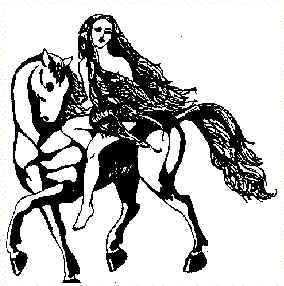
Lady Godiva was a noble woman who lived in Coventry, England in the eleventh century. She had the noblesse gived by birth but also the noblesse of her soul. Together with her husband Leofric, the Earl of Mercia, Lady Godiva founded the monastery at Coventry in 1043. Leofric quickly became active in public affairs, handling financial matters that arose as the town of Coventry grew around the monastery. The tax burden on the peasant populace also grew, as mandated by Leofric, and soon Lady Godiva began her campaigning for a tax reduction. As the story goes, Leofric agreed to the reduction on one condition. He would reduce the local taxes when his wife would ride naked through the market square of Coventry. Once Lady Godiva ensured that she truly had his permission to ride naked through the town, she announced she would do it. Legend has it that Godiva sent advance word to the townspeople of Coventry, asking them to avert their eyes as she rode naked through the market. |
|
|
 |
|
|
|
|
|
|
In March 1996 it was reported that a Marchioness in Rome would appear stark naked on billboards in a campaign to deter women from wearing fur. The Italian branch of the International Animal Welfare Fund said that the 52 year old woman would appear with her arms folded beneath her chest in the poster, pubic hair showing, the slogan proclaiming: "The only fur I'm not ashamed to wear." The model told reporters she had been inspired by Lady Godiva, who rode naked on a horse through the English city of Coventry in the 11th century to persuade her husband to cut taxes. "I am offering my naked image to defend and protect all animals, living and feeling creatures, from torture and cruelty inflicted for reasons of fashion and vanity alone," she said. Earlier that year, a woman in Coventry threw off her coat and stood naked in front of a thousand worshippers at a service marking the centenary of Britain's car industry. She told the congregation in Coventry Cathedral: "In the spirit of Lady Godiva I'm here to mourn the death of my mother and the 17 million people killed directly by the motor car." |
|
|
|
Modern women have been inspired by this story and did their own protest in the same way. |
|
|
|
Out of respect for Godiva, all complied with her wishes. All except one tailor named Tom, who could not help but sneak a peek as she rode by. Immediately after viewing her, Tom was struck blind. From this story comes the phrase 'Peeping Tom'. Historians generally agree that this portion of the story was added on as an embellishment much later in history than the actual event. There is historical evidence for details of the Lady Godiva story, including land and tax records of the time. Later retellings of the event that have survived include accounts chronicled by Roger of Wendover and Henry Knighton, both of whom died in the fourteenth century. |
|
|
|
Here is another version of the story in which you might sense a light bitter flavour. |
|
|
|
One of the most famous early personalities of the 11th century was Lady Godiva (Godwa or Godgifu) who allegedly rode naked the streets of Coventry in Warwickshire as a protest against her husband's high taxes on the people of the city. This husband, Earl Leofric, a Saxon Earl of Mercia, died an old man in 1057, nine years before the Norman Conquest. They seemingly had issue, at least one daughter, who married into the Malet family. 29 years after her husband's death, Lady (Countess) Godiva held many estates in Warwickshire, including Coventry, as revealed by the Domesday Book in 1086. Chronologically, either Leofric had married a child bride, or Lady Godiva was a very old woman at the time of the Domesday Survey in 1086. The former is the most likely. The lordships bestowed on Lady Godiva in Warwickshire by William the Conqueror in 1066 were considerable, probably the result of an alliance struck either with Leofric or Lady Godiva before the Conquest. Since, Lady Godiva was a wealthy woman in 1057, and still wealthy after the Conquest, it is not likely she displayed herself in protest after that date, since she would have been protesting her own taxation. She apparently inherited her lands and titles in 1057. Therefore, the event in question probably took place, if at all, several years before 1057, when, young and innocent, the impatient and passionate Lady Godiva, appalled by her aging husband's despotic ways, leapt on her nag and took to the streets of Coventry in all her naked glory, perhaps too young to realize that within a few short years she would be in full control of all the taxation of her husband's considerable holdings at the time of his death, holdings which she carried through to at least 1086. |
|
|
|
home |
|
gallery |
|
gifs |
|
|
|
|
|
backgrounds |
|