|
A Tale of Two Horses |
|
| It's
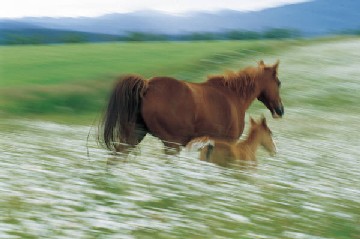
been said, by some, that you shouldn't change horses in midstream. It's been said in reply, by certain others, that you might, if your horse has taken the bit and seems too dangerous to get you across the stream safely. Yet another group of people is busily employed in smirking and saying things like, "Perhaps you'd rather change diapers in midstream!" The valuable function they provide is allowing people to laugh at the situation, while simultaneously distracting their attention from everything that was relevant about the original question. (Jon Stewart, I'm talking about you. And your ilk.) Unfortunately, none of the expressions above capture the situation very well - perhaps this is somewhat in the nature of simple sayings, but nonetheless it is true. Perhaps the attempt to provide a decent analogy should at least be made once more. Consider a slightly more complex scenario. Picture an entire herd of horses, and several camels (hereinafter referred to as "horses"), standing in the middle of a very large stream, with riders on their backs. The horses and their riders are of all different sizes, ages, and temperaments. All of the horses are tied together with various lengths of rope. The ropes snaking from one horse to the next are so thickly tangled and intertwined, it's often impossible to tell which are connected to which, or what would happen if you pulled one. It's impossible to miss the horse you're riding. Yes, he's right underneath you, but he's also the biggest horse in the herd, and you aren't his only rider. Very few horses here are carrying more than one, but your horse carries more riders than any of the others. He also has more ropes attached to him than anyone else, so that when he moves, there is a visible pull on horses all across the stream. While it seems generous for one horse to attempt getting several riders across the stream, his riders seem unable to see it that way, even while other horses are in the midst of throwing their riders and trampling them. At this time I will attempt to convey the level of noise going on in this scene, which is roughly equal to 12 mega-dins. Your horse, and its multiple riders, are certainly doing their part. It usually happens that whenever one rider gets control of your horse's reins, all the other riders turn and raise a chaotic cacaphony of complaint. Some claim that your horse should cut its ties to all the other horses, cross the stream and leave the other riders to their fates. Some say (never realizing the irony) that your horse has too many riders; you should kick one or more of them off to lighten the load and continue on your way. Some will opine that if all the riders would abandon the horses they have now, they could all pile on one miserable horse and cross the stream that way. Add to this babble the panicked shouts and shrill directions coming from all the other riders. It's not easy listening. Allow me to add more confusion to an already messy scene. You see that many of these horses are pulling in opposite directions, over the shouts of their helpless riders. Some, as I have noted, have thrown their riders and are busily trampling them; still others have tired of trampling their own riders and have turned to attacking the riders of other horses. Worse yet are those horses doing this at the behest of their riders. You bear on your own body the marks of one such attack, as do all of the riders of your horse. The horse responsible has been disowned, and its riders have a new mount. Still it remains to cross this treacherous stream. The horse you're riding believes that using its size every now and then, to help its own riders and others, is not a bad thing. It has been thrashing through the water in a specific direction, trying to get you and your fellows to the opposite shore. It has been difficult to move against both the current and the weight of the herd it is attached to by so many lengths of snarled rope. Yet with perseverance your horse has pulled closer to the shore, and several others have been pulled closer along with you. It is against this backdrop that someone offers you a change of horses. Changing horses is an important thing to do, with a job this exhausting. Still, you have to pick your moment - and your horse. The horse they show you is not in favor of pulling other horses toward shore with you. Instead he would look to those other horses for assurance, for guidance. You turn in the saddle and look back at the sweating, bucking knot of horses, straining against their ropes in every possible direction, maintaining a delicate equilibrium that will trap them in the stream forever, and trying to sell it as "stability." Choose wisely, guys. Good luck crossing that stream. |
|
|
|
|
|
|
|