
Hello, Welcome to my Website ! This is the first time for me to create a web page. I will discussed about communications, types of communications, namely, Telephone and E-mail. In Telephone and E-mail, I will discussed about what there are, who invented them, the history of Telephone and Email and their advantages and disadvantages.

Communication
Telephone
E-Mail
Reference
Communication is a transfer of a message from one point (sender/source) to another (receiver/destination) via path or channel. There are so many ways people can communicate, for e.g. through birds, messenger with horses, letters via postman, letters in bottles, Morse code, telephone, mobile, 3G and e-mails. The very first form of ‘information’ electrically transferred was the human voice in the form of a code (i.e. Morse code), which was then converted back to words at the receiving site. And the latest communication is 3G (the Third Generation Phone).
Communication
nowadays becomes more and more important to this world. The people in this
world can connect each other through communication. It does not matter where
you are in this part of the world;
Not only people
need to communicate with the world, animals also need the communication in
order to live in this world. Unlike us humans, animals communicate in different
ways. Let’s take bats for example. Bats, though they have eyes, cannot see.
They only have their ears in order to do the communication. They use their ears
to “see”. Bats send sensors every path they go through and when there is a thing
in front of them, the sensors will bounce back to their ears.
There are 4 elements of Communication, namely, Source (sender), Destination (receiver), means of path (channel) and messages. If one of the elements above missing, then communication will break down.

What is Telephone?
In Greek word tele means far, and phone means sound. (M.Miller, 1988). The Telephone set is an instrument used to transmit and receive information or calls sequentially or simultaneously, thus permitting one party to communicate with another. (Harb, 1989) These means that telephone nowadays is very useful, sophisticated, and reliable tools of modern civilization for a sender to send messages or information to other people (receivers). Telephone is wire-based electrical systems.
The Telephone set
In Telephone set, it consists of 5 components: which is “a transmitter, a receiver, a bell, a dialer, and a switchhook.” (Harb, 1989, p.9) From a transmission perspective, a telephone set consists of electroustical transducers. The mouthpiece or transmitter is a change from acoustical energy into electrical energy. The earpiece or receiver is a change of electrical energy into acoustical energy.
Who invented Telephone?
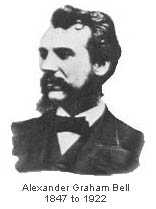
Picture 1: http://www.privateline.com/Telephone History/History1.htm.
 (see Picture 1) was the one who invented Telephone.
He was born on 3rd March 1847 in Edinburgh, Scotland. He moved to
Ontario, and then to the United States, lives in Boston and began his career as
inventor. His first invention is Microphone; it was because Bell had been
interested in the education of deaf people. His greatest invention was Telephone
in 1876. Alexander Graham Bell died in Baddek, Nova Scotia on 2nd
August 1922.
(see Picture 1) was the one who invented Telephone.
He was born on 3rd March 1847 in Edinburgh, Scotland. He moved to
Ontario, and then to the United States, lives in Boston and began his career as
inventor. His first invention is Microphone; it was because Bell had been
interested in the education of deaf people. His greatest invention was Telephone
in 1876. Alexander Graham Bell died in Baddek, Nova Scotia on 2nd
August 1922.
The History of Telephone
The first Telegraph was invented in 1830. Then in 1854 to 1860, an Italian inventor, Antonio Meucci, developed and designed the first transmitter and receiver of a telephone set. And finally in 1876, Telephone was invented by Alexander Graham Bell.
It started on 2nd June 1875, when Bell testing or experimenting with his harmonic telegraph, accidentally he heard a ‘clink’ from its metal spring which is stuck in his instrument receiver. Then he realized that he could hear sound over a wire and the “vibrating spring had acted as a transmitter.”(Harb, 1989, p.8). On 14th February 1876, Bell applied for a patent for his first an electrical speaking Telephone. And on 7th March 1876, his patent has been approved. Finally, on 10th March 1876 the first ‘talk’ on Telephone was being carried out. Bell Telephone company was founded on 7th July 1877.
Model of Alexander Graham Bell’s Telephone
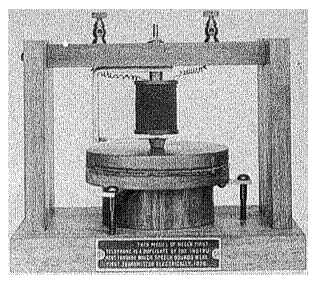
This model of Bell’s first telephone is a duplicate of the instrument through which speech sounds were first transmitted electrically in 1875. (http://inventors.about.com/ibrary/inventors/bltelephone.htm.)
Advantages of Telephone:
1. We can communicate with other people in other country, every time and any where. For e.g. Long distance calls.
2. We can inform / tell news to other people using telephones without meeting them in person.
3. Using telephone is faster, easier and cheaper then sending news by letters.
4. For education, using telephone line as a modem, for internet access.
5. No or less risks of health hazards for e.g. ‘ear damages’ or hearing problems.
6. For emergency e.g. when our neighbour’s houses on fire, we can call fire brigades using our on telephone at home.
Disadvantages of Telephone:
1. The customers need to pay for telephone bill monthly. If the customers used telephone frequently, the bill will be expensive.
2. Telephone will make one’s life be useless, for e.g. if the people talk for a long period of time, it will waste their valuable time for their family, education and themselves, even their money.
3. Telephone cannot be carried away from its connected cables at home or office. Not like mobile, which we can bring it any where.
Summary:
Telephone is very important in our everyday life. Even though, there are so many competitive, for e.g. mobile phones, 3G and letters, Telephone still has it own ‘unique’. Telephone is cheaper and easy to use compare to mobiles phone, 3G and letters.
Telephone is developed on 10th March 1876. Telephone was used everywhere in this world. Although, there are advantages and disadvantages of Telephone, it still useful to us.

What is an E-MAIL?
E-mail is also known as an electronic mail. E-mail is the sending and receiving of messages, letters and documents. E-mail also can send and receive pictures and sound messages. E-mail is like a normal daily mail that people send through postmen but unlike e-mail, it does not need to be sent through posts. E-mail is sent and received via internet. Using e-mail is much faster and easier than mailing post.
Today e-mail becomes more and more famous as it suits the communication of today’s modern world. Most people nowadays use e-mail to send message. It makes things for people easier. If you want to tell something to someone but the person is not available and you cannot contact the person, e-mail can help you. With just go to the computer and you can send messages through e-mail at the internet to the person.
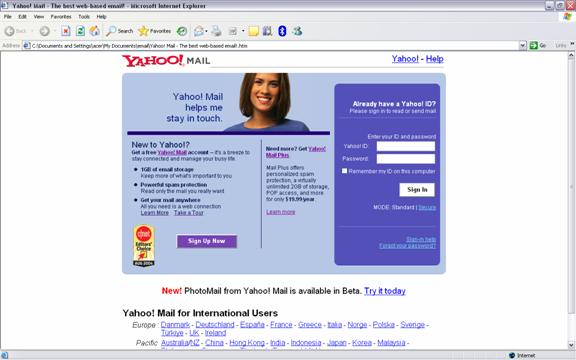
The above picture is taken from the website http://mail.yahoo.com.
This is one of the examples of the e-mail servers that we can find in the internet service. There are several other e-mail servers we can find like at www.hotmail.com, www.msn.com, www.netscape.com and www.brunet.bn.Each e-mail servers give different services for the users. For example at yahoo.mail.com, user can choose one of services provided by them. The user either chooses the normal e-mail account, or the exclusive e-mail account.
The History of E-Mail
The information below is taken from the website http://www.livinginternet.com.
 In early 1960’s, timesharing computers were developed.
In early 1970’s, TENEX operating system was developed.
In late 1971, the first ARPANET e-mail application was developed.
In 1972, the FTP program added the commands MAIL and MLFL.
In early 1980’s, SMTP was developed.
READMAIL was improved and became RD.
RD was improved and called NRD.
SNDMSG and NRD were recoded to become WRD, which was later renamed
as BANANARD.
BANANARD was improved and called MSG.
MS and MH (Mail Handler) were developed.
In 1978, MMDF (Multi-purpose Memo Distribution Facility was
developed.
In early 1980’s, sendmail program was created.
In 1988, the first commercial e-mail was used in the internet.
In 1993, the beginning of the large internet e-mail as a global
standard.
Advantages of E-Mail:
Ü Sending messages using e-mail is much faster compared with by post-mailing. By e-mail, the messages can be received within minutes or hours.
Ü By using e-mail, the person does not have to go and meet another person to tell the messages. He or she only has to use internet to access e-mail.
Ü Sender can send to many different recipient at a time. This also saves time as user does not have to copy and paste the message all over again or duplicate the message if using post-mailing.
Ü The process of e-mail is simple and direct. Not like post-mailing, the mails have to be processed at post office before it is send to the recipient.
Disadvantages of E-Mail:
Ü The e-mail sent depends on the server. Sometimes the message is failed to send or slower when the server is down or has some problems.
Ü There is no emotional feeling shown between the sender and the recipient. This may happen to be a problem where the sender is difficult to tell what the recipient’s feeling. Whereas when face to face, we can see the person’s feeling or we can hear it when using telephones.
Ü Sometimes the recipient cannot read what the message is saying. This is due to the sender type in the message wrong or inaccurate. This also can cause misunderstanding between the sender and the receiver.
Ü The message can be lost. This occurs when the user does not check his or her e-mail account within a period of time.
Summary:
E-Mail is simple, faster, easier to make. E-mail can send messages in a minutes. Most of the user are everyone for e.g. teenagers and adults.
References:
1. M. Miller, (1988) Modern Electronic Communication. Third Edition, Prentice-Hall, New Jersey.
4. Mary Bellis, (2005), The History of Telephone. Available at: http://inventors.about.com/ibrary/inventors/bltelephone.htm.
Appreciation:
My first sincere and kindly thanks to my old friends, Zulhilmi bin Haji Muhammad and Mohd. Mahdinie bin Haji Abdullah, who teach me how to do the Web page using Microsoft FrontPage until I launched my website.
Thank you.
About me:
Done by : Muhd Zulhilmi bin Haji Mai Yussof. Roll no.: 05B0679
if you want to ask me or to give opinions about the topics that I discussed above you can simply E-Mail me at : [email protected]