| SPATIAL CHANGES IN CHANNEL MORPHOLOGY ALONG A DRYLAND ANASTOMOSING DISTRIBUTARY SYSTEM PETER R. BRUNNER School of Environmental Studies, Griffith University, Brisbane, Qld, 4111, Australia The primary aim of this study was to investigate the channel morpholgy in particular, cross-sectional geometry and planform characteristics of five dryland anastomosing rivers in the lower Condamine-Balonne, a large low-angle alluvial fan distributary system in South-east Australia. The following specific research questions were asked. 1. Does the physical charachter and downstream behaviour differ between the multiple channels in relation to cross-sectional geometry and planform? 2. If there is a difference, what are the potential mechanisms which have caused downstream variations in cross-sectional geometry and planform? These specific research questions were examined in order to assess some of the changes that may occur in channel morphology of dryland anastomosing rivers typical of inland Australia. Studies of which feature poorly in current geomorphology literature. In summary. Differences in downstream cross-sectional geometry and planform were significantly different between the outer and inner channels of this alluvial fan. Bankfull area or the overall channel size of individual rivers declines with distance downsteam, although magnitude, nature and rates of decline vary between individual systems. The outer channels (Culgoa, Narran) have a median downstream channel size 100m2 and 40m2 larger than the inner systems (Briarie-Birrie, Ballandool, Bokhara). The Culgoa and Narran Rivers have a relative slow linear decline in channel size around 0.5m2 per km, in comparison, the inner systems display rapid logarithmic declines around 1.2m2 per km. The decline in channel size along individual rivers is accommodated by bankfull widths and thalweg depths that either change little in the downstream direction (outer channels) or become considerably wider and shallower or progressively narrower and deeper in the downstream direction (inner channels). Varaiations in downstream cross-sectional geometry between individual river channels is reflected in their position on the low-angle alluvial fan, significant variations in valley slope, bed topography, flow variability, bed and bank material and in-channel islands. Planform characteristics of the inner systems of this low-angle alluvial fan in response to low stream power and aggradation, display sinuous channels and a high degree of anabranching. These channels are at stage II in Smith et al. (1989) model of anastomosing development - the anastomosing stage. The Culgoa and Narran Rivers are at stage IV - the single channel stage, with less anabranching reaches in response to high stream power and efficient conveyance of both water and sediment. The inner systems are also near boundary thresholds on Lane`s (1957) relationship between channel planform, slope and mean annual discharge. This suggests that the inner systems are highly unstable 'dis-equilibrium' channel planforms. The main cause for this near threshold positioning is that the inner systems are the youger channels of this low-angle alluvial fan and are presently undergoing a transition phase towards a single-channel stage. This transition is a response to increasing channel maturity or downcutting of longitudinal profiles associated with alluvial fan morphology with large meandering bends cut off in the process. |
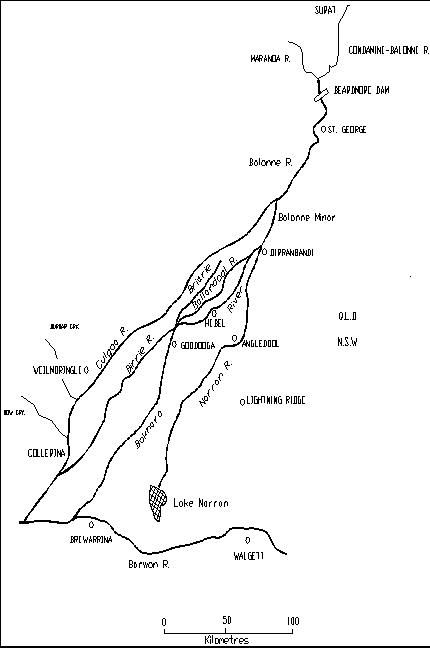 |
| The Condamine-Balonne Study Site (Sketch Produced By P.Brunner) |
| Further Information on this Study: [email protected] |