AND AEOLIAN INTERACTIONS
(DIAMANTINA RIVER, CENTRAL AUSTRALIA)
Peter R Brunner, PhD Candidate
Griffith University, Australia
Copyright (c) Peter R Brunner, 2002
However, their has been little research attention on contemporary fluvial geomorphology at the catchment scale along large dryland rivers, in particular those that anastomose. Many of the generalities expressed in reviews of dryland rivers have been carried out at the plot or local scale; along small steep basins; and, in Mediterranean regions dominated by winter rainfall regimes.
To enable efficent long-term management and provide solid concepts relating to dryland rivers, its essential to determine if, and how, knowledge at the local scale can be scaled up to the catchment scale; the influence of different dryland physiographric and climatic settings; and, to develop our current understanding of interactions or coupling between differnt aspects of dryland catchments, for example fluvial and aeolian process interactions.
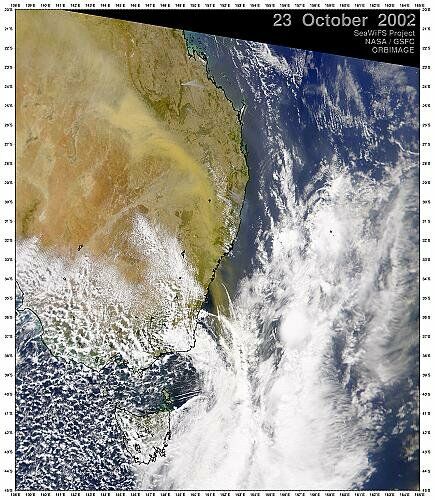
Research into contemporary fluvial and aeolian process interactions along dryland environments are rare.In Australia, wind erosion is a significant environmental and economic problem and its inland rivers may be linked with wind erosion in response to alluvial sediment supplies on their high floodplains fueling major dust storms. This assumption by McTainsh et al. (1999) although highly respected in regards to high floodplain environments of inland rivers being the main zone of fluvial-aeolian interaction, once again highlights the issue of scale as the study was carried out at the local scale. There have been few estimates of the volume and character of alluvium sediment supply and alluvium removed by flood and wind events along different dryland river-floodplain environments to warrant McTainsh et al. (1999) assumption to be scaled up to the catchment scale. Furthermore, there have been few estimates of dust deposition inputs to dryland river systems despite their positive and negative implications such as, essential aquatic nutrient supply during low flow stages and river algae choking or increased sediment loads.
This study will be the first of its kind. It will provide contemporary information on both dryland fluvial and aeolian processes and their interaction at the catchment scale and through time along a large lowland anastomosing river system - The Mighty Diamantina - dominated by a summer rainfall regime. The study has national and international significance as it will yield quantitative data to improve our understanding of the functionality of large inland rivers at the catchment scale; develop information on environmental flow requirements and other aspects of river sustainabilty suitable for integration into water allocation plans for inland rivers; and, develop information for forcasting the effects of wind erosion and dust deposition along inland river-floodplain environments.