Where does India Stand?
1. Introduction Banking lives on the inadequacies of the system. The floats generated through delays caused by unforeseen circumstances and unavoidable infrastructure problems have seen even the least of the efficient banks sail through the worst of the times. But what if all these inadequacies were to die, and that too in a wave. It doesn’t take much to recognize that the Internet has already had a profound effect on the delivery of financial services and is likely to bring more radical changes. Some years ago, Mary Meeker (Morgan Stanley Dean Witter’s Internet analyst) forecast that financial services would be among the industries most profoundly affected by the Internet, since the distribution of financial products doesn’t require any physical exchange of goods. The impact is bound to be higher and tougher for those in India as a slew of disturbances in the internal and external environment kept them so much preoccupied that they hardly got a chance to prepare themselves for the challenges of Internet that requires them to urgently and radically restructure their business model. With this in mind, the author replicated for India a survey that management
consultants Booz-Allen & Hamilton conducted on Corporate Internet Banking.
While next section details the experiences of the western society with
Internet Banking, Section 3 gives the results of the survey. Section
4 talks of the challenges the Internet is likely to pose for banks in India
and Section 5 discusses the strategic options that the Banks may have.
Paper ends with the acknowledgments and the concluding remarks.
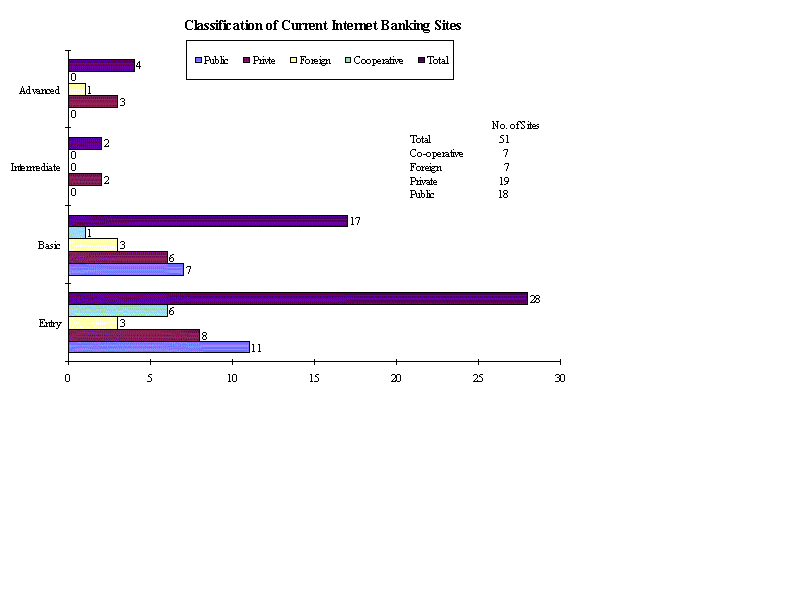
2. Internet Banking - Experiences of the West Looking at vertical portals on the Internet, one finds that a handful of companies in the financial services industry have nabbed market dominance. In early 1999, according to Media Metrix, America Online finance reached 14% of Internet users; Yahoo! Finance, 6%; Intuit’s Quicken.com 5%, E*Trade, 2%; and Schwab.com, 1%. Still, E*Trade and Schwab.com have supported a very strong revenue and customer growth momentum. In the second quarter of 1999, E*Trade added a very impressive 333,000 new accounts bringing its customer base to 1.24 million accounts with $26 billion in assets held. Interesting here is the fact that these Internet finance leaders of today 1) are really new companies 2) are supporting increasing momentum that’s gaining market share; and 3) are playing their growth games under different rules than the incumbents. So while WingspanBank.com without any branch can provide its customers with the benefits of a 100bps more on deposits, E-loan.com gives potential borrowers a facility to search and compare the offerings of thousands of providers and facilitates low cost mortgages by eliminating agent’s commissions. While new internet-based products, such as electronic bill presentment and payment (EBPP), e-check and e-cash are bound to change the bank’s monopolistic control over clearing systems Cybercash, Netbill, Digicash and Millicent with their high availability, safe design, good security, accountability, very low cost and efficiency are all set to erode the money in its conventional sense. The experiences of the west are the clear indicators that Internet Banking is not far off for India. The Internet usage, combined with aggressive moves by new Internet players in this highly fragmented industry will have profound effects on financial services. But are the Indian banks ready for this sudden change? Where do we stand as of today? Would future be as diverse as today or would traditional banks painfully lose incremental revenue growth opportunities to a host of aggressive players that may rapidly consolidate the new revenue opportunities in the business. And what exactly do the banks need to do to meet the challenges of “Banking Business without Barriers.” Author tries to find out the answer to these question through an extensive Internet Banking Study for India. 3. Indian Banks on Web : The Survey This study is an effort to understand the strategic impact of the Internet on the financial services industry. 3.1 The Methodology This study examines the rapidly growing Internet Banking market with an Indian perspective. Extensive research has been put to explore all the banking sites of the banks available in India. These sites have been evaluated, analyzed and classified as Entry, Basic, Intermediate or Advanced depending upon the content or the facilities they provide on the web. The results are studied separately for Public, Private, Foreign and Co-operative Sector banks. Apart from banking sites, various researches on Internet banking already on or completed have also been studied and an effort has been made to project the shape of netbanking for India in the times to come. Views of several banking executives have been taken as an attempt to gauge Indian banking Industry’s preparedness for the future challenges. 3.2 The findings
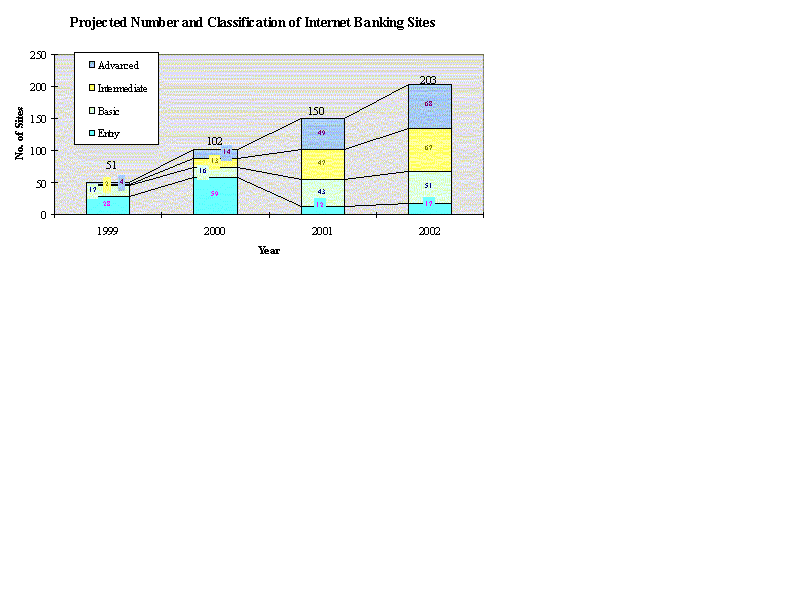
· Only 51 banks are currently offering any kind of Internet Banking services.· In general, these Internet sites offer only the most basic services · 55% are so-called “entry level” sites, offering little more than company information and basic marketing materials· In general, the Foreign and private banks are far ahead of Public Sector or Co-operative Banks in terms of the number of sites and their level of development. · The private banks, with futuristic management and net-pro mindset seem all prepared to continue the “pathfinder” role in Indian Internet Banking.
· There is a lot of room to expand
· Entry level sites will fall from 55% to less than 10%· Other Interesting Points · Most of the Internet Banking sites have been developed with the Non Resident Indian perspective.
Definition of Internet Banking Site Classifications Entry Level
4 Strategic Implications Internet banking would drive us into an age of creative destruction. Established processes and products would have to renew themselves even before they seemed to have outlived their utility. The Internet is the change agent that is going to destruct the physical value chains of legacy banking and create a vastly more efficient digital value chain. All this because of three major characteristics · No physical exchange
· Closed single line links would be replaced by multiple customers and banks joining ‘Many to Many’ networks and defining ‘virtual communities’ for information sharing and transaction initiation· ‘Single package’ applications fragmenting · ‘One Step Solution’ would become a thing of past as banks would have to identify their core competencies since its not tough for customer to switch.· ‘Proprietary’ standards moving to ‘open’ standards, thereby significantly increasing customers’ flexibility and choice
· Customers would be no longer dependent on dedicated systems for each banking relationship · Platform independence would facilitate integration with in-house systems (bank and customer)
5. Consumer Banking - A Special Look As mentioned in the findings, Indian Banks seem to be gearing up for retail banking in a big way. With world’s second largest population and more than 5 million internet users, the number expected to grow at more than 200% in next two years, retail banking surely holds the key for India. Even the Morgan Stanley Dean Witter Internet research emphasized that Web is more important for retail financial services than for many other industries. The next two three years are likely to see a huge disturbance in the market and a virtual but creative destruction in the whole banking value chain. Both prices and costs should come down as consumers migrate to online services. Operating efficiencies from online account servicing should reduce cost by 15-25% relative to regular accounts, but even greater savings are possible. The customers would no longer be branch customers but rather the bank customers. The unconventional net banks would try to lure the customers away from their current banks by offers like high deposit rates, which will lower overall net revenue for online accounts. First movers that provide the highest level of service and innovative product offerings may have some margin leverage initially, but this should deteriorate as competition increases. Under the new business model, the Internet would expand consumer banking’s reach... Banks would be able to compete for customers outside their branch footprints. The steps would be taken to lure high-value customers such as refunding ATM charges. The Internet’s potential would extend companies’ reach, enabling them to tap into attractive demographics. An off-line consumer may pick a bank based on its ATM proximity, convenience, and product fees, while the online customer would be able to use any ATM with no surcharge. Infact, most likely is that ultimately a small group of large, technologically sophisticated, and nationally branded banks will have the opportunity to significantly increase the size and quality of their customer base through the Internet. ...But the Internet would require banks to expand the range of their product and service offerings. Apart from offering online accounts, the net-banks would have to tailor specific products for the Internet, like online bill presentment or credit cards with instant online approval. Level of service would need be enhanced through online account. Since today’s value-added product could easily be tomorrow’s commodity, success would depend more on product innovation than ever. ...These changes could bode ill for legacy banks that choose not to embrace new opportunities. Their asset base would diminish as customers would transfer accounts to banks that offer the convenience of online access, one-stop shopping, and better deposit rates. The profits would be squeezed and ultimately only those who would change to learn to change would survive. The value of the branch will decrease but won’t drop to zero. This because of the fact that multi-tiered distribution would be even more important in the future. Still, the notion that physical branches are an essential part of banking would be dispelled. Without the overhead of a bricks-and-mortar retail network, the operating costs would be greatly reduced and thus better pricing on commodity items like checking would be possible. So in short, revenues will be much larger for successful vertical portals because they’ll be able to cross-sell a broader range of products. Moreover, entities with strong data-mining and target marketing capabilities will also collect very profitable advertising amounts. Again, because customers will expect better pricing from an online provider, profitability will be driven by cost control and scale. So, if this all is to happen, it would surely not happen overnight. There is a long way to go but some immediate steps need be taken. Coming back to where it all started, how do the today’s legacy banks prepare themselves for this change. What all options do they have? This is explored in the next section. 6. Options for the banks Most banks today are pursuing what might be described as a ‘fortress’ strategy, defending themselves against new entrants while waiting for more clarity in the online world. The fortess strategy has the benefit of relying on traditional sources of advantage; it plays to the strengths of current legacy banks. The risk, of course, is that these sources of advantage may not be enough to keep out new entrants that rely on a totally different business model. Banks must today at least hedge by experimenting with the web business
model. But it call for profound organizational changes if it is to
be executed successfully. It needs the banks to fundamentally re-assess
their opportunities for adding value and hence re-define their roles in
the new paradigm
6.1 What to do right now - A short term path
Whatever be the strategy chosen and option adopted, certain key parameters would determine the Banks success on the Web:
Technological and market discontinuities are combining to generate rapid change and high uncertainty in banking. In such an environment, routinely to apply the strategies of the past may be the riskiest option of all. The challenge may not be very immediate but as the survey suggests, the future would see a spurt in the Internet Banking and ‘me-too’ strategies would not work. This would pose serious questions regarding distribution channels, internationalization, value focus and innovation. The winners may not necessarily be traditional banks and the key to success would be the banks readiness to change ad adopt to fast changing customer needs. Recognizing the core competencies and configuring value propositions would determine how well the bank faces this challenge? It is an opportunity for those who can harness the power of this technology to reduce costs and offset the squeeze of spreads by greater volume and new services. Those who would choose to ignore, and stay embedded within their old business models, would better start counting their days. Afterall its better being ready, otherwise even the dinosaurs can face extinction. Sites Referred
|
||



 Classification
of Internet Banking Sites in India
Classification
of Internet Banking Sites in India