My TINTIN page- ( collected from the net )
|
The young Georges Remi, with his nom de plume Hergé, could never have imagined, that through his creation Tintin, he would become so famous internationally. A modest, charming and humorous man, Hergé is regarded as the Father of the European strip cartoon. Although he created many other cartoon characters, it is Tintin that has aroused the imagination of generations of readers. Tintin is the hero of twenty-four adventure stories, of which the most famous is Explorers on the Moon. This book has sold more than 5 million copies. The creator of Tintin preferred a simple discreet lifestyle. Georges Remi hid behind Hergé, who hid behind Tintin. |
| When Tintin was born, Georges Remi was only twenty-one. He had already been using the name Herge for 4 years, this was devised by inverting his initials (G.R.) to RG. While at school, he never stopped drawing and his first published work appeared in a scouting magazine. |
 His
first job, after leaving school, was in the subscriptions department of
the staunchly Catholic and conservative newspaper, Le Vingtième
Siecle. His insatiable appetite and gift for drawing was soon
spotted by Father Wallez, who ran the newspaper. He was subsequently
entrusted with a new weekly supplement for children, Le Petit Vingtième.
The hero that he created at the very end of 1928 was, in a way, a
substitute for Georges Remi. The character, Tintin, was a journalist, a
special envoy sent to the furthest corner of the earth, a correspondent
charged with reporting his impressions of his journeys to those at home. His
first job, after leaving school, was in the subscriptions department of
the staunchly Catholic and conservative newspaper, Le Vingtième
Siecle. His insatiable appetite and gift for drawing was soon
spotted by Father Wallez, who ran the newspaper. He was subsequently
entrusted with a new weekly supplement for children, Le Petit Vingtième.
The hero that he created at the very end of 1928 was, in a way, a
substitute for Georges Remi. The character, Tintin, was a journalist, a
special envoy sent to the furthest corner of the earth, a correspondent
charged with reporting his impressions of his journeys to those at home. |
 Tintin
first appeared in Le Petit Vingtième on 10th January 1929.
Accompanied by Snowy, the young reporter boards the train for Moscow.
For Tintin, it is the start of a great adventure, for Herge, it is the
start of a career. Tintin
first appeared in Le Petit Vingtième on 10th January 1929.
Accompanied by Snowy, the young reporter boards the train for Moscow.
For Tintin, it is the start of a great adventure, for Herge, it is the
start of a career.
The mixing of reality and fiction had only just started. |
 Tintin's second assignment was to the Belgian Congo. Tintin au Congo
(1931-the dates mentioned refer to the first
publication in book form) depicts the colonial period. The European view
of Africa at the time was based on ignorance; it still was in 1946 when
Hergé reworked the book for its colour edition.
Tintin's second assignment was to the Belgian Congo. Tintin au Congo
(1931-the dates mentioned refer to the first
publication in book form) depicts the colonial period. The European view
of Africa at the time was based on ignorance; it still was in 1946 when
Hergé reworked the book for its colour edition. |
 In
Tintin in America (1932), our hero takes
on Al Capone and his gangsters in Chicago. The sad plight of the Red
Indians is well documented. In
Tintin in America (1932), our hero takes
on Al Capone and his gangsters in Chicago. The sad plight of the Red
Indians is well documented. |
 An
evil gang of international drug smugglers is encountered in Cigars of
the Pharaoh (1934). Thomson and Thompson,
whose roles become progressively more important throughout the series,
attempt to arrest Tintin. An
evil gang of international drug smugglers is encountered in Cigars of
the Pharaoh (1934). Thomson and Thompson,
whose roles become progressively more important throughout the series,
attempt to arrest Tintin. |
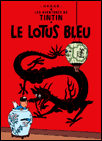 The
Blue Lotus (1936) is a continuation of Cigars
of the Pharaoh. Tintin meets Chang, who becomes a lifelong friend.
In Rastapopoulos he discovers a formidable foe who will appear again.
While Herge was working on Tintin's adventures in China, the
Sino-Japanese war was devastating the Chinese continent. The conflict
extended well beyond the date of publication of The Blue Lotus.
This confirmed the visionary character of the work of the author, who
had a sure grasp of contemporary developments and was meticulous about
depicting authentic detail . The
Blue Lotus (1936) is a continuation of Cigars
of the Pharaoh. Tintin meets Chang, who becomes a lifelong friend.
In Rastapopoulos he discovers a formidable foe who will appear again.
While Herge was working on Tintin's adventures in China, the
Sino-Japanese war was devastating the Chinese continent. The conflict
extended well beyond the date of publication of The Blue Lotus.
This confirmed the visionary character of the work of the author, who
had a sure grasp of contemporary developments and was meticulous about
depicting authentic detail . |
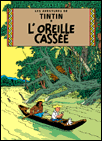 The
Broken Ear (1937) sees Tintin embarking for
South America to retrieve a stolen fetish. He becomes involved in the
military and economic affairs of the region. Herge was inspired by the 3
year war between Bolivia and Paraguay. Newspapers were an enormous
source of material. Counterfeiting had been in the forefront of the
news. The
Broken Ear (1937) sees Tintin embarking for
South America to retrieve a stolen fetish. He becomes involved in the
military and economic affairs of the region. Herge was inspired by the 3
year war between Bolivia and Paraguay. Newspapers were an enormous
source of material. Counterfeiting had been in the forefront of the
news. |
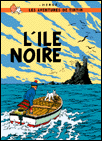 In
The Black Island (1938), Tintin and Snowy
visit Scotland and track down a gang of counterfeiters. In
The Black Island (1938), Tintin and Snowy
visit Scotland and track down a gang of counterfeiters. |
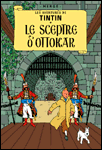 King
Ottokar's Sceptre (1939) is a reflection of
contemporary world events. Germany annexes Austria. Borduria attempts to
invade Syldavia. It is a story of an "Anschluss" that goes
wrong thanks to Tintin and Snowy. It is in this fictitious Central
European Balkan State, Syldavia, that Tintin is first confronted by
Bianca Castafiore. King
Ottokar's Sceptre (1939) is a reflection of
contemporary world events. Germany annexes Austria. Borduria attempts to
invade Syldavia. It is a story of an "Anschluss" that goes
wrong thanks to Tintin and Snowy. It is in this fictitious Central
European Balkan State, Syldavia, that Tintin is first confronted by
Bianca Castafiore. |
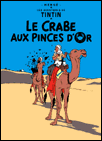 In
The Crab with the Golden Claws (1941),
Tintin discovers opium concealed in tins of crab meat. He also meets for
the first time Captain Haddock, who will become his principal companion. In
The Crab with the Golden Claws (1941),
Tintin discovers opium concealed in tins of crab meat. He also meets for
the first time Captain Haddock, who will become his principal companion. |
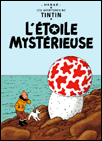 The
first story to be put into the colour format, The Shooting Star
(1942), concerns the race to retrieve part of a
meteorite which falls in the Artic Ocean. The
first story to be put into the colour format, The Shooting Star
(1942), concerns the race to retrieve part of a
meteorite which falls in the Artic Ocean. |
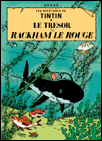 In
The Secret of the Unicorn (1943) and Red
Rackham's Treasure (1944), we learn of the
life of Haddock's famous ancestor, Sir Francis Haddock, Cuthbert
Calculus and his shark submarine help to buy back Haddock's family
estate: Marlinspike Hall . In
The Secret of the Unicorn (1943) and Red
Rackham's Treasure (1944), we learn of the
life of Haddock's famous ancestor, Sir Francis Haddock, Cuthbert
Calculus and his shark submarine help to buy back Haddock's family
estate: Marlinspike Hall . |
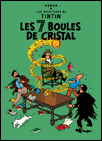 The
Seven Crystal Balls (1948) has 7 scientists
mysteriously falling into a coma after a 2 year trip through Peru and
Bolivia. Professor Calculus disappears and Tintin, Snowy and Captain
Haddock finally set off in search of him. This adventure is concluded in
Peru. The
Seven Crystal Balls (1948) has 7 scientists
mysteriously falling into a coma after a 2 year trip through Peru and
Bolivia. Professor Calculus disappears and Tintin, Snowy and Captain
Haddock finally set off in search of him. This adventure is concluded in
Peru. |
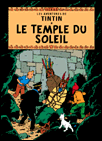 In
Prisoners of the Sun (1949), Calculus is
rescued from the last remaining Incas. Everywhere in the world, car
engines are exploding: petrol has undoubtedly been doctored. An oil
crisis threatens. In
Prisoners of the Sun (1949), Calculus is
rescued from the last remaining Incas. Everywhere in the world, car
engines are exploding: petrol has undoubtedly been doctored. An oil
crisis threatens. |
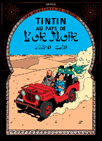 Kalish
Ezab. A world war is imminent. Tintin becomes a radio officer on the
"Speedol Star" and heads off for Khemikhal, the chief port in
Khemed in Land of Black Gold (1950). Kalish
Ezab. A world war is imminent. Tintin becomes a radio officer on the
"Speedol Star" and heads off for Khemikhal, the chief port in
Khemed in Land of Black Gold (1950). |
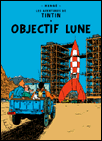 Destination
Moon (1953) details the preparation for and
the beginning of the lunar expedition which will leave from Syldavia
oil. Destination
Moon (1953) details the preparation for and
the beginning of the lunar expedition which will leave from Syldavia
oil. |
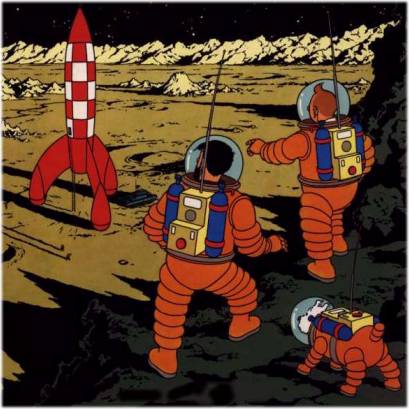
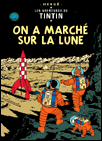 Explorers
on the Moon (1954) describes the first Space
voyage. And so Tintin, Snowy, Captain Haddock and Thomson and Thompson
landed 15 years before the Americans arrived on the moon. Because Herge
conducted such painstaking research, this most futuristic of his stories
does not show its age and was far from superseded by subsequent events. Explorers
on the Moon (1954) describes the first Space
voyage. And so Tintin, Snowy, Captain Haddock and Thomson and Thompson
landed 15 years before the Americans arrived on the moon. Because Herge
conducted such painstaking research, this most futuristic of his stories
does not show its age and was far from superseded by subsequent events. |
 The
Calculus Affair (1956) is Herge's commentary
on the Cold War. Bordurian and Syldavian agents try to kidnap Calculus
in order to steal his plans for a secret weapon, which will "make
the people of Borduria and their glorious ruler KurviTasch, masters of
the world". This also marks the debut of Jolyon Wagg of the Rock
Bottom Insurance Company. The
Calculus Affair (1956) is Herge's commentary
on the Cold War. Bordurian and Syldavian agents try to kidnap Calculus
in order to steal his plans for a secret weapon, which will "make
the people of Borduria and their glorious ruler KurviTasch, masters of
the world". This also marks the debut of Jolyon Wagg of the Rock
Bottom Insurance Company. |
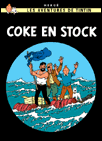 In
the book Red Sea Sharks (1958), the
reader learns that slave-trading still exists. Africans aboard the
freighter Ramona are destined to be sold as slaves in Mecca. Tintin
versus Rastapopoulos once again. Chang, Tintin's friend from The
Blue Lotus, is on his way to Europe. The aircraft that he is
travelling on crashes in the Himalayas. In
the book Red Sea Sharks (1958), the
reader learns that slave-trading still exists. Africans aboard the
freighter Ramona are destined to be sold as slaves in Mecca. Tintin
versus Rastapopoulos once again. Chang, Tintin's friend from The
Blue Lotus, is on his way to Europe. The aircraft that he is
travelling on crashes in the Himalayas. |
 Tintin
in Tibet (1960) is a story about real
friendship. Tintin is convinced that Chang has survived and goes to
Nepal in search of him. It was Hergé's favourite story. Tintin
in Tibet (1960) is a story about real
friendship. Tintin is convinced that Chang has survived and goes to
Nepal in search of him. It was Hergé's favourite story. |
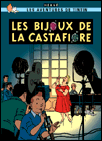 In
The Castafiore Emerald (1963), the
principal characters of the series find themselves at Marlinspike Hall
and act out a classic comedy behind closed doors. In
The Castafiore Emerald (1963), the
principal characters of the series find themselves at Marlinspike Hall
and act out a classic comedy behind closed doors. |
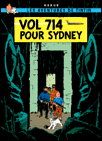 Flight
714 (1968) is the broken journey, the foray into
the unknown, into the world of extraterrestrials and flying-saucers. Flight
714 (1968) is the broken journey, the foray into
the unknown, into the world of extraterrestrials and flying-saucers. |
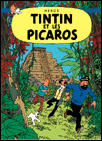 Tintin
and the Picaros (1976) marks the return of
Tintin to San Theodoros, previously visited in The Broken Ear. The last
Tintin adventure to be published in the colour format. Tintin
and the Picaros (1976) marks the return of
Tintin to San Theodoros, previously visited in The Broken Ear. The last
Tintin adventure to be published in the colour format. |
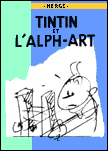 The
final, unfinished adventure of Tintin and Snowy, Tintin et L'Alph
Art (1986), is set in the art world. Published
in sketch-form, in the final frame Tintin is led away to be solidified
into a sculpture to be named "A Reporter". We shall never know
what happens.... The
final, unfinished adventure of Tintin and Snowy, Tintin et L'Alph
Art (1986), is set in the art world. Published
in sketch-form, in the final frame Tintin is led away to be solidified
into a sculpture to be named "A Reporter". We shall never know
what happens.... |