
|
|||||||||||||||||||||||||||||||||
Dinesh Raheja
One of the most entertaining message
films, Shri 420
probes the eternal moral battle between virtue and sin.
It delves into the corrosive effect of the bright lights of a
big city on a simple soul. It has also been an inspiration for
numerous films like Raju
Ban Gaya Gentleman and the recent Bas
Itna Sa Khwaab Hai.
Kapoor's Chaplinesque protagonist Raj is full of life and
good cheer. Rushing to greet a new life, he sings Mera
joota hai Japani, a song which, in the Fifties,
became almost anthemic in its popularity.
Raj reaches the promised land, Mumbai. He finds the streets
of the city are not, after all, paved with gold. Reality bites
Raj as he finds his prized BA degree and his medal for honesty
almost worthless.
True, Raj encounters the love of the common people ---
especially from Lalita Pawar (Ganga mai), who is taken by his
naivete. But broken and disheartened, he soon has to pawn his
honesty medal.
He meets Vidya (Nargis) who --- in a dramatic gender role
reversal --- saves him from drowning. Vidya is a teacher with
ramrod-straight morals. Love blossoms between the two guileless
souls as they share a saucer of tea and duet to Pyar
hua iqrar hua.
Raju takes on a lowly job at a laundry and strives to make a
future for himself and Vidya. On the job, he meets haughty
bombshell Maya (Nadira), who opens up another, very different
world for him.
The heroines are both symbolically named: Vidya represents
knowledge while Maya represents the ephemeral pleasure of all
desires.
Maya feels Raju's ability with cards could be his gateway to
big money. She transforms Raju into a fake prince and, along
with a grasping capitalist (is there any other kind?), Seth
Sonachand, makes Raju a materialistic card sharp.
Raj's morals are the first casualty at the lure of easy
money. His love for Vidya threatens to be second. He takes her
to his club; she recoils and runs away. Raju's attempts to
follow are thwarted by Maya who admonishes him with Mud
mud ke na dekh mud mud ke.
Vidya's Jaane wale
mudke zara dekh ke jaana falls on seemingly
unheeding ears. The divide between the two lovers runs deeper
when Raj gets involved in a get-rich-quick scheme endangering
other people's money.
Sonachand and Maya or Vidya?
Shri 420
can be seen as an allegory for the choices before the
still-innocent, newly-independent citizens of India.
Noted writer K A Abbas writes another socio-realist story
(along with V P Sathe) after Awara
for Raj Kapoor. The latter laced it with Shanker-Jaikishan's
catchy tunes, Shailendra and Hasrat's lyrics and narrated it
with humour and depth of feeling.
Kapoor also displayed unique ability in investing the romance
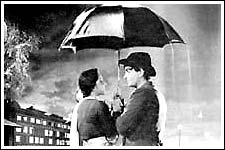
between Raj and Vidya with lyricism. The
two-lovers-under-an-umbrella magic of Pyar
hua iqrar hua is still potent.
Kapoor also adeptly evokes Raj's gradual disillusionment with
the siren call of non-ethical materialism. In Ramaiya
vastavaiya, when Nargis is mourning her loss [Tu
aur tha tera dil aur tha, tere man mein yeh meethi katari na thi],
a conflicted Raj finally joins in towards the end with his
lament [Kaun jo mujhko
kahe, maine dil tujhko diya].
The perfromances help the film's endorsement of ethical
living and high thinking. Nargis' quiet demeanour in the film
contrasted with Raj Kapoor's flamboyance. Nadira's laquered,
diamond-studded character comes across as a beacon of danger,
with her eyes flashing fire and brimstone.
Kapoor is the soul of innocence, with very human failings.
You believe in his journey from an agitated striver to a man who
finally rediscovers his finer self.
Sidelights:
* A special film as it was Nargis' last under Raj Kapoor's
direction. She did one more for R K Films, the Shambu Mitra-directed
Jaagte Raho
--- though only in a special appearance in Jaago
Mohan pyaare.
* Nadira's seductress gown for Mud
mud ke na dekh was stitched so tight she couldn't
sit down. The agony was worth it, she says: "Even today, at
the racecourse, people sing the song when they see me."
* Nadira's smoking in the film with a cigarette-holder became
a fashion statement. The veteran actress maintains she has never
smoked in real life. Nadira became Raj Kapoor's rakhi
sister during Shri 420.
* Sadhana faced the camera for the first time as a group
dancer for a song in the film.
The Music: * A time when Mukesh was busy with his own acting career (he
was hero opposite Usha Kiron in Anuraag,
1956). The success 'voice' for Raj Kapoor in the director's
earlier superhit Awara,
Mukesh sang only Mera
joota hai Japani, Ichak daana and a small stanza in Ramaiya
vastavaiya for Shri
420.
* The talented Manna Dey benefitted most. He sang the classic
Pyar hua iqrar hua
besides Dil ka haal
sune dilwala and Mud
mud ke na dekh.
* If Shailendra wrote simple, meaningful lyrics in Mera
joota hai and Ramaiya
vastaviya, Hasrat excelled with Ichak
daana. Lata was Shanker-Jaikishan's first choice for
heroines' songs then and she sang all the Nargis numbers.
* A still-struggling-for-her-niche Asha Bhosle sang Mud
mud ke na dekh --- one of her first hit songs. It
helped build her image for saucy numbers. |
|||||||||||||||||||||||||||||||||
| Courtesy: Rediff.com | |||||||||||||||||||||||||||||||||