Sassafras
Sassafras albidum
Family--Lauraceae
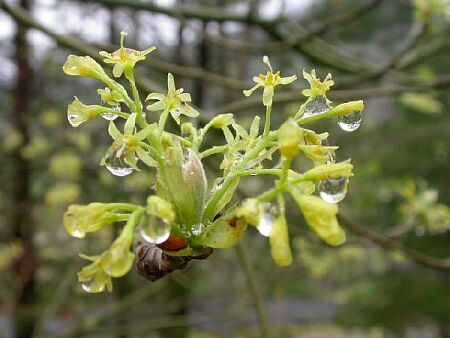
The lauraceae family is composed of aromatic shrubs and trees and also includes spicebush. Sassafras is not an exception and its leaves and stems have the characteristic, spicey aroma of other members of its family. Sassafras is a tree which is typically 30' to 60' feet tall and a spread of 25' to 40' feet. M. Dirr,(Manual of woody landscape plants,1998) lists the national champion as 78' by 69', in Kentucky. Unfortunately, sassafras trees are seen as a nuisance which invade pastures and are cut down. As a result most of the trees seen in our area appear to be shrubs. If left to their own, sassafras trees will form a thicket since they can sprout from their roots. Sassafras trees develop a "...red brown, deeply furrowed bark, with flattened ridges about a an inch and a half thick, and appear(s) as if washed with ashen gray." (Knowing your trees, Colingwood and Brush, 1974) The word sassafras is thought to be of Native American origin. Flowers are usually dioecious and appear in April before the leaves. Fruits are a long, dark blue drupe. Leaves occur in three shapes on each tree. Sassafras has long been considered medicinal and has been used as a flavoring agent. However, safrole, the constitute of sassafras which gives the tree it's aroma is thought to be carcinogenic. However, the leaves are still used in File, a necessary ingredient in Gumbo. The fruits are not rated as a significant wildlife food source. However, birds of the flycatcher family do eat the fruits even though they subsist primarily on insects. Sassafras is one of our most beautiful native trees and should be used more for landscaping. It's fall coloration is rated as spectacular.
--photo and text by Anonymous Friend