KVK, Waghai
Year of Establishment
1985Thrust area
Dang is basically a forest dominated rainfed area with high rainfall. It has hilly and undulating terrain with negligible area under irrigation. The infrastructure facilities like roads, transports, marketing, etc. are poor, besides, and the most of the population is tribal which are illiterate and economically poor.
The major thrust areas are as under:
The major field crops grown are paddy, nagli, pigeonpea, gram and jowar. Among other crops wheat, groundnut (summer), vegetable (brinjal, tomato, chillies) and fruit crop (mango) are also cultivated. Adoption rate of recommended technologies is low. As a result, the productivity of these crops is very low. Farmer are to be convinced through training and demonstrations to adopt recommended technologies in order to enhance yield of the crops.
Soil erosion is a major problem due to hilly and undulating terrain with shallow soils. Adequate attention to training on soil conservations and rain water management is required.
The productivity of livestock (cows, buffaloes and goat) is very low. Hence it is necessary to impart training on housing, feeding, management and health care.
The tribal keep local breed of poultry with traditional methods. The scientific poultry keeping training is required for increasing production level.
There is a scope for introduction of dryland horticultural crops.
Self-employment among tribal youths through skill oriented income generating activities.
District Profile
Total geographical area is 1.72 lac ha.
Average Rainfall - 1800 to 2000 mm with 85 to 95 rainy days.
Tribal population (93.96%) is predominant and literacy is 47.56 per cent out of total population 1.44 lac.
Soils are generally hilly, undulating and shallow to medium in depth.
Forest and wasteland area is 1.09 lac ha., which occupies 63.74% of the total area.
Main crops are Nagli (Hill millets) (0.14 lac ha. area), Paddy (0.10 lac ha. area), Niger (0.06 lac ha. area) and Black gram (0.04 lac ha. area).
Salient activities and achievements
Training
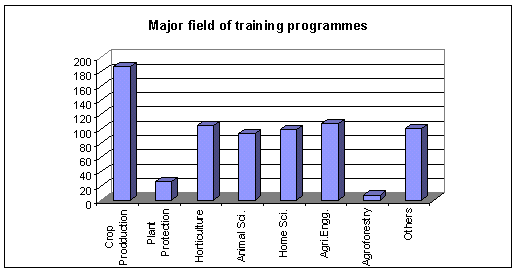
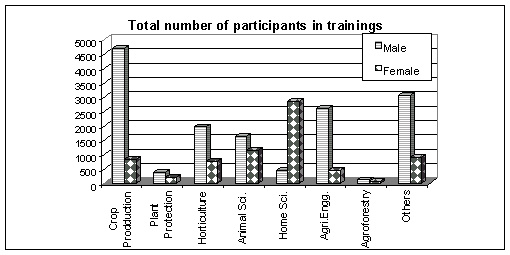
The survey of the area was conducted to know the cropping pattern, economic and social status, people’s attitude, technological gap etc. Needs of the tribal farmers were assessed and accordingly following training courses were conducted.
Impact
KVK, Waghai has started its activities of training tribal from December 1984 with main objective for the all-round development of tribal in Dang district.
In order to study the extent of adoption of improved practices by the trained and untrained tribal farmers of Dang, twelve improved practices of hybrid Jowar crop were selected to know the adoption level of the respondents. results are presented in Table-1.
Table - 1 : Distribution and comparison of respondents according to their extent of adoption of improved crop practices of Jowar crop.
|
Category of Tribal farmers |
||||
|
Trained (N:50) |
Untrained (N:50) |
|||
|
No. |
Percent |
No. |
Percent |
|
|
Low (0.33 score) |
02 |
4.00 |
29 |
58.00 |
|
Medium (34.66) |
33 |
66.00 |
19 |
38.00 |
|
High (67-100 Score) |
15 |
30.00 |
02 |
4.00 |
|
Mean Score |
6.74 |
4.32 |
||
|
Sampling variance (s) |
1.70 |
2.02 |
||
‘Z’ 12.73
The data presented in Table-1 revealed that training programmes arranged by KVK for tribal farmer played an important role in increasing the rate of adoption of improved Jowar practices.
Twelve improved practices of Improved hybrid Jowar cultivation were selected to know the knowledge level of the respondents.
Table : 2 : Distribution and comparison of respondents according to their knowledge level.
N = 50
|
Category of Tribal Farmers |
||||
|
Trained ( N:50) |
Untrained (N:50) |
|||
|
No. |
Percent |
No. |
Percent |
|
|
Low ( 0-33 score) |
02 |
4.00 |
17 |
34.00 |
|
Medium (34-66 score) |
11 |
22.00 |
30 |
60.00 |
|
High (67-100) |
37 |
74.00 |
03 |
6.00 |
|
Mean Score |
8.17 |
4.96 |
||
|
Sampling variance(s) |
2.27 |
2.41 |
||
‘Z’ 15.28 ** 0.01 level of significance
The data presented in Table: 2 revealed that the training programme imparted by KVK to tribal farmers played on important role in increasing the knowledge of improved practices of Jowar
Impact of Training in Agril.Engineering :
Training programme of Agricultural Engineering covered various subjects like soil and water conservation techniques, use of agril. implements, minor repair and maintenance of oil engine etc. Five villages were selected for maintenance of oil engine and pump set.
From the 52 farmers, trained 32 were interviewed to study the impact of the training programme Of them; 17 per cent farmers were found complete repairer. They are maintaining their own oil engines and also having the ability to repair oil engines of their and adjoining villages. They are able to earn from this work.(Table : 3).
Fifty six per cent farmers were found partial repairer. They can maintains their own oil engines but do not have the confidence to extend their ability to other. There were 27 per cent farmers who are unable to repair.
Table : 3 Impact of training on minor repair and maintenance of oil engines and pump set
|
Sr.No. |
Particular |
No. of farmer |
Percent |
Remarks |
|
1. |
Complete repairer |
5 |
17 |
Self employed |
|
2. |
Partial repairer |
17 |
56 |
Normal maintenance |
|
3. |
Unable to repair |
8 |
27 |
- |
Success Stories
1. Tribal couple developed by KVK :
Shri Rahubhai Gavit is 58 years old/ He had upto 7th standard education. His wife Sitaben is 48 years old and having S.S.C. education. They possess 30 acre of land in Mokhamad village which is 65 km away from KVK, Waghai. They were following traditional practices of Paddy, Nagli and Vari crops in one season only. Eight months leisure time was used in preparing and marketing of bamboo baskets.
This couple came in contact with KVK, Waghai in 1988. They were participated the training courses on package of practices of paddy crop, Nursery management and propagation methods. They have adopted new technologies learned from the trainings and their income boost up. In leisure time they were managing the nursery and prepared mango and ber grafting. They had started floriculture cultivation also. Thus, they have boost up their income more than a lac rupee in a year. Now, this couple is the happiest tribal couple in the area. They are also guiding and assisting the other tribals of their village.
2. Tribal Women in Agriculture :
Smt. Kamalaben M. Bhoye of Jamalapada village possess only 3.5 hectares of cultivated land. She followed traditional agricultural practices for drilled paddy, Nagli and var. She was getting low yield and poor income of about 2000 to 3000 rupees.
She had undergone training courses at KVK, Waghai during 1988. She was imparted training of improved varieties, improved package of practices of paddy, nagli and gram, soil and water conservation, land levelling, cultivation of horticultural crops, e.g. grapes, mango, guava, etc.
After the trainings, she adopted improved agricultural technologies at her own land. She created irrigation facility with the help of nationalised bank. It helps her harvesting three season. She being a pioneer in Dang district, planted grapes in 10 gunthas. She purchased two buffaloes. Now, she earned up to 20 to 30 thousand per year. Being a social worker, she advised other farmers too.
3. An effort for Irrigation Cooperative Society
Borigavtha village situated 10 km away from KVK, Waghai on the bank of Khapri river. Two young engineer of KVK made up their mind to use these run away water for irrigation purpose. A 42 members, irrigation co-operative society was established in 1988-89 (Regd.No. K-3053). With the technical guidance and 75% financial help from Technical Sale Cooperative, Vadodara and 25% financial help from Tribal Development Corporation, a lift irrigation project was established successfully. About 139 acres of land is being irrigated. Now these farmers can harvest crop in three seasons. Their income has been increased 2 to 3 times now. This cooperative runs successfully.
4. Farmers can earn more by marketing collectively
People of the Khapri river belt area in Dangs district cultivate fruit and vegetable crops. They were not getting good produce. Due to lack of systematic marketing facilities they were unable to fetch good price and market too. KVK Waghai studied the technological constrains viz. improper use of water, traditional cultivation practices, improper use of fertilizer, etc., and convinced the farmers for the use of scientific practices They were also motivated to start cooperative society so as they can sale their produce at will and also that they could get good prices. Now the farmers are getting more yield and good prices. KVK has also arranged to impart the training on fruit and vegetable cultivation and scientific aspects. In 1991, the society has broadened their objectives with input marketing also. It also helps in borrowing for poultry, fisheries and crop loans from district banks and other agencies. Thus, the economy and social status of the local people is increased.
5. An unemployed tribal youth
Sadhuram is a unemployed and poor tribal youth possess 10 th std. education. He contacted KVK, Waghai in 1987 and being imparted the poultry training. Then he got the training in Integrated Poultry Development Centre, Vyara also. Again for the technical guidance and financial problems, he contacted KVK, Waghai. He established his own poultry unit-Broiler farm. He was in constant touch with KVK for poultry vaccination, nutrition and technical guidance. He used to bought one day old chicks from Lakhmapur (Nasik district) @ Rs.12.50 per chick. He used to sale the chicks after 45 days when the chicks got on an average 1.5 kg weight. He could do the same business five times a year. He is now getting Rs. 70 to 80 thousands rupees in a year.
6. Success in Cultivation of Summer Paddy in Dangs District:
Under the guidance of Krushi Vigyan Kendra, Waghai which are located at the front entrance door to Dangs district, Just like a "Krushi yatra Dham" , the irrigation society was established under the presidenceship of enthusiastic farmer Ramjbhai. Then Ramjibhai Makes a distinct image by his first trial to cultivate summer paddy (var. Jaya) and achieved about 4500 kg. Production per hectare.
Sccording to the Principles of Extension "Seeing is Believing", the 10 farmers of village kudkas are very impressed by the results of above trial of summer paddy varieties Jaya. By this way, the farmers of Dangs made glorious step for scientific cultivation under the guidance of Krushi Vigyan Kendra- Waghai. This is a proud of KVK, Waghai that the efforts of them resulting in success and aboriginal farmers of Dangs became a part of this success race.
7. EMPLOYMENT THROUGH AGRICULTURE
Mr. Kishanbhai Surjibhai Sable of the village Vangan is the Person who developed himself as a very satisfied farmer. He is 30 and educated up to BRS (forestry). He comes from very poor tribal family. After taking education he was loaded with the responsibility of his family and initially he was looking for job but he could not get any. In 1986, he was first time came into contact with the KVK Waghai's Scientists, and he got motivation toward self employment through modern agricultural concepts. After that he was regularly participated in the various activities of KVK. At that time he managed his farming, through little agriculture and selling of deshi wine, yet he cannot cope up the requirements of his family. In the year 1990 he managed land leveling in 1.0 ha. land and started the vegetable cultivation. Simultaneously he purchased an oilengine and pumpset by taking financially help from his friends. After that he prepared 'Nootan mango grafts' by himself after taking training in KVK. At present he has Watermelon cultivation, 1 buffalo, 2 bullock, 2 Oilengine and a semi-nursery and 24 mango trees.
In the current year 1998 he earn Rs. 18,000 by selling of watermelon and Rs. 20,000 by selling of sagi stumps and Rs. 4000 by selling of mangoes. According to this he managed total income of Rs. 42,000 in a year. According to him this is just starting Mr. Kisanbhai is a very good example of light house for unemployed tribal youth to guide and move toward deep ocean of success.
Success in cultivation of improved pigeonpea Var. BDN-2 in Dangs district.:
The 15 farmers of village Hanmatchand make distinct image by Scientific cultivation of Pigeonpea variety BDN-2 and increased the production potential. The guidance was provided by Krushi Vigyan Kendra - Waghai, which are located at front entrance door to Dangs district just like a Krushi yatra Dham".
On the behalf of the farmers of DFangs, Shri Somabhai here expresse4d his own opinion that weeds are the most dangerous enemy of farmers. To control the weeds, I have take the guideline of KVK, Waghai and followed the advice given by them.
I am very impressed to see the unbelievable plant growth more branches, more pods which was never before.
Improved variety and two weeding resulted in harvesting of 950 kg production per ha. I am requesting to all farmers of Dangs to adopt the Scientific methods and techniques and give their share to boost up the crop production programme of nation.
Success in cultivation of Gram Variety Dahod Yellow in Dangs:
Recently, the front line Demonstration (FLD) was arranged at the villages Nadagkhadi and Goriya, under the guideline of Krushi Vigyan Kendra, Waghai which are located at the front entrance door to Dangs District Just like "Krushi yatra Dham". In this demonstration the aboriginal farmer Shri Somabhai Gayakwad of village Nadakhadi said his own opinion, this is highlighter here. Shri Somabhai says that in our traditional method of cultivation i.e. sowing of local variety, only two primary tillage and broadcasting methods of sowing, gave only 705 kg production of gram per hectare, but afterward, I followed the advises of KVK, Waghai and sow improved variety Dahod yellow, four times primary tillage operation with plough and harrow, and sowing in lines leads to 1325 kg production per hectare.
Rameshbhai of village Goriya also expressed his experience that line sowing increase the production of gram just double.
From above opinion of farmers, it can be clearly denoted that there is no doubt that adoption of Scientific techniques is indispensable to increase the production.