KVK, Randheja
Year of Establishment
: 1977Thrust area
1. Sustainable agriculture including (a) Non-chemical farming, (b) Use of bio-fertilizers, (c) Green manuring, (d) Compost making, and (e) Vermiculture and vermicompost.
2. To increase the yield levels of different crops by transfering the technologies, mainly, (a) Seed treatment, (b) Fertilizer management, (c) Plant Protection measures, (d) Latest recommended varieties of different crops.
3. Irrigation saving technologies specifically (a) Critical period for irrigation for major crops, (b) Water saving methods of irrigation, (c) Mulching
4. Shift to cultivate crops which requires less water like castor, mustard, pulses and horticultural crops
5. Rain water harvesting by (a) Premonsoon ploughing and (b) Recharging ground water (Well recharge)
6. Increase the milk production by (a) Management and feeding of milch animals and (b) Providing better hygienic conditions
7. Fruits and vegetables preservation
8. Health care and nutrition of children
9. Income generation for rural women by sewing, embroidery, knitting and preparation of different articles.
Agro-ecological situation of the district:
Total geographical area is 64255 ha.
Average rainfall is 615mm with 26-42 average rainy days.
Soil is sandy loam.
Total no. of villages are 75 in which marginal farmers (6,084), small farmers(5,006), and big farmers (1680) represent the farming communities.
Main crops are Castor, Wheat, Bajra, Mustard and Vegetables.
Animal population - Buffalo(44231nos.), Goat(14564nos.), Bullocks(6483nos.), Cow(5291 nos.).
Activities and achievements:
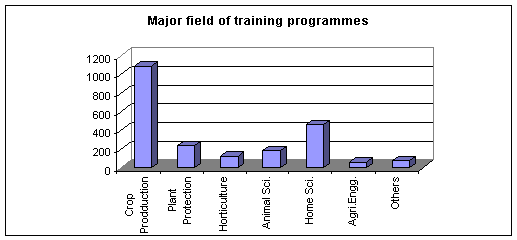
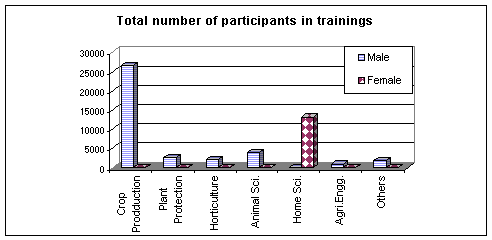
Training needs were identified by survey method, observing farmer’s methodology while working on the field and discussions with the farmers, farm women and youths.
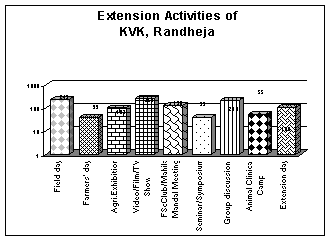
Extension Activities
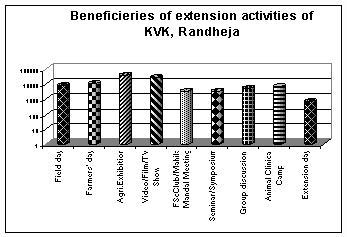
First Line Demonstrations:
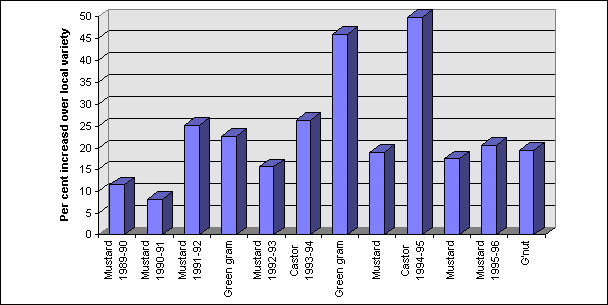
Per cent increased in yield of improved varieties over local variety
Impact:
KVK is organizing training programmes for farmers and carry out extension programme under Lab to Land and follow up.
In order to know, the effectiveness and adoption of practices discussed, demonstrated and experienced during training, an evaluative study was designed and carried out with special structural interview schedule administered to the purposively selected group of farmers (170). The farmers of 5 villages were informed through their leaders by post to attend evaluation session and follow up training. The results of the evaluation for 162 families turned up at the centre can be narrated as under:
N = 162
Numbers Percentage
1. Retention of knowledge(could received)Recollect details of training
a. Crop production 141 87
b. Plant protection #9; 60 37
c. Animal management #9; 24 15
2. Adopted as trained:
a. New varieties 149 92
b. Right use of fertilizer 135 83
c. Adequate plant protection measure 131 81
The quick study has brought out salient points of gainful impact of KVK which can be summarized as under :
Gain in their knowledge of technologies for Bajri, wheat, cotton, vegetable specially for new varieties and plant protection measures and agronomic practices.
New crops of castor and mustard were taken up in three villages after trainings and demonstrations.
Recurrent contact of KVK was beneficial and demanded.
Use of seed cum fertilizer drill by more than 40 farmers.
Ten farmers purchased cross bred cows and 25 started using balanced concentrate.
Effectiveness of training courses conducted on paddy crop
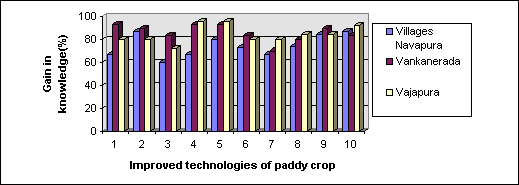
Technologies of paddy crop
1. Variety selection 6. Sowing distance
2. Seed treatment 7. Fertiliser application in seed bed
3. Preparing seed bed 8. Weed control
4. Sowing sprouted seed 9. Water management
5. Age of seedlings 10. Use of bio fertiliser in paddy field
Adoption of the improved technologies of paddy crop by farmers (per cent)
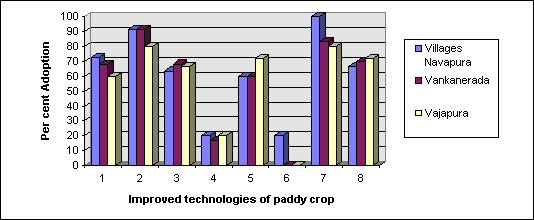
Improved technologies of paddy crop
1. Seed treatment with salt solution 5. Proper age of paddy seedling
2. Sowing of sprouted seeds 6. Transplanting paddy in line
3. Seed treatment with fungicide 7. Maintaining plant population
4. Treatment to paddy seedlings 8. Use of bio fertiliser in paddy field
SUCCESS STORIES:
1. Skill training can help increasing earnings
Shri Dineshkumar Dangi, a young tribal boy of Randheja village was one of the participants in the training on ‘Tractor driving and minor repairing’. He did not show any prominence in college education and failed in T.Y.B.A. Then he started working as a daily paid labour on farmers’ field. Before acquiring the skills of driving a tractor, he used to earn about Rs. 300/- per month. After successfully completing the training, he has been called for as tractor driver by a progressive farmer. Now Shri Dineshkumar is earning Rs. 1200/- per month. Thus, he has been able to raise his family income we can say above poverty line with the skills he learned in the training.
2. A small demonstration works well - Acceptance of variety ‘Kalinga’ by farmers.
Improved paddy variety Kalinga was sown on the demonstration farm of KVK, Randheja. Farmers of Vajapura village visited the farm and they were impressed by the paddy variety. A demonstration of this new variety was planned to be organised on the field of the one progressive farmer of Vajapura village. The variety was found superior in duration, water requirement, lodging, pests and diseases attack and in yield over local variety. Many farmers visited the demonstration field. During kharif 1996, the seeds spread over 13 villages on 24 farmers’ fields in 31 bigha land. In all 160.500 kg of ‘Kalinga’ seeds were sowed by the farmers.
3. Plantation on Bunds is also paying :
During 1990-91, KVK took initiative to convince the farmers to grow fruit crops and other plants on the bands of their farms. Special training programmes were also organised for the purpose. One of the trainee Mr.Shankarbhai Patel has planted 25 trees of Coirdia augustifolia during 1991-92. During 1995-96, he earned a net profit of almost Rs. 4,000.00 from the twenty survived plants.
4. A self employed rural youth can earn more :
Shri Jayeshkumar D. Patel a rural youth of Sonipur village has completed his M.Com. in 1994. He did not get job and decided to start something of his own. He contacted KVK, Randheja. He was guided for dairy farming and advise to approach SBI, Randheja to get loan for Dairy unit. He started Dairy unit For the first ten months the total milk yield was 29,100 lit. with total sales of Rs. 3,43,200/-. Deducting a total recurring expenses of Rs. 1,44,700/-, the available surplus comes to Rs. 1.98,500/-. If interest of the bank loan be deducted from this, the net receipts would come to Rs. 1,69,700/- for the ten months. This is a unique example of self employed rural youth.
5. A house wife can also earn - A case of biscuit production.
Mrs. Daxaben Pandya of Randheja village joined the training course on bakery product preparation during 1995. She was well trained on ‘Nankhatai, Coconut biscuit and Wheat flour biscuits. She started home scale production of these items. She earned a net margin of Rs. 25/- per kg. product. In a year she got Rs.12,500/- as a net profit from the Services for production as well as sale of biscuits. This provided good economic support to her family.