The Evolution of KVK
The Second Education Commission (1964-66), under the Chairmanship of Dr.D.S.Kothari has recommended the establishment of agricultural polytechnics for imparting vocational education in agriculture to school dropouts and other rural youths. The Planning Commission and Inter-Ministerial Committee during Fifth Plan (1973-78) considered the issue. As a follow-up action, the ICAR appointed a committee headed by Dr. Mohan Singh Mehta in 1973 for formulating the institutional design for vocational training in agriculture.
The committee suggested ICAR to start Krishi Vigyan Kendra throughout the country and enunciated the following basic concepts:
The Kendra will impart learning through work-experience and hence will be concerned with technical literacy, the acquisition of which does not necessarily require the ability to read and write as a pre-condition.
The Kendra will impart training to only those extension workers who are already employed or to the practicing farmers and fishermen. In other words, the Kendra will cater to the needs of those who are already employed or those who wish to be self-employed.
There will be no uniform syllabus for a Kendra. The syllabus and programme of each Kendra will be tailored to the felt needs, natural resources and the potential for agricultural growth in that particular area.
The Indian Council of Agricultural Research has established the first Krishi Vigyan Kendra (KVK) in Pondicherry in the year 1974. Nineteen KVKs were established till the end of the fifth five-year plan. In view of its growing utility and the demand, 70 KVKs were sanctioned during the sixth five-year plan (1980-85). During seventh five-year plan, 20 more KVKs were established. In 1991-92, the total number of KVKs went up to 183 when the council established 74 new KVKs. By the end of the year 1994, there were 261 Krishi Vigyan Kendra in the country.
The Concept of KVK
The development of agriculture mainly depends on the use of research information appropriately integrated as per suitable technologies. Improved agricultural technologies, even when sound as scientific standards, are of limited value if they are not adopted due to their inappropriateness to suit the agro-climatic area or socio-economic milieu in which the farmers operate. The extension per se refers to the field extension, which is the responsibility of the state development departments, but ICAR is involved in first line extension system called centre extension through State Agricultural Universities, ICAR Research Institutes and Voluntary Organizations.
During the period of establishment of KVKs, the training organisations functioning in rural areas were focussing much attention on transfer of new information, rather than new skills. This was primarily due to lack of skilled trainers and proper infrastructure facilities available with these organisations.
KVKs are innovative science-based institutions developed mainly to impart vocational training to the farmers and field level extension workers.
The prime goal of KVK is to impart training as per needs and requirements in agriculture and allied aspects to all farmers, farmwomen, farm youth and school dropouts in the villages. While designing the courses, the concept of farming system as well as real farm situations are taken into account, to ensure that the enterprises in which they are trained are commercially viable and profitable. Such vocational training helps them to sustain their earning in the rural areas through self-employment activities and make them economically self-reliant.
They are provided training not only in agriculture and allied vocations but also in other income generating activities that may supplement their family income during off-season.
Philosophy of KVK
The Krishi Vigyan Kendra is the grass-root level institution for transfer of technology and vocational training. It is designed for bridging the gap between the available technologies at one end and their application for increasing production on the other. The basic philosophy of the Kendra includes:
The prime goal should be accelerating agricultural and allied production through acquisition of vocational skills and application of appropriate technologies and inputs.
"Teaching and learning by doing" and "work experience" are the main principles of for imparting skill training.
The emphasis is on improving the socio-economic conditions of weaker sections of the society by generating income oriented self-employment opportunities to make them economically self-reliant.
The Krishi Vigyan Kendra is the activity center with strong training, demonstration and development base for bringing about sound and speedier technological revolution and production break-through in agriculture and allied fields with higher degree of sustainability.
Objectives of KVK
Planning and conducting survey of the operational area in order to prepare resource inventory with special reference to identifying the training needs of the farming community.
Planning and conducting production oriented, need based short and long duration training courses both on the campus as well as in the villages for various target groups with priority on the weaker and the poorer sections.
Developing and organising non-formal educational programmes by way of field days, farm visit, farmers fair, radio talk, literature, etc., as the follow-up information support to training courses.
Organising Farm Science Clubs, both in rural school and in villages in order to induce liking and interest in younger generation for scientific farming through supervised projects.
Developing and maintaining the instructional farm and demonstration units on scientific lines as they facilitates for providing work-experience to the trainees and also disseminating the latest technical know-how.
Providing practical training facilities of the Kendra to the teachers and the students of vocational agriculture of the higher secondary schools.
Imparting some general education to rural illiterates and school dropouts in order to make them not only good farmers but also better citizens.
Providing added training facilities in the areas for home making and nutrition education for rural community.
Gradually enlarging the training facilities to encompass other important areas such as home crafts, cottage industries, etc., in consistency with the requirements of the integrated rural development in collaboration with concerned organisations.
Implementing all such schemes of the ICAR and other related organisations that intend to strengthen the training programmes of the Kendra.
Mandate of KVK
Till the end of the 7th five-year plan, the major mandate of KVKs was only training function. Moreover, they also carry out a number of extension education activities to promote and speed up the process of adoption of agricultural technology.
With the beginning of the 8th five-year plan, other TOT Projects of the council were integrated with KVK. As such, the functional span of the KVK has been reviewed, revised and restructured. Now the mandate of KVK includes:
1. Conducting on-farm testing for identifying technologies in terms of location-specific sustainable land use system.
2. Organise short and long-term vocational training courses in agriculture and allied vocations for the farmers and rural youths with emphasis on "learning by doing" for higher production on farms and generating self-employment.
3. Organise front-line demonstrations on various crops to generate production data and feedback information.
4. Organise training to update the extension personnel with emerging advances in agricultural research on regular basis.
Thus, the earlier emphasis was on human resource development through training of the farmers and extension workers. With the changing scenario of agriculture, the mandates of the KVKs have been modified to make them more effective institutions for technology transfer as well as its integration.
Beginning and Growth of KVKs in Gujarat State
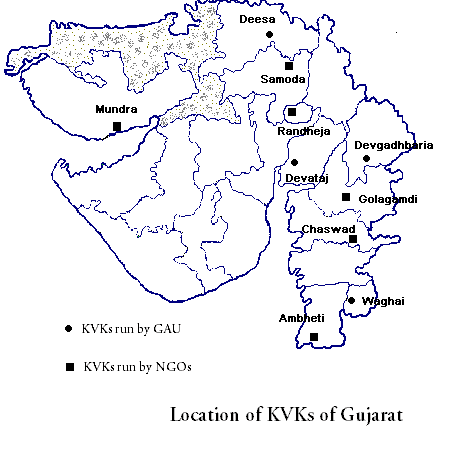
The first KVK was established by the ICAR in Pondichery in the year 1974. In Gujarat the ICAR has allotted first KVK to GAU on 22nd February,1976 at Deesa (Banaskantha). Subsequently, a KVK has also been allotted to NGO-Gujarat Vidyapith, Ahmedabad in the year 1977 at Gram Seva Kendra, Randheja (Gandhinagar). During the Sixth Five Year Plan two KVKs have been alloted to GAU. One was started on 1st January, 1983, at Devgadhbaria (Panchmahals) and another in December, 1983 at Waghai (Dangs).
One more KVK has been started during November 1985 by GAU at Devataj (Kheda). NGO-Saraswati Gram Vidyapeeth, Samoda, has started KVK during April 1991 at Samoda (Mehsana). During 8th FYP, four more KVKs have been alloted in the State. Of that, two were started during 1992. First by NGO-Gujarat Vidyapeeth, Ahmedabad, at Ambheti (Valsad); and another by NGO-Rural Agro Research and Development Society, Mundra at Mundra (Kachh). During 1994 NGO-BAIF, Pune has started a KVK at Chaswad (Bharuch). On 9th March 1995, the tenth KVK in the State was started by NGO-Mangal Bharti, at Golagamdi (Vadodara).
The growth of KVKs is depicted in Table-1.
Table 1: Growth of KVKs in India and Gujarat.
|
Sr.No. |
Period |
Number of KVKS |
|
|
India |
Gujarat |
||
|
1. |
Up to 5th plan (1975-76 to 1979-80) |
19 |
2 |
|
2. |
Up to 6th plan (1980-81 to 1984-85) |
70 |
2 |
|
3. |
Up to 7th plan (1985-86 to 1989-90) |
20 |
1 |
|
4. |
Annual Plan (1990-91 to 1991-92) |
74 |
- |
|
5. |
Up to 8th plan (1992-93 to 1997-98) |
78 * |
5 |
|
Total |
261 |
10 |
|
* Up to : 1995-96
The Scenario of the State Agricultural Situation
The Gujarat State with 1.96 lakh square kilometers of area has population of 341 lakhs. About 70% of the population are living in 18,574 villages. The Gujarat is organised in 24 districts with state capital at Gandhinagar.
The Gujarat is situated on the West Coast of India and lies between 200.1’ and 240.1’ North latitude. It is flanked by the Arabian sea on the west, the Gulf of Kutchh in the South-west, Pakistan in the North of the Rann of Kutchh, Rajasthan in the North, Madhya Pradesh in the North-East and Maharashtra in the South and South-East. It has a coastline of nearly 1290-km on the west.
Table 1: Agroclimatic zones of Gujarat State
|
Sr. No. |
Agroclimatic zone |
District |
Rainfall in mm. |
Climate |
Soil |
Name of KVK located in the zone |
|
1 |
South Gujarat Heavy rainfall |
Dangs, Bulsar |
1793 |
Sub-humid Semi arid |
Deep Black Coa-stal Alluvium |
Waghai Ambheti |
|
2 |
South Gujarat medium rainfall |
Surat, Bharuch |
974 |
-do- |
-do- |
- Chaswad |
|
3 |
Middle Gujarat |
Kheda, Panchmahals Vadodara |
904 |
Semi arid |
Medium black |
Devataj D’baria Golagamdi |
|
4 |
North Gujarat |
Banaskantha Ahmedabad, Gandhinagar, Mehsana, Sabarkantha, |
735 |
Arid Semi arid |
Gray Brown Coastal Alluvium |
Deesa - Randheja Samoda - |
|
5 |
North west |
Kutchh |
340 |
Arid |
Gray Brown Deltic Alluvium |
Mundra |
|
6 |
North Saurashtra |
Amreli, Bhavnagar, Jamnagar, Rajkot, Surendranagar |
537 |
Semi arid |
Medium black Calcareous |
- |
|
7 |
South Saurashtra |
Junagadh |
844 |
Dry, Sub Humid |
Medium black Coastal Alluvium |
- |
|
8 |
Bhal and Coastal |
Part of Ahmedabad, Bhavnagar, Kheda |
650 |
Semi arid Dry |
Medium black Coastal Saline |
- |
Gujarat from the viewpoint of physical features is divided into three regions viz.,
The main land plains extending from the Rann of Kutchh and the Aravalli hills in the north to the river Damanganga in the south,
The hilly peninsular region of Saurashtra and the rocky and sandy areas of Kutchh, and
The northeastern hill tract.
The main land is almost plain made up of alluvial soil and some sandy soil in the north. The Saurashtra region has an irregular high core. The low coastal strip covered with sand and alluvial unites with the high land fringe by a 75-m contour. The eastern hilly region is comprised of the districts of Panchmahals, Dangs, eastern part of Vadodara, Bharuch and Surat districts. The soils of Gujarat have wide spectrum ranging from desert soil to deep black soils.
There exists an earmarked variation in Agro-climatic conditions. The Gujarat is divided into eight agro-climatic zones. Important characteristics of these are given in Table No.1.
Table 2: Land Use Pattern in the Gujarat State
|
Sr.No. |
Type |
Area (%) |
|
1 |
Net Sown area |
38.50 |
|
2 |
Double cropped |
13.50 |
|
3 |
Total cropped area |
52.00 |
|
4 |
Culturable waste land |
10.30 |
|
5 |
Area under forest |
10.00 |
|
6 |
Non-Agril. use |
05.80 |
|
7 |
Current & cultivable fallow |
16.50 |
|
8 |
Permanent pasture and grazing |
04.60 |
|
9 |
Miscellaneous |
00.80 |
|
Total Geographical Area |
1,95,98,000 ha. |
|
About 52 per cent geographical area is under crops. About 16.50 per cent area is cultivable fallow and 10.30 per cent area is cultivable wasteland that needs to be exploited for intensive crop production. The area under irrigation in Gujarat is nearly 22 per cent mainly by wells (78.4%) and by canals (19.5%).
The cropped area is equally put under total food grains and cash crop like oilseeds, fiber crops, etc. Pearl millet, sorghum, maize and rice are the principal cereals, whereas pigeonpea and gram are the main pulses cultivated in the State. Other pulses like green gram, black gram, etc., are cultivated as inter/mixed crops. Groundnut is the main oilseed crop grown in north and south Saurashtra agro-climatic zones. Rapeseed, mustard and cotton are grown in sizable area and confined to North Gujarat and Saurashtra region. The detailed distribution of cropped area in the state is depicted in the Figure No.1.
About 75 per cent of the net sown area are rainfed, which makes agriculture unsustainable and uncertain. The North Gujarat and Saurashtra occupy of the 75 per cent area in the State, which needs immediate attention for rainwater management especially through in-situ moisture conservation. Judicious use of ground water resource is required due to constantly decreasing under ground water level. Horticulture and agro-forestry may be encouraged for efficient land use. The wasteland development will help in reducing burden on cultivable land. The middle and south Gujarat have better canal irrigation. However, they have problem of water lodging which require attention because it is also posing salinity.
Average land holding of farmers of the State comes to 3.17 ha. Majorities of the farmers are marginal (26%), small (26%) and medium (44%) farmers. These categories of farmers are holding 83.51 per cent of available cultivable land for agriculture purpose.
The farmers in Gujarat resort to Animal Husbandry for supplementary income. The mixed farming is the common feature through out Gujarat. In 1994-95, Gujarat is producing annually 44.59 lakhs tones of milk, 4682 lakhs of eggs and 23.01 lakhs kg of wool. The dairy cooperative movement, which was first initiated in the state, has provided developmental and milk marketing network for all categories of farmers.
Thus, the agricultural scenario of the state clearly shows the necessity of KVKs in each of the district in the state. As such, only 10 KVKs have been sanctioned in the state by the ICAR as against the policy of the ICAR of establishing atleast one KVK in each of the districts.