Year of Establishment 1983
Thrust area
1. Dissemination of knowledge and management skill of improved technology of water management, fertilizer use and plant protection measures in cereal and pulse crop.
2. Popularization of management skill for rearing milch animals for increasing their productivity.
3. To promote fruits and vegetables cultivation.
4. To train farmers for establishment of nursery for fruits, vegetables and forest plants.
5. To promote kitchen gardening.
6. Introductions of new crops like castor.
7. Popularization of improved handtools / implements in the operational area.
8. Improvement of socio-economic status of tribal people through poultry farming.
9. Upliftment of socio-economic status of women by imparting vocational training for employment generating.
Agro-ecological Situation of the District
· Total geographical area is 8866 sq. km.
· Average rainfall is 800 to 900 mm with average 36 rainy days.
· Total population 29.6 lakhs.
· Total population of Scheduled Tribe is 9,69,523.
· Literacy rate: Male 40.79 per cent and Female 14.85 per cent.
· Area under forest is 2,24,262 hectare.
· Total cultivated land is 5,06,112 ha.
· Total irrigated land is 69,525 ha. (14.93 per cent of cultivated land).
· Area (lakh ha.) under major crops: Paddy (11.18), Maize (16.45), Pigeonpea (3.62), Black Gram (2.29), Wheat (4.30), Gram (4.05), Groundnut (1.59).
· Major animal population: Deshi cattle (8.68 lakh), Cross breed cattle (0.03 lakh), Buffaloes (12.49 lakh), Sheep (0.12 lakh) and Goat (5.49 lakh).
Activities and Achievements
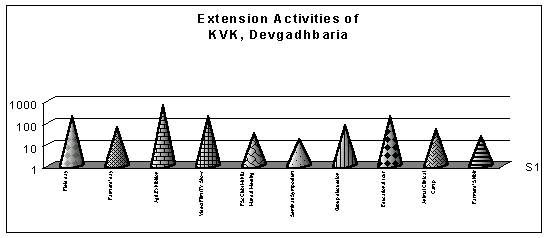
D. Extension Activities

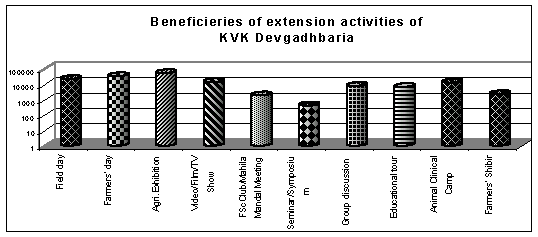
1. Change in cropping pattern:
Farmers have started to grow maize with improved varieties like Farm Sameri, Ganga Sefed-2, and Gujarat Makai-1. In some of pockets where irrigation water is available, cultivation of Rabi Maize has also been started. Similarly, area under gram and wheat has also increased wherever irrigation facility was available.
Areas under vegetables like ginger, garlic, onion, chillies, etc; is increasing. Fruit crops like ber, custard apple, watermelon, muskmelon and guava has been introduced. Summer groundnut cultivation has also been introduced in the command area of Kadana dam.
2. Change in productivity:
(a) Cereal crops:
Yield of maize, paddy and wheat has increased on the fields of trained farmers as compared to average yield of the district. This may be due to adoption of improved varieties and low cost technologies like time of sowing, spacing, soil and water management, critical irrigation, soil and water conservation techniques, etc.
(b) Pulse crops:
Awareness about improved varieties, better land management, proper time of sowing, moisture conservation, use of bacterial cultures and FYM has been created through Front line demonstrations, which helped in increasing productivity of these crops. The increase in production due to FLD is about 23, 18 and 21 per cent in green gram, moth bean and gram respectively.
(c) Oilseed crops:
Because of increase in irrigation facilities in some pockets and demonstrations on groundnut and mustard has promoted the farmers to introduce these crops in the area. About 23 per cent yield has been increased due to front line demonstration in mustard crop.
(d) Vegetables:
Farmers have now started to grow Zinger, Garlic, hybrid Tomato, Chillies, Turmeric, Yam, Brinjal etc. due to post training KVK activities. Now area under hybrid tomato is increasing slowly day by day due awareness of more yield and income
3. Use of fertilizers/ Bio-fertilizers :
Due to realisation of importance of FYM as ideal organic manure to supply nutrients slowly as required by the plant and a good soil moisture conserving material, they have started to apply FYM in their soils as much as available. Rhizobium cultures are also using by the farmers for their pulse crops. Farmers have increased the use of N fertilizers in maize and paddy. After training the farmers have learnt the importance of balanced nutrition and fertilizers in some of the crops.
4. Use of HYV:
Training and demonstrations realised the importance of improved varieties. Now they are using varieties like Farm Sammeri, GS-2, G.Makai-1 for maize, GR-11 and GR-4 for Paddy. Dahod yellow and ICCC-4 for Gram, Zandewal T-9 for Udid and T-15-15 for Arhar.
5. Overall :
Training to the farmers created confidence among them to go for improved varieties and recommended package of practices for major crops. Symultaneously the farmers have diverted towards growing of arid fruits in waste land and fallow land. Cultivation of vegetables in the kitchen garden and as regular crop such as zinger, garlic, onion , chillies and clusterbnean has also got momentum.
6. Employment generation :
Due to imparting the training on poultry farming for fifteen days period, 33 per cent of the total participants have established their own small unit of poultry.
7. Adoption of Scientific poultry enterprise
Table : Impact of Training Programme (from 12-3-96 to 26-3-96) on Scientific Management of Poultry birds.
|
Sr.No. |
Name of specific technology |
Technology adopted (No.of trainees) |
Extent of adoption (percent) |
|
1. |
Scientific housing |
9 out of 33 |
27.2 |
|
2. |
Improved breed |
9 out of 33 |
27.2 |
|
3. |
Scientifically management and feeding |
9 out of 33 |
27.2 |
|
4. |
Av. strength of the farm |
100 to 500 birds |
|
|
5. |
Family income increase (Rs. per month) |
Rs. 200 to 900 |
|
Front Line Demonstrations:
Per cent increased in Yield of the improved varieties over local varieties

Success story
1. A twenty four years old Ranjitsinh Motisinh Baria is educated upto fifth standard. He possess six acre of land with a responsibility of 8 family members. He did not maintain economically his family. Being a tribal, he used to cultivate deshi maize. He joined crop production training in KVK, Devgadhbaria in 1993. After being trained he changed his cropping system and starting cultivated hybrid maize, improved tur variety etc. He was then also imparted training on cultivation of hybrid tomato through telephonic method. He was guided full set of hybrid tomato cultivation. He was earning rupees 5 to 6 thousand in a year before training, but now he is earning 10 to 12 thousand rupees per year. He is continuously improving his family income.
2. Chauhan Chaturbhai Hirabhai of village Rabari Taluka-Devgadhbaria resides on his own 1.60 ha. land, which is very near from natural spring. He started Dimond business about 20 yrs. ago. Due to industrial sickness, he returned back to his village and started farming. Traditional farming of maize did not meet his family expenditure. He contacted KVK, Devgadhbaria on dt. 6-6-1997 and expressed his willingness to join on campus training programme on package of practices of vegetables commenced from 15-7-97 to 17-7-97. He was imparted knowledge about latest agricultural technologies, which infect he puts in his cultivation practices. He changed his cropping pattern and started growing vegetables in kharif and rabi. He cultivated groundnut crop in summer which has solve the problem of fodder too.
Due to change in cropping pattern, he earned net profit of Rs. 17,400 per annum against Rs. 6900 per annum from his 1.60 ha. land. Now, Chaturbhai is became innovative farmer of this KVK. He also guiding other relatives and villagers to change the traditional cropping pattern to earn more.
Case study:
1. Name : Ramabhai Mansukhbhai Baria
2. Village : Umedpura, Bhagat fariu
3. Taluka & district : Ta-Limkheda, Dist. Dahod.
4. Year of Training : 1995
5. Size of land holding(ha.) : 3.55
6. Net income before training in KVK : Rs. 40,000/-
7. Area under vegetable/fruits/cash crops: Before training Nil…
8. Area under improved varieties : Nil..
9. Area under vegetables, fruits/cash crops after training (ha.) : 1.00
10. Area under improved varieties : 2.55 ha.
1. Area under multiple cropping before training : 1.00 ha.
2. Area under multiple cropping after training : 3.55
3. Net income : Rs. 75,000/-
4. Net income increase after training : Rs. 35,000/-
Case No. II
1. Name : Aamaliyar Chetanbhai Delsinh
2. Village : Galaliawad, Dahod
3. Taluka & District : Dahod
4. Year of training : 1996
5. Size of poultry farm holding : 400 birds
6. Income before training in KVK : Rs. 30,000/- per annum
7. Income after training in KVK : Rs. 45,000/-