KVK , Devataj
YEAR OF ESTABLISHMENT
1985THRUST AREA
Reclamation of problematic soil & irrigation water management.
Low average crop productivity of major crops like paddy, bajara in kharif and wheat, mustard, rustica tobacco and gram in rabi.
Low average milk production of buffalow and cow.
Low area under horticultural crops.
Poor socio-economic status of farm women.
DISTRICT PROFILE (1995-96)
Total geographical area is 7194 sq. km.
Average rainfall is 770 mm. with average 35 rainy days.
Total population 34 lakhs.
Literacy rate in Male- 80.49 % and Female- 49.93%.
Net cultivated land 5,11,410 hectare.
Total irrigated land 2,44,000 hectare (46.54 per cent of cultivated land).
Area (lakh ha.) under major crops: Paddy (2.45), Pearl millet (1.05), Tobacco (0.75), Wheat (0.74), Mustard (0.30), and castor (0.21) Banana (0.17).
Major animal population: Deshi cattle (2.71 lakh), Buffalows (6.48 lakh), Goat (0.94 lakh), Crossbreed cattle (0.38 lakh) and poultry birds (8.06 lakh).
SALIENT ACTIVITIES AND ACHIEVEMENTS
A. Training
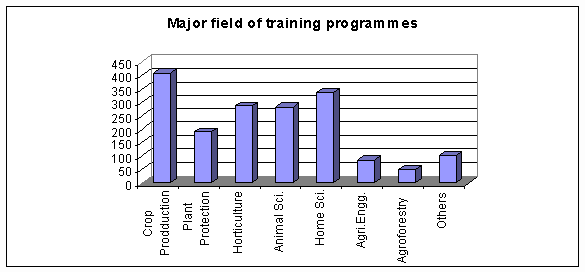
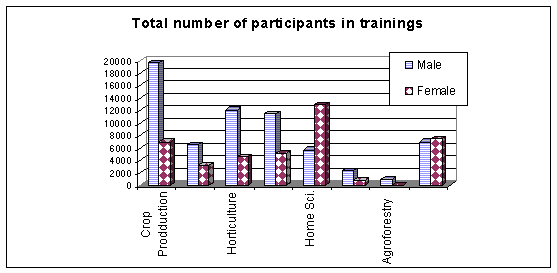
During the year 1985-86 to 1995-96, total 1492 training courses were conducted. Total 61933 males and 39581 females were participated. Training programmes were formulated as per needs of the farmers after the survey work.
Over and above training related to crop production, skill oriented training of softwood grafting in mango, eye budding in anola and ber and Nutan grafting in sapota were successfully imparted. Fisheries’ training has given momentum for establishing fisheries co-operative societies in the district. The training in sewing cum patchwork and tailoring led many trainees to be self-employed.
B. Demonstrations on farmers’ field
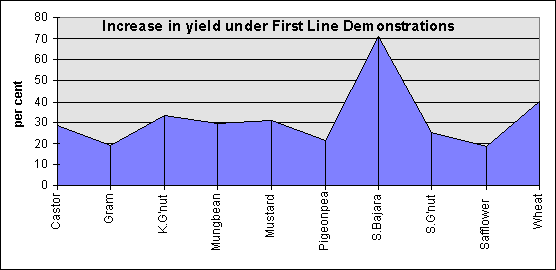
The First Line Demonstrations organised by the KVK shown good hike in the yield of the demonstration plots. The increase in yield ranges from lowest of 20 per cent in gram to 72 per cent in Bajra. These FLDs created confidence amongst the farmers about the potentiality of the crop production technologies.
Extension Activities
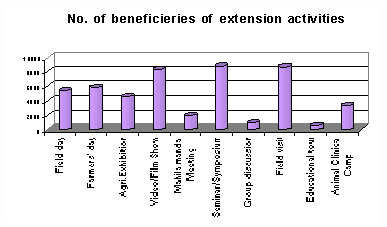
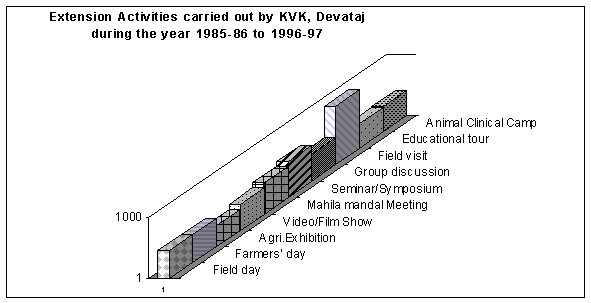
The KVK has also undertaken various extension activities like field day, farmers’ meeting, farmers’ day, exhibition, field visit, animal clinical camp, etc. The details of activities undertaken and the beneficiaries thereof are depicted in figure.
Impact
A: Adoption of paddy technologies
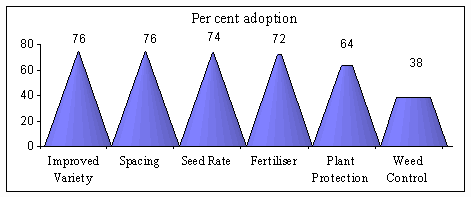
A study was undertaken to learn impact of training on adoption of various paddy production technologies. Technology viz., variety, spacing, seed rate and fertilizer were adopted by more than 70 per cent of the respondents.
B: Adoption of wheat technologies
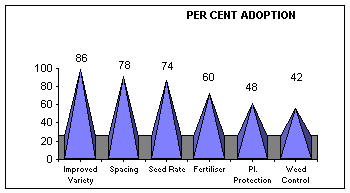
The study undertaken to learn the impact of training on wheat production technologies revealed that improved variety was adopted by 86 per cent of the trainees, whereas spacing and seed rate were adopted by almost 75 per cent of the trainees.
C: Adoption of mustard technologies
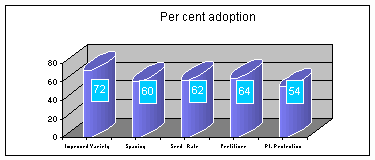
The results of the study revealed that more than 60 per cent trainees have adopted spacing, seed rate and fertilizer. As a result of training, almost 72 per cent trainees have adopted improved variety of mustard.
D: Adoption of livestock production technologies
Table: 1. Impact of training programme on scientific care and management of milch animals, (Cross breed cow and bufallow)
|
Technology Adoption (No. of Trainees) |
Extent of adoption (per cent) |
||||
|
Cow |
Bufallow |
Cow |
Bufallow |
||
|
1. |
Scientific housing |
23 |
20 |
76.66 |
66.66 |
|
2. |
Concentrate feeding |
27 |
25 |
90.00 |
83.33 |
|
3. |
Milking, watering, A. I. and vaccination |
28 |
28 |
93.33 |
93.33 |
|
4. |
Pre and post partum scientific case |
29 |
26 |
96.66 |
86.66 |
While, the milk production technologies related to cow have been adopted by more than 76 per cent of trainees, the net increase in income was 16.60 per cent (from Rs.10, 800 to Rs.12, 600). There were more than 66 per cent of the trainees who have adopted buffalow milk production technologies; the increase in their net income was to the tune of 13.75 per cent (from Rs.7, 850 to Rs.8, 930 per annum).
E: Impact of Home Science training
Since 1989, the KVK is organising six months vocational training in sewing-cum-patch work. The ultimate goal is to develop skill of trainees, so as they can earn while utilizing their leisure time. A study was take-up in 1995-96 covering 50 trainees.
There were 20 per cent trainees who were getting between Rs.300 to Rs.400 per month by undergoing the work on the basis of the skills they have received during training.
Further, out of them, 20 per cent women have their own machine. While, remaining 80 per cent of them have applied for bank loan for purchase of sewing machine through DRDA.
F: Gain in knowledge due to training
A study was carried out in four villages of Petlad taluka. Randomly 80 trained and 40 untrained farmers were selected. Seven improved practices of paddy and wheat crops were selected to know the knowledge level of the respondents. A teacher made test, modified to suit the local conditions was used to measure the knowledge level of the respondents. The results of the study are given in Table 2 and 3.
Table: 2. Distribution of respondents according to their level of knowledge of 9; 9; 9; recommended practices of paddy.
|
Category of farmers |
|||||
|
Trained (N=80) |
Untrained (40) |
||||
|
No. |
Percent |
No. |
Percent |
||
|
Low (0-33 score) |
10 |
12.50 |
15 |
37.50 |
|
|
Medium (34-66 Score) |
52 |
65.00 |
39 |
47.50 |
|
|
High (67-100 Score) |
18 |
22.50 |
6 |
15.00 |
|
|
Mean X |
55.71 |
50.94 |
|||
|
Variance S |
85.19 |
92.16 |
|||
‘t’ = 2.633
The data presented in table-2 reflect that calculated ‘t’ value is significant at 5 per cent level of probability. Which revealed that there is significant difference between the trained and untrained farmers in respect of their knowledge level of practices of paddy. Thus, it could be concluded that training programme played an important role in increasing their level of knowledge of seven improved practices of paddy.
Table: 3. Distribution of respondents according to their level of knowledge of recommended practices of wheat.
|
Category of farmers |
||||
|
Trained (N=80) |
Untrained (N=40) |
|||
|
No |
Percent |
No |
Percent |
|
|
Low (0-33 Score) |
18 |
22.50 |
20 |
50.00 |
|
Medium (34-66 Score) |
52` |
65.00 |
15 |
37.50 |
|
High (67-100 Score) |
10 |
12.50 |
5 |
12.50 |
|
Mean X |
53.88 |
48.31 |
||
|
Variance S |
76.87 |
114.27 |
||
‘t’ 2.88
The data of table –3 clearly showed that there is a significant difference between the trained and untrained farmers This indicate that training played an important role in increasing their level of knowledge of wheat cultivation technology.
Success stories
A Widow self employed through patchwork
Mrs. Gitaben Rameshbhai Patel had lost her spouse at an young age of 22 year. She was having with limited income from agriculture and milch buffalow with a responsibility of two children. To meet the financial requirements of her family, she contacted KVK, Devataj for guidance so as which enterprise she should start with. She was motivated for starting sewing & patchwork and subsequently she was enrolled for six months training programme for sewing & patchwork at KVK Devataj. The KVK also helped her getting sewing machine from IRDP under subsidy programme.
After completion of farming, she started doing job work of sewing and patchwork. Initially, she could earn Rs.100 to Rs.150 per month. Now she is earning Rs.350 to Rs.500 per month as an additional income. Her expertise and enthusiasm gave her popularity not only in nearby villages but also in Jaipur. Foreign customers are also visiting to buy patch worked bed sheet of Geetaben.
Dairy Farming - A Prosperous Rural Enterprise
Shri Chandrakantbhai, a commerce graduate, is having eight acres of land in Palej village, which is 10 km. away from KVK, Devataj. Salinity and water logging conditions restrict the farm income. Being an educated and enthusiastic young man, he thought to start a dairy farm. He joined the short term training on dairy farming at KVK, Devataj in 1992. This helped him in developing self-confidence.
His family owed two buffalows, to which he added four more. As a result of due advice and help from the KVK, he could get loan from bank, from which he added six more buffalows to his herd.
In the first year i.e. 1993-94, he earned gross income Rs.99, 000. He purchased three more buffalows in the year 1993-94. In the second year i.e. 1994-95 he earned Rs.2.5 lakhs. He added seven more milch animals to his dairy farm from this income. Next year, he built up cattle shed. During this time, he regularly visited KVK, Devataj for his day to day problems. The KVK has guided on the balanced ration, techniques of Urea treatment, animal health care, silage making, dairy management, etc.
By now he has repaid all bank loans and possesses a good herd of 17 milch animals including two cross breed cows. His annual milk production is 25,500 liters, whereby earning a net profit of Rs.1.5 lakhs per year from this enterprise.
A will will find a way
Shri Suryankantbhai C. Vyas of village Kamala (Dabhan) of Nadiad taluka, suffered from paralysis in 1994. Being handicapped at the age of 45, another attack in 1996 required longer treatment. In such a disease one does not loose confidence but also looses his sizable savings. He being the only earning person in his family was very nervous about his family income.
A small report in a daily newspaper about celebration of ‘Women in Agriculture Day’ by KVK, Devataj on 4th December 1995, enlightened his thinking. In this women day, Aonla and its uses were also taught. Emphasis was given on technology on Anola production, its medicinal value and processing. Mr. Vyas got a hope for earning through such products. He thought that he could use his own few Aonla trees grown in his varandah. He started correspondence with KVK, Devataj and showed his willingness to learn about Aonla uses. Considering his illness, Training Associate (Home Science), KVK, Devataj visited his home and taught usage of Aonla, ber and other fruits.
Mr. Vyas now started selling ber, pickles, juice, aonla items and buttermilk at his home and started earning Rs. 30-40 per day. Later, he has also acquired training to make Aonla candy. Now, he is earning Rs. 1500/- to 1800/- per month. He is very happy that even being a handicapped, he managed to give stability to economy of his family.
CASE STUDIES
HORTICULTURE / AGROFORESTRY
CASE NO. 1
1. Name Jadav Valubhai Alubhai
2. Village Tarakpur
3. Taluka & District Ta-Khambat, Dist-Kheda
4. Year of training 1995
5. Size of land holding (ha) 2.02 ha.
6. Income before training in KVK Rs.7, 000.00
7. Area under Ber cultivation before training Nil
8. Area under Ber cultivation after training 0.25
9. No. of budded plants planted 70
10. Successful plants 56
11. Total Expenditure Rs.660.00
(Cost of plant, planting & others inputs of one year)
12. Total Sales Rs.6, 160.00
13. Net income Rs.5, 500.00
14. Income from other agricultural activities Rs.7, 000.00
15. Total annual income Rs.12, 500.00
CASE NO. 2
1. Name Jadav Laljibhai Gobarbhai
2. Village Tarakpur
3. Taluka & District Ta-Khambhat, Dist. Kheda
4. Year of training 1995
5. Size of land holding (ha) 2.00 ha.
6. Income before training in KVK Rs.6, 500.00
7. Area under Ber cultivation before training Nil
8. Area under Ber cultivation after training 0.25 ha.
9. No. of budded plants planted 70
10. Successful plants 57
11. Total Expenditure Rs.650.00 (Cost of plant, planting, others inputs of one year)
12. Total Sales Rs.5, 575.00
13. Net income Rs.4, 925.00
14. Income from other agricultural activities Rs.6, 500.00
15. Total annual income Rs.11, 425.00
CASE NO. 3
1. Name Dabhai Popatbhai Kalubhai
2. Village Tarakpur
3. Taluka & District Ta-Khambhat, Dist.-Kheda
4. Year of training 1995
5. Size of land holding (ha) 6.14 ha.
6. Income before training in KVK Rs.13, 500.00
7. Area under Ber cultivation before training Nil
8. Area under Ber cultivation after training 0.20 ha.
9. No. of budded plants planted 50
10. Successful plants 41
11. Total Expenditure Rs.415.00 (Cost of plant, planting, & others inputs of one year)
12. Total Sales Rs.3, 690.00
13. Net income Rs.3, 275.00
14. Income from other agricultural activities Rs.13, 500.00
15. Total annual income Rs.16, 775.00
CASE NO. 4
1. Name Dabhai Ramubhai Rahubhai
2. Village Tarakpur
3. Taluka & District Ta-Khambhat, Dist.-Kheda
4. Year of training 1995
5. Size of land holding (ha) 2.00 ha.
6. Income before training in KVK Rs.7, 500.00
7. Area under Ber cultivation before training Nil
8. Area under Ber cultivation after training 0.25 ha.
9. No. of budded plants planted 70
10. Successful plants 60
11. Total Expenditure Rs.1, 020.00 (Cost of plant, planting, & others inputs of one year)
12. Total Sales Rs.8, 850.00
13. Net income Rs.7, 830.00
14. Income from other agricultural activities Rs.7, 500.00
15. Total annual income Rs.15, 330.00
CASE NO. 5
1. Name Dabhai Niginbhai Valabhai
2. Village Tarakpur
3. Taluka & District Ta-Khambhat, Dist.-Kheda
4. Year of training 1995
5. Size of land holding (ha) 2.82 ha.
6. Income before training in KVK Rs.11, 250.00
7. Area under Ber cultivation before training Nil
8. Area under Ber cultivation after training 0.25 ha.
9. No. of budded plants planted 70
10. Successful plants 56
11. Total Expenditure Rs.690.00 (Cost of plant, planting, & others inputs of one year)
12. Total Sales Rs.2, 688.00
13. Net income Rs.1, 998.00
14. Income from other agricultural activities Rs.11, 250.00
15. Total annual income Rs.13, 248.00
CASE NO. 6
1. Name Dabhi Bhailalbhai Veersinghbhai
2. Village Tarakpur
3. Taluka & District Ta-Khambhat, Dist. Kheda
4. Year of training 1995
5. Size of land holding (ha) 2.85 ha
6. Income before training in KVK Rs.10, 500.00
7. Area under Ber cultivation before training Nil
8. Area under Ber cultivation after training 0.25 ha.
9. No. of budded plants planted 70
10. Successful plants 42
11. Total Expenditure Rs.510.00 (Cost of plant, planting, & others inputs of one year)
12. Total Sales Rs.4, 032.00
13. Net income Rs.3, 522.00
14. Income from other agricultural activities Rs.10, 500.00
15. Total annual income Rs.14, 022.00
CASE NO. 7
1. Name Dabhi Dhurabhai Kalubhai
2. Village Tarakpur
3. Taluka & District Ta-Khambhat, Dist.-Kheda
4. Year of training 1995
5. Size of land holding (ha) 6.14 ha.
6. Income before training in KVK Rs.16, 100.00
7. Area under Ber cultivation before training Nil
8. Area under Ber cultivation after training 0.25 ha.
9. No. of budded plants planted 70
10. Successful plants 51
11. Total Expenditure Rs.918.00 (Cost of plant, planting, & others inputs of one year)
12. Total Sales Rs.6, 426.00
13. Net income Rs.5, 411.00
14. Income from other agricultural activities Rs.16, 100.00
15. Total annual income Rs.21, 511.00
CASE NO. 8
1. Name Chauhan Vaghjibhai Chaturbhai
2. Village Tarakpur
3. Taluka & District Ta-Khambhat, Dist.-Kheda
4. Year of training 1995
5. Size of land holding (ha) 2.43 ha.
6. Income before training in KVK Rs.11, 050.00
7. Area under Ber cultivation before training Nil
8. Area under Ber cultivation after training 0.25 ha.
9. No. of budded plants planted 70
10. Successful plants 68
11. Total Expenditure Rs.930.00 (Cost of plant, planting, & others inputs of one year)
12. Total Sales Rs.5, 610.00
13. Net income Rs.4, 590.00
14. Income from other agricultural activities Rs.11, 050.00
15. Total annual income Rs.15, 640.00
CASE NO. 9
1. Name Chauhan Kavabhai Pitamberbhai
2. Village Tarakpur
3. Taluka & District Ta-Khambhat, Dist.-Kheda
4. Year of training 1995
5. Size of land holding (ha) 2.53 ha.
6. Income before training in KVK Rs.12, 200.00
7. Area under Ber cultivation before training Nil
8. Area under Ber cultivation after training 0.25 ha.
9. No. of budded plants planted 70
10. Successful plants 62
11. Total Expenditure Rs.780.00 (Cost of plant, planting, & others inputs of one year)
12. Total Sales Rs.4, 464.00
13. Net income Rs.3, 684.00
14. Income from other agricultural activities Rs.12, 200.00
15. Total annual income Rs.15, 884-00
HOME SCIENCE
CASE NO. 1
1. Name Patel Puspaben Kanubhai
2. Village Limbali
3. Taluka & district Ta-Petlad, Dist.-Kheda
4. Year of training 1994
5. Income from sewing before training Nil
6. Year of purchase & Cost of Sewing machine 1995 - Rs.4, 500.00 with motor
7. Annual supplementary income from sewing Rs.3, 600.00
CASE NO. 2
1. Name Patel Sudhaben Bhupendrabhai
2. Village Devataj
3. Taluka & district Ta-Petlad, Dist.-Kheda
4. Year of training 1995
5. Income from sewing before training Nil
6. Year of purchase & Cost of Sewing machine 1995 - Rs.1, 100.00 + subsidy
7. Annual supplementary income from sewing Rs.3, 600.00
CASE NO. 3
1. Name Patel Geetaben Rameshbhai
2. Village Devataj
3. Taluka & district Ta-Petlad, Dist.-Kheda
4. Year of training 1995
5. Income from sewing before training Nil
6. Year of purchase & Cost of Sewing machine 1995 - Rs.1, 100.00 + subsidy
7. Annual supplementary income from sewing Rs.6, 000.00
CASE NO. 4
1. Name Nashimben Allisha Fakir
2. Village Sojitra
3. Taluka & district Ta-Petlad, Dist.-Kheda
4. Year of training 1995
5. Income from sewing before training Nil
6. Year of purchase & Cost of Sewing machine 1995 - Rs.1, 100.00 + subsidy
7. Annual Supplementary income from sewing Rs.2, 400.00
CASE NO. 5
1. Name Nasimbanu Gulabanabi Khalifa
2. Village Sojitra
3. Taluka & district Ta-Petlad, Dist.-Kheda
4. Year of training 1993
5. Income from sewing before training Nil
6. Year of purchase & Cost of Sewing machine -
7. Annual supplementary income from sewing Rs.1, 200.00
PATCHWORK
CASE NO. 1
1. Name Sudhaben Kanubhai Patel
2. Village Devataj
3. Taluka & District Ta-Petlad, Dist.-Kheda
4. Year of training 1990
5. Income from patch work before training Nil
6. Subsidiary income through patch work Rs.150.00 per month
7. Increase in subsidiary income Rs.1, 800.00 per year
CASE NO. 2
1. Name Geetaben Rameshbhai Patel
2. Village Devataj
3. Taluka & District Ta-Petlad, Dist.-Kheda
4. Year of training 1990
5. Income from patch work before training Nil
6. Subsidiary income through patch work Rs.400.00 per month
7. Increase in subsidiary income Rs.4, 800.00 per year
CASE NO. 3
1. Name Sudhaben Arjunbhai Patel
2. Village Devataj
3. Taluka & District Ta-Petlad, Dist.-Kheda
4. Year of training 1992
5. Income from patch work before training Nil
6. Subsidiary income through patch work Rs.200.00 per month
7. Increase in subsidiary income Rs.800.00 per year
CASE NO. 4
1. Name Ilaben Pravinbhai Patel
2. Village Devataj
3. Taluka & District Ta-Petlad, Dist.-Kheda
4. Year of training 1990
5. Income from patch work before training Nil
6. Subsidiary income through patch work Rs.250.00 per month
7. Increase in subsidiary income Rs.3, 000.00 per year
CASE NO. 5
1. Name Jyotsanaben Vinubhai Patel
2. Village Devataj
3. Taluka & District Ta-Petlad, Dist.-Kheda
4. Year of training 1994
5. Income from patch work before training Nil
6. Subsidiary income through patch work Rs.150.00 per month
7. Increase in subsidiary income Rs.1, 800.00 per year