KVK, Deesa
Year of Establishment
1976Thrust area
To increase productivity of major crops of the operational area namely, castor, mustard, wheat, potato, green gram, sorghum, etc., by motivating the farmers to adopt recommended production technology.
To increase the productivity of milch animals by adoption of modern technologies of breeding, feeding, management and health care.
To motivate the farmers to go for arid horticulture crops like ber, pomegranate, custard apple, lemon, sapota, guava, etc.
To disseminate technologies related to water management especially water saving technology by (a) irrigation at critical stages of the crop and (b) drip irrigation system particularly in horticultural crops.
Promoting agro-forestry in tribal pockets.
Employment generation for women through skill oriented income generating activities such as sewing, preparation of bakery products, and fruits and vegetable preservation.
Employment generation for youth through skill oriented income generating activity such as maintenance and repairs of tractors, pump-set, plant protection appliances, etc., raising nurseries for agro-forestry plants, and grafting and budding of horticultural crops.
District Profile (1995-96)
Total geographical area is 12.33 lac ha.
Average rainfall is 450-500 mm with average 25 to 30 rainy days.
Land holding pattern - Big farmers (69%), Small farmers (19%) and marginal farmers (12%).
Major crops are pearlmillet (3.04 lac ha.), Mustard (1.52 lac ha.), Kharif Jowar (1.25 lac ha.), Castor (0.96 lac ha.), Wheat (0.54 lac ha.), Pulses (0.5 lac ha.), Cumin (0.52 lac ha.) and Potato (0.12 lac ha.).
Major animals are Buffalo, Indian cattle, crossbreed, goat, sheep etc.
Milk production approx. 1300 lac kg. Dairy sector is improving day by day.
Net irrigated area varies from 2 to 90 per cent in vav and vadgam talukas respectively.
Achievements
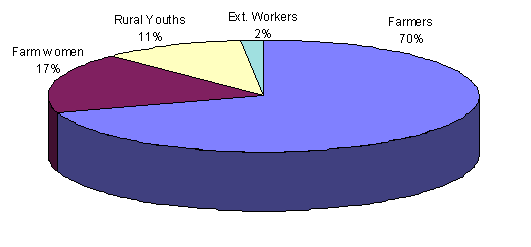
Out of total 1416 training courses, 1377 training corses for practising farmers/farm women, 9 training courses for rural youth and school dropout and 30 training courses for extension workers has been conducted by KVK, Deesa and nearly fifty thousands trainees were trained during the year 1976 to 1995.
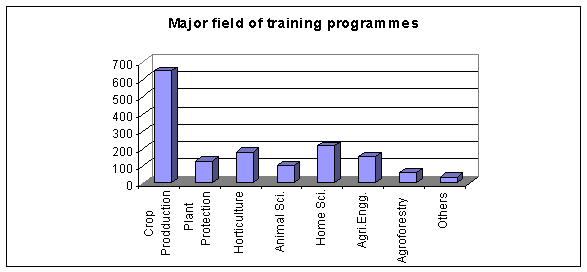
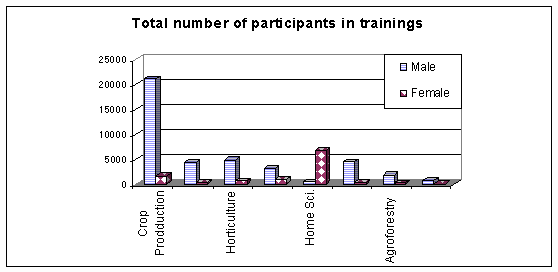
Details of different groups of the total trainees:
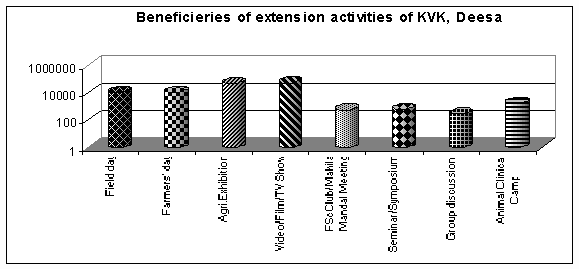
C. Extension Activities
Impact studies
Adoption of white grub control technology
KVK, Deesa has conducted block demonstrations in the year 1990-91, to 1994-95 in different villages of Danta and Vadgam talukas to demonstrate the groundnut growers the technology for whitegrub control. To know the extent of adoption of the technology by the farmers; a study was conducted.
The present investigation was carried out in the Major Kharif Groundnut growing areas of two talukas i.e. Danta and Vadgam during the year 1994-95. Among these talukas only three villages from Danta and two villages from Vadgam were selected for this study. The date were collected by personal contact of 80 groundnut growers by the staff of KVK, Deesa and analyzed in the light of objectives. Major findings can be summarized as under:
Majority of the respondents (91.25 per cent) had adopted new recommended technology for the control of whitegrun in kharif groundnut.
More than 91.25 per cent of farmers had knowledge about new technology.
Technological gaps in adoption with respect to the new recommended technology by the farmers are decreased.
Of the respondents, 68.75 per cent believed that adopting new technology of white grub control could increase more than 20% yield.
Among the constraints faced by the farmers in adoption of new technology, prominent were the cost of insecticides (50.00%); to follow recommended dose of insecticides (18.75%); and availability of insecticides (17.50%).
There were significant and positive correlation between adoption and education.
Impact of training on castor production technology
To know the impact of the training on castor production technology during 21.11.94 to 23.11.94 (25 farmers) at KVK Deesa, a survey of seven farmers has been made. Based on the results of the survey, following conclusions were made:
|
Sr. No. |
Particulars |
Before training |
After training |
|
a |
Variety |
GAUCH-1 |
GCH-4 |
|
b |
Sowing |
July – September according to farm condition |
First fortnight of August |
|
c |
Fertilizer |
Not applying regularly |
Applying 75-50-0 NPK kg/ha. according to recommendation |
|
d |
Plant protection measures |
Nil |
Need base application |
|
e |
Production |
2000-2500 kg/ha. Variation in production was observed due to serious problem of wilt. |
3000-3200 kg/ha. |
Impact of trainings on wheat production technologies
To know the impact of the training on wheat production technologies; during 6-12-94 to 8-12-94 (220 farmers), a survey of six farmers was made. Based on the results of the survey, following conclusions were made:
|
Sr. No |
Particulars |
Before training |
After training |
|
a |
Variety |
Sonalika, Lok-1 |
GW-496 |
|
b |
Seed treatment |
Due to not application of seed treatment termite problem is serious |
Chlorpiryphos 20% EC at the rate of 450gm/100kg grain in 4.500 lit. of water. |
|
c |
Sowing |
Suitable condition of farm |
15 Nov. to 25 November |
|
d |
Fertilizer |
Applying at very low than recommendation |
Applying 120-60-0 NPK/ha. as per recommendation. |
|
e |
Irrigation |
Unaware of critical stages of irrigation |
Most of the farmers are applying irrigation at different critical stages. |
|
f |
Production |
2500 to 3500 kg./ha. |
4500-5000 kg./ha. |
Farmers have suggested that during on campus training more emphasis should be given on practical aspect and visit should be arranged on progressive farmer’s field.
|
Sr.No |
Major technologies transfered |
Adoption in per cent |
|
1 |
Control of white grub in kharif groundnut |
90 |
|
2 |
Crop rotation with kharif groundnut e.g. kharif groundnut-potato-summer bajara |
85 |
|
3 |
Farming of budded her in dry land area |
30 |
|
4 |
Control of Termite by seed treatment in wheat |
45 |
|
5 |
Introduction of Castor variety GCH-4 |
72 |
|
6 |
Line Sowing in tribal pockets |
76 |
|
7 |
Use of modem irrigation techniques in plantation crop |
20 |
|
8 |
Introduction of funnel crop in adopted tribal villages |
60 |
|
9 |
vaccination in Animal |
65 |
|
10 |
Artificial insemination in Tribal pockets |
35 |
Success stories
1. Kharif Groundnut cultivation :
The problem of constant decreasing the area under kharif groundnut in Banaskantha district had been studied by KVK, Deesa. It has been realized that the heavy infestations of white grubs in the light soils of this district were the major constrains in the kharif groundnut cultivation. Training programmes, FLDs on oil seeds and problem oriented demonstrations especially on groundnut crop were conducted using the University recommendation of seed treatment with Ekalux 25 EC. @ 25 ml per kg seed for effective control of white grubs in Groundnut. The results motivated the farmers to cultivate the kharif Groundnut and the area under cultivation of kharif Groundnut in Banaskantha district increased effectively. Crop rotation of Groundnut in kharif with Potato in Rabi as per the University recommendation is being followed in this district also.
2. Fruit orchard in pastureland of village panchayat.
Two villages i.e. Rajpur and Amirgadh were selected to established the fruit orchards in their pasture land, with a financial support of IRDP, Palanpur, KVK, Deesa had provided technical guidance and in selecting the fruit species. Drip irrigation system was introduced in both the orchards, with a view to save the expenditure on water, labour, fertilizer application etc.
|
Sr.No. |
Name of fruit crops |
Name of species |
Rajpur (P) |
Amirgadh |
||
|
Area |
No.of Pl. |
Area |
No.of Pl. |
|||
|
1. |
Mango |
Rajapuri & Kesar |
1.5 |
234 |
1.5 |
234 |
|
2. |
Sapota |
Kalipatti |
1.0 |
156 |
1.0 |
156 |
|
3. |
Lime |
Kagdi |
2.0 |
800 |
1.0 |
400 |
|
4. |
Guava |
Lakhman-49 |
0.5 |
200 |
0.5 |
200 |
|
5. |
Ber |
Gola, Umran |
1.0 |
400 |
- |
- |
|
6. |
Anola |
Anand-2 |
- |
- |
0.5 |
117 |
|
7. |
Anola on field boundary |
- |
6.0 |
1790 |
4.5 |
1107 |
During the establishment years of orchards, intercropping income was generated. DDO, Palanpur has shown keen interest and motivate the farmers in spot meeting. Other 10 village Panchayat also approached for orchard plantation in their pasture land. Now it is familiar tradition in the district.
3. Ber budding
Looking to the suitability of Ber in arid and semi arid region and as the district possess these characteristic, more emphasis was given to Ber budding training. No.of farmers got budding training and implemented at their own unirrigated land.
Paragbhsai Revabhai Thakor, 48 year old is a landless labour. He got training on Ber budding. He also got labour work at Zanzansar farm of self-employment women association, Radhanpur (SEWA). He is earning extra with his skill of budding.
Three hundred twelve women of self-employment women association, Radhanpur also got training on Ber budding, kitchen gardening and nursery training. Deshi Ber was budded with Gola and Umran varieties in the Radhanpur, Santalpur and Vav taluka through SEWA.
STUDY OF BIO-GAS HOLDERS OF BANASKANTHA DISTRICT REGARDING REASONS OF ADOPTION, CONSTRAINT IN ADOPTION, PROBABLE REASONS FOR FAILURES AND DIFFICULTIES IN OPERATING THE BIO-GAS PLANT.
1. INTRODUCTION
Present energy crisis draws our government attention towards promotion and utilization of renewable sources of energy as supplement to the fast depleting conventional sources of energy. Bio-gas technology is a one of the best supplement energy sources for rural areas because in anaerobic diagestion of the waste (dungs of cow and buffalo etc.) results not only in valuable bio-gas production but also in slurry whose fertilizer value is almost intact or even better.
Despite the multifaced advantages of bio-gas technology, it is seen that this technology is not much popularize in rural areas due to some reasons.
Therefore, it has been felt necessary to study the reasons for adoption, constraints in adoption, probable causes of failures and difficulties in experienced by bio-gas holders. Results of this study may be helpful to policy planners, researchers, extension workers etc. for their future plan.
Hence the present study is carried out with following objective :
2. OBJECTIVES :
To find out the reasons for adoption of bio-gas technology.
To study the constraint viewed by adopters.
To analyse the probable causes for failure of bio-gas plant.
To study the difficulties experienced by adopters in operating bio-gas plant.
To study socio economic characteristics of adopters.
3. METHODOLOGY:
The present study was conducted by Mr. M. B. Patel, Training Associate (Agril. Engg.) and other technical staff by Krishi Vigyan Kendra, Deesa in the area of Banaskantha district of Gujarat State during the year 1997-98.
For the purpose of the study 50 adopters of three talukas of Banaskantha district were selected and list of adopters was received from the office of Gujarat State Agro-Industries Corporation located at Deesa.
Respondents were contacted personaly at their bio-gas plant site for collection of information.
The data were collected with the help of structured interview schedsule incorporating all the items on which information were required.
On account of limited time, resources and scatterly located respondents the study is to be kept restricted for fifty (50) respondents of 8 (Eight) village/ of three talukas of Banaskantha district.
Table : 1 Village wise distribution of respondents.
|
Sr. No. |
Name of Taluka |
Name oof village |
Number of respondents |
|
1. |
Deesa |
1. Ranpur 2. Samsherpura 3. Malgadh 4. Vadaval 5. Lakhani 6. Vasna |
04 04 10 06 09 03 |
|
2. |
Tharad |
7. Pathamada |
06 |
|
3. |
Deodar |
8. Mitha |
08 |
|
Total |
3 Taluka |
8 Villages |
50 Respondents |
4. RESULTS AND DISCUSSION
4.1 AGE
Table: 2 Distribution of respondents according to their age.
|
Sr. No. |
Age group |
Respondents |
|
|
Number |
Percentage |
||
|
1. |
Young age (Upto 25 years) |
02 |
4 |
|
2. |
Middle age (26 to 50 years) |
41 |
82 |
|
3. |
Oldage (above 50 years) |
07 |
14 |
It is obvious from the above table that majority of the respondents (82per cent) were from the middle age group.
The results indicated that the respondents of the middle age group have showed more interest towards adoption of bio-gas technology rather than young and old age group.
4.2 EDUCIATION
Education influences adoption of any new technology, hence information on formal education were collected and categorised as under.
Table : 3 Distribution of respondents according to their education.
|
Sr. No. |
Education level |
Respondents |
|
|
Number |
Percentage |
||
|
1. |
Illiterate |
12 |
24 |
|
2. |
Upto Primary (7th std.) |
21 |
42 |
|
3. |
Above primary (above 7th std.) |
17 |
34 |
The data presented in the above table revealed that 42 per cent of respondents were having education upto primary level followed by 34 per cent respondent above primary level and rest of only 24 per cent were illiterate.
It is obvious from above figures that three forth of total respondents (76per cent) got education. It shows that educated respondents have taken keen interest in adoption of bio-gas technology.
4.3 LAND HOLDING:
The size of land holding is directly affecting in adoption of any new technology. Hence information on land holding was collected and categorised as below:
TABLE: 4 – Distribution of respondents according to the size of land holding.
|
Sr. No. |
Land holding |
Respondents |
|
|
1. |
Marginal size (upto 1.00 ha.) |
11 |
22 |
|
2. |
Small Size (1.00 to 2.00 ha.) |
14 |
28 |
|
3. |
Big size (above 2.00 ha.) |
25 |
50 |
The date presented in above table revealed that 50 per cent of respondents were found to have large size holding where as 28 per cent respondents were found to have small size holding and 22 per cent respondents have marginal size holding.
Above figures indicates that size of holding is positively affecting the adoption of bio-gas technology.
4.4 HERD SIZE (LIVESTOCK POSSESSION)
Bio-gas plant needs dungs for preparing slurry. Hence information of total animals (small and big ) holding were collected and categorised as under:
TABLE: 5 Distribution of respondents according to the size of herd.
|
Sr. No. |
Land holding |
Respondents |
|
|
1. |
Small size (upto 3 herd.) |
05 |
10 |
|
2. |
Medium size (4 to 6 herd) |
22 |
44 |
|
3. |
Large size (above 6 herd) |
23 |
46 |
The above data revealed that majority of respondent (90per cent) possessed more than three animals.
It is due to fact that possession of more than three animals provide sufficient quantity of dungs for preparing slurry.
4.5 REASONS FOR ADOPTION OF BIO-GAS TECHNOLOGY :
TABLE: 6 Reasons for adoption of bio-gas technology as viewed by the adopters.
|
Sr. No. |
Reasons for adoption |
Frequency |
Percentage |
|
1. |
Smokless, hence it does not affect eyes. |
42 |
84 |
|
2. |
No blackening of utensils |
38 |
76 |
|
3. |
Cheaper |
30 |
60 |
|
4. |
Fast cooking |
26 |
52 |
|
5. |
Easy cooking |
20 |
40 |
|
6. |
Less dangerous |
16 |
32 |
|
7. |
Produces rich fertilizer |
15 |
30 |
|
8. |
Easy operation |
15 |
30 |
|
9. |
Harmless to health |
07 |
14 |
|
10. |
Keeps the house clean |
04 |
8 |
Above table reveals the merits of bio-gas technology as viewed by the adopters. The data indicate that adopters installed bio-gas technology as it is smoke less (84%) and hence it is not affect the eyes of the users adversely. More than three forth of adopters(76per cent) preferred bio-gas because it did not blacken the utensils. Sixty per cent of the adopters perceived that bio-gas is cheaper than other alternative fuel liker wood., LPG, Kerosin. As compared to traditional "Chullah" adopter felts food can be cooked speedly (52per cent) and easily (40per cent). Some other reasons for adoption of the bio-gas technology were that less danger of accidents from this technology (32per cent). It is easu operation (30per cent) produces rich fertilizer (30per cent) from the slurry left over , Harmless to health (14 per cent) and few adopters found this technology is useful for keeping the house clean (8 per cent).
4.6 CONSTRAINTS IN ADOPTION OF BIO-GAS TECHNOLOGY:
The constraints in adoption of any new technology is endless. The major constraints viewed by adopters in bio-gas technology were studied and listed as below:
TABLE: 7 Constraints viewed by respondents in adoption of bio-gas.
|
Sr. No. |
Constraints in adoptions |
Frequency |
Percentage |
|
1. |
Lack of money |
40 |
80 |
|
2. |
Easy availability of fuel wood |
25 |
50 |
|
3. |
Lack of knowledge about technology |
22 |
44 |
|
4. |
Long procedure for getting subsidty |
19 |
38 |
|
5. |
Lack of animals holding |
10 |
20 |
|
6. |
Changing of resident |
05 |
10 |
|
7. |
Shortage of space for construction of bio-gas plant |
03 |
6 |
The data in above table clearly reveals that a sizeable number of adopter’s believed that lack of money (80per cent) is main hurdle in bio-gas technology followed by easy availability of fuel wood(50per cent) and lack of knowledge (44per cent) some other constraint viewed by adopters were long procedure for getting subsidy (38per cent), lack of animal holdings (20per cent) changing of resident (10per cent) and shortage of space for construction of bio-gas plant(6per cent).
4.7 PROBABLE CAUSES FOR FAILURE OF BIO-GAS PLANT VIEWED BY ADOPTERS.
Table : 8 Probable causes for failure of bio-gas plant viewed by adopters.
|
Sr. No. |
Causes |
Frequency |
Percentage |
|
1. |
Lack of required care |
25 |
50 |
|
2. |
Clogging of Inlet pipe |
12 |
24 |
|
3. |
Gas leakage |
11 |
22 |
|
4. |
Water vapour deposition in to gas pipe line |
10 |
20 |
|
5. |
Lack of water facility near plant for preparing slurry |
8 |
16 |
|
6. |
Poor construction |
7 |
14 |
|
7. |
Migrating problem (change of residence) |
5 |
10 |
Above figures shows that lack of required care (50per cent) is the main probable cause for failures of bio-gas plant followed by clogging of Inletpipe (24per cent) and gas leakage (22per cent). Some other probable causes were watervapour deposition in gas pipe line (20per cent). Lack of water facilities near plant for preparing slurry (16per cent), poor construction (14per cent) and Migrating problem (10per cent)
CONCLUSION:
From the above study it can be concluded that the low economic status, long procedure for subsidy and lack of knowledge were main constraints in adoption of bio-gas technology. Therefore, it is recommended that (1) the concerned organizations propagating the bio-gas technology should come up with still cheaper plant and there is also a need to subsidise this technology more so that it can be afforded by the poor farmer.
(2) Effort should be made to make the subsidy procedure simpler and also the developmental department should come forward to help the interested farmers for getting this technology.
(3) It is also felt necessary to increase awarness among farmers about the technology by various extension methods.
(4) Most of respondents felt that by using bio-gas instead of fuel wood they are saving fuel of approximately cost of 1000 – 1200 rupees.
(5) It is felt by respondents that the investment made by them (except subsidy) is recovered in two years of successful running of bio-gas plant.
(6) All the bio-gas plant of 2 cubicmetre (22 plant) and 3 cubicmetre (28 plant) with "Dinbandhu" designs was constructed by the subsidy of Gujarat Agri-Industries Corporation Ltd.,.
(7) The amount of subsidy is ranging from 2500 to 3600 rupees according to types of farmers, cast and its location.
CASE STUDY IN RESPECT OF AGROFORESTRY.
|
1. |
Name |
Chavada Devisinh Pratapsinh |
||
|
2. |
Village |
Divadi |
||
|
3. |
Taluka |
Danta |
||
|
4. |
District |
Banaskantha |
||
|
5. |
Income before contact with KVK from mound land/hilly land. |
There was no income from this land but used as grazing land. |
||
|
6. |
Year of contact with KVK |
March-1991 |
||
|
7. |
Area of mound land |
Approximately 0.10 ha. |
||
|
8. |
Year of rejuvensesence ber plants |
June 1991 |
||
|
9. |
No. of rejuvenesence ber plants |
40 |
||
|
10. |
Successful plants |
40 (20 Gola variety and 20 Umran variety) |
||
|
11. |
Percentage of plant stand |
100per cent |
||
|
12. |
Total expenditure (cost of fertilizers |
Year |
Expenditure (Rs.) |
|
|
pouning and pesticides of last four years |
1994-95 |
130.00 |
||
|
1995-96 |
295.00 |
|||
|
1996-97 |
315.00 |
|||
|
1997-98 |
390.00 |
|||
|
Total: |
1130 |
|||
|
13. |
Total sales of last four years |
Year |
Income (Rs.) |
|
|
1994-95 |
500.00 |
|||
|
1995-96 |
1200.00 |
|||
|
1996-97 |
2200.00 |
|||
|
1997-98 |
2400.00 |
|||
|
Total: |
6300.00 |
|||
|
14. |
Net income of last four years from mound |
Year |
Net income (Rs.) |
|
|
land only |
1994-95 |
370.00 |
||
|
1995-96 |
905.00 |
|||
|
1996-97 |
1885.00 |
|||
|
1997-98 |
2010.00 |
|||
|
Total: |
5170.00 |
|||
|
15. |
Others |
Mr. Chavda has also got the fire wood approximately 800 kg during the last four years. i.e. 1994-95 to 1997-98. and this income was also Rs. 600.00 |
||
CASE STUDY
|
1. |
Name |
Prajapati Triboovandas Mohandas |
||
|
2. |
Village |
Kotda (Pirojpura) |
||
|
3. |
Taluka |
Amirgadh |
||
|
4. |
District |
Banaskantha |
||
|
5. |
Year of training |
1997 |
||
|
6. |
Technology adopted |
Gobargas plant 2 cubic metre |
||
|
7. |
Family size |
5 member |
||
|
8. |
Before adoption of technology fuel expenditure pattern. |
|||
|
Sr. No. |
Name of fuel |
Quantity utilized per month |
Monthly expenditure |
Annual expenditure |
|
1. |
Fuel used |
180 kg |
180 |
2160 |
|
2. |
Dry manure (chhana) |
15 kg |
30 |
360 |
|
3. |
Kerosine |
5 litre |
15 |
180 |
|
Total |
2700 |
|||
|
9. |
After adoption of Gobargas technology fuel expenditure pattern: |
|||
|
Sr. No. |
Name of fuel |
Quantity utilised per month |
Value Rs. |
Annual expenditure |
|
1. |
Fuel used |
60 |
60 |
720 |
|
2. |
Dry manure (chhana) |
5 kg |
10 |
120 |
|
3. |
Kerosine |
2 litre |
6 |
72 |
|
Total |
912.00 |
|||
10. Due to the adoption of Gobargas technology annual saving of Rs. 1782.00
11. Cost of adoption of technology including subsidy Rs. 5500.00
12. Net expenditure born by farmers including his own labours work Rs. 2700.00
From above case study it is revealed that expenditure born by farmers for adoption of Gobargas technology was recovered in one and half year of adoption of this technology.
With the adoption of this technology many other benefits listed below are also enjoyed by farmers.
Weed free with increased N content rich farm yard manure is obtained from Gobargasd plant.
Smokless fuel protect the eye’s of woman from smoke and allied diseases.
Healthy environment prevail near residence.
Instantly usable for speedy cooking.