KVK, Ambheti
Year of establishment
1992Thrust area
1. To increase and sustain the productivity of different crops by (a) plant protection measures of pests and diseases of different crops, (b) seed treatment for controlling pests and diseases, as well as by (c) efficient fertilizer and water management.
2. Sustainable agriculture by use of (a) non-chemical farming, (b) bio-fertilizers and (c) green manure.
3. Increasing milk production through (a) management and feeding of milch animal, (b) selection of better breeds and (c) providing good hygienic conditions.
4. Grain saving by controlling store grain pests.
5. Care and nutrition of children by vaccination and food management to babies.
6. Income generation by sewing, embroidery, knitting and preparation of different handcraft articles.
AGRO-ECOLOGICAL SITUATION OF THE DISRICT
Total geographical area is 5135 sq. km.
Average rainfall is 1703 mm with average 80 rainy days.
The cultivated land is 3,36,473 ha.
Total irrigated land is 1,22,493 ha. (36.4 per cent of cultivated land). Different means of irrigation are Canal (49.16%), Wells (48.43%), Ponds (1.67%) and Tube wells (0.74%)
Total population is 21,73,672 in which scheduled tribe are 11,81,404 and scheduled caste are 65,714.
Literacy percent in male is 62.03 and in female is 46.18.
Forest area is 1,24,936 ha.
Main crops are Paddy (1.09 lakh ha.), Sugarcane (0.34 lakh ha.), Pulses (0.12 lakh ha.), Mango (0.21 lakh ha.), Sapota (0.05 lakh ha.), and Coconut (0.04 lakh ha.).
Livestock population : Indigenous cow (1.06 lakh), Cross breed cow (12.59 lakh), Buffaloes (0.79 lakh)
Activities and achievements
Extension Activities:
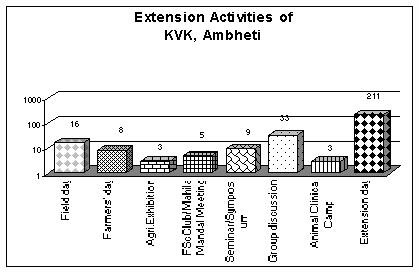
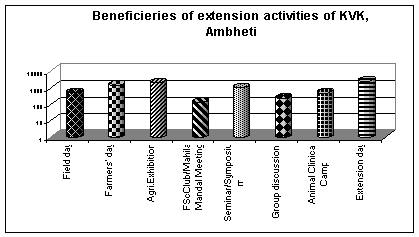
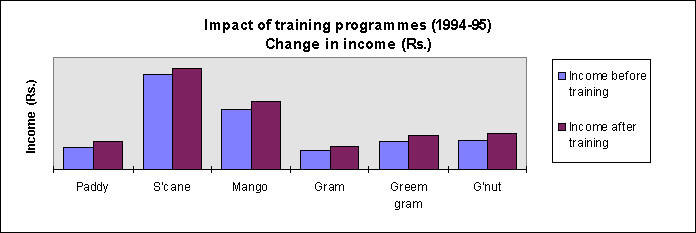
Impact of training programmes
| Name of specific technique / skill transferred |
No. of trainees |
Adoption (per cent) |
Income before trg. (Rs. / ha.) |
Income after trg. (Rs. / ha.) |
|
|
1. |
Improved varieties & fertilizer management in paddy |
52 |
73.29 |
9,800/- |
12,100/- |
|
2. |
Improved varieties & fertilizer management in brinjal & Bottle gourd |
39 |
61.54 |
20,500/- |
26,000/- |
|
3. |
Identification & control measures of pests in paddy |
39 |
43.58 |
9,100/- |
10,900/- |
|
4. |
Seed treatment in paddy (seeds & seedlings) with MEMC, & bio-fertilizers |
14 |
57.14 |
9,800/- |
11,250/- |
|
5. |
Identification of control measure of pests / diseases in mango |
99 |
45.45 |
26,500/- |
29,000/- |
|
6. |
Identification and control measures of pest and diseases in sugarcane |
13 |
62.00 |
38,000/- |
41000/- |
|
7. |
Fertilizer and weed management in sugarcane |
11 |
43.75 |
36,500/- |
40,000/- |
|
8. |
Seed treatments with melathion, MEMC and Use of bio-fertilizer in sugarcane |
22 |
54.54 |
37.200/- |
39,500/-
|
|
9. |
Package of practices of green gram |
20 |
42.25 |
12,000/- |
15,200/- |
|
10. |
Package of practices of kharif paddy |
18 |
53.25 |
9,200/- |
11,000/- |
|
13. |
Pest & disease management in kharif paddy |
39 |
46.42 |
8,500 |
9,700 |
|
14. |
Weed & fertilizer management in kharif paddy |
9 |
65.25 |
11,400 |
15,750/- |
|
15. |
Package of practices of gram |
34 |
34.00 |
5,000/- |
10,250/- |
|
16. |
Identification and control measures of major pests of mango |
22 |
51.25 |
26,900/- |
30,400/- |
|
17. |
Seed treatment with fungicide in sugarcane |
22 |
52.54 |
43,200/- |
45,100/- |
|
18. |
Identification & control measures of sugarcane pests |
11 |
58.75 |
42,900/- |
45,300/- |
|
19. |
Fertilizer management in sugarcane |
12 |
41.75 |
41,900/- |
44,200/- |
|
20. |
Identification and control measures of pests and diseases of brinjal and tomato |
12 |
62.25 |
22,300/- |
26,250/- |
|
21. |
Seed treatment with fungicide, bio-fertilizers and fertilizer management in summer groundnut |
19 |
61.00 |
12,500 |
15,625 |
|
22. |
Identification and control measures of pest and diseases of summer groundnut |
24 |
46.35 |
12,375/- |
16,500/- |
|
23. |
Package of practices of kharif paddy |
32 |
45.00 |
11,468/- |
15,525/- |
|
24. |
Seed treatment and fertilizer management in summer groundnut |
25 |
48.42 |
14,000/- |
19,357/- |
|
25. |
Fertilizer management in kharif paddy |
12 |
60.66 |
13,333/- |
16,333/- |
|
26. |
Identification and control measures of pests of sugarcane |
13 |
33.33 |
60,000/- |
67,000/- |
|
27. |
Identification and control measures of pests and diseases of kharif paddy |
10 |
30.00 |
12,500/- |
14,100/- |
|
28. |
How to raise healthy seedlings of paddy? Planting techniques of paddy |
18 |
61.25 |
10,200/- |
13,572/- |
|
29. |
Seed treatment and fertilizer management in gram |
55 |
51.66 |
9,146/- |
12,541/- |
|
30. |
Identification and control measures of pests and diseases of gram |
36 |
35.00 |
10,500 |
13,250/- |
|
31. |
Overcoming biannual bearing in mango |
14 |
71.42 |
6.71 per tree |
1921 per tree |
|
32. |
Identification and control measures of pest and disease in summer groundnut |
34 |
41.50 |
19,915/- |
15,565/- |
|
33. |
Raising of healthy seedlings of paddy and planting techniques in paddy crop |
17 |
63.33 |
13,832 |
10,416 |
|
34. |
Package and practices of paddy |
12 |
49.16 |
14,083 |
10,583/- |
|
35. |
Seed treatment and method of fertilizer application in kharif paddy |
17 |
49.37 |
11,913/- |
8,862/- |
|
36. |
Package and practices of summer groundnut |
35 |
53.50 |
20,1423 |
15,910/- |
|
37. |
Package of practices of gram |
29 |
49.00 |
12,350/- |
8,300/- |
|
38. |
Identification and control measures of pests and disease in gram |
15 |
41.25 |
13,125/- |
8,938/- |
|
39. |
Package and practices of sugarcane |
13 |
45.00 |
80,800/- |
69,000/- |
|
40. |
Seed treatment and fertilizer management in watermelon. |
13 |
38.00 |
41,000/- |
34,000/- |
Adoption of no cost and low cost paddy technologies
Table: Impact of training programme on rising of paddy nursery and planting technique
|
Sr. No. |
Name of specific technology |
Technology adoption (No. of trainees) |
Extent of adoption (per cent) |
|
A |
Reduction in seed rate up to 15 kg / ha. |
14 |
82.35 |
|
B |
Seed treatment |
4 |
23.53 |
|
C |
Use of 2-3 seedlings / hill |
14 |
82.35 |
|
D |
Line sowing during transplanting |
12 |
70.58 |
The above training programme was carried out during 1996-97 in Dhodhadkuwa village in which 17 farmers were trained. Generally, farmers are used to plant paddy with 10-15 seedling per hill. They plant randomly without maintaining distance of sowing and also that without any seed treatment. As a result, they required very higher seed rate.
Almost 82 per cent trainees started transplanting with 2-3 seedling / hill while more than 70 per cent trainees started transplanting in line. As a result of all these low and no cost sustainable technologies, the income of the trainees was increased by 32.8 per cent (from Rs.10,416 to Rs.13,832 per hectare).
Adoption of plant protection measures in Gram
Table Impact on training programme on "Identification and control measures of pest and diseases in gram"
|
Sr. No. |
Name of specific technology |
Technology Adoption (No. of trainees) |
Extent of adoption (percent) |
|
1. |
Identification of disease - wilt |
11 |
73.33 |
|
2. |
Identification of pests – 1. Pod borer 2. Aphids |
13 9 |
86.66 60.00 |
|
3. |
Use of fungicide for control of wilt |
8 |
53.33 |
|
4. |
Use of pesticides for control of 1. Pod borer 2. Aphids |
11 7 |
73.33 46.66 |
Before the training programme, the farmers were never using any fungicide / pesticide for control of pest and diseases in gram. The pod borer used to make severe damage i.e. to the tune of 25 to 30 per cent. Considering the need of farmers, a training programme on said aspect was arranged in Jan, 1997. Fifteen farmers of Motapondha (Omkutch) and Karaya villages participated. As a result of the training, the majority of farmers are able to identify the major pest and disease of gram. They also started using pesticides / fungicides for the control of the pests. By this way, the farmers are able to achieve the remarkable yield. There is an increase in net income by 31.78 percent (from Rs.9,250 to Rs.10,190 per hectare).
Case Study
Name :Uttambhai Budhabhai Patel
Address :Keshal falia, Ambheti, Ta: Kaprada, Dist. Valsad.
Size of land holding : 5 ha.
Income before training in KVK : 55,000/-.
Year of training : November 1994
Crop : Bottle gourd : Ridege gourd
Income before training : Rs.4,500 / 0.10 ha. : Rs.3,500 / 0.10 ha.
Season : Rabi 1995-96 : Kharif 1996-97
Variety : Warad : Surekha
Total production : 1500 kg/0.10 ha. : 1200 kg./0.10 ha.
Gross income : Rs.10,000 / 0.10 ha. Rs.10,000 / 0.10 ha.
Net income : Rs.8,450 / 0.10 ha. : Rs.7,330 / 0.10 ha.
Increase in income : Rs.3,950 : Rs.3,870
after training
Case Study
Name : Ganeshbhai Uttambhai Ganvit
Village : Sukhala, Patel faliu, Ta: Kaprada, Dist. Valsad.
Size of land holding : 12.0 acres
Year of training : June-1997
Crop / Technology : Paddy (Transplanting)
Use of seedling before training : 10-12 seedlings per hill
Use of seedling after training : 3-4 seedling per hill
Seed rate before training : 50 to 55 kg. per acre
Seed rate after training : 15 to 20 per acre
Expenditure : Labour cost for T.P.
Before training : Rs.1,200 / acre
After training : Rs.450 / acre
Saving in labour expenses : Rs.750 / acre.
Saving in seed : Rs.210 / acre (Rs.6 / kg.)
Total saving : Rs.960 / acre
Total production before training : 1100 kg / acre
Total production after training : 1300 kg / acre
Increased profits : a. Saving in cost : Rs.960
b. Increase in products. : Rs.1,200
Total Increased Profit : Rs.2,160
Case study
Name : Naranbhai Nishabhai Patel
Village : Jarafaliu, Motapondha, Ta:Kaprada, Dist.Valsad.
Size of land holding : 0.80 ha.
Annual income : Rs.15,000 Per Annum
Year of training : Sept.1995
Crop/Technology : Brinjal (Improved practices)
Area : 0.10 ha.
Season : Rabi 1995-96
Total production : 1500 kg / 0.10 ha.
Gross income : Rs.7,000 / 0.10 ha.
Cost of cultivation : Rs.3,000 / 0.10 ha.
Net Profit : Rs.4,500 / 0.10 ha.
Case Study
Name : Ravindrabhai Mohanbhai Patel
Address: : At: Mota pondha, Kandol faliu, Ta:Kaprada, Dist. Valsad
Size of land holding : 2.0 ha.
Income before training : Rs.35,000
Year of training : November,1997.
Crop : Bottle gourd
Variety : Warad
Season : Rabi 1997-98.
Cost of cultivation : Rs.3,717 / 0.10 ha.
Total yield : 2500 kg / 0.10 ha.
Gross income : Rs.7,200 / 0.10 ha.
Net profit : Rs.3,500 / 0.10 ha.
The farmer was of the opinion that on the same piece of land he has harvested Ridge gourd using the same pillars and wires has earned good profit during that season too.
Case Study
Name : Mohanbhai Budhiyabhai Patel
Address : Kandol faliu, At. Motapondha,
Ta: Kaprada, Dist.Valsad
Size of land holding : 2 ha.
Income before training : Rs.35,000 / acre
Year of training : July, 1996.
Crop : Mango
Technology used : Drenching of pechlobutrazol @ 15-20 ml / tree
Impact Treated trees ; Untreated trees.
No. of trees 5 20
Yield / tree 120 kg. 60 kg.
Selling rate Rs.250 / 20 kg. Rs.250 / 20 kg.
Expenditure (fertilizer, 400 / tree -
pesticides, hormones, labours.)
Gross profit 1500 / tree 750 / tree.
Net profit 1100 / tree 750 / tree.
Increase in net profit of the five trees : Rs. 500.00
Case Study
Name : Ramubhai Harjibhai Thorat
Village : Kakadkopar, Simalpani faliu, Ta: Karada, Dist. Valsad.
Land holding : 2 ha.
Income before training : 40,000 per acre
Crop : Pointed gourd
Year of training : 1995
Area under crop grown : 0.10 ha.
Gross income : Rs. 10,800 / 0.10 ha.
Cost of cultivation (wire, pillars,: Rs. 3,000 / 0.10 ha.
fertilisers, labour, & pesticide)
Net profit : Rs. 7,800 / 0.10 ha.
This crop is biennial and therefore, the profitability in the second year may again increase by at least 25 per cent, as the cost of cultivation will be reduced. Eight farmers of nearby village have also harvested such profitability.
Case study
Name : Amrutbhai Chhaganbhai Patel
Village : Bhawani faliu, Ambheti, Ta:Kaprada, Dist.Valsad.
Land holding : 4 ha.
Income before training : Rs. 60,000
Crop : Pointed gourd.
Variety : Local
Area : 0.10 ha.
Total production : 1280 kg / 0.10 ha.
Selling rate : Rs. 10 to 15 / kg.
Gross income : Rs. 15,360 / 0.10 ha.
Cost of cultivation (wire, pillars,: Rs. 4,000 / 0.10 ha.
fertilisers, pesticides, labour).
Net profit (1st year) : Rs. 11,360 / 0.10 ha.
Net profit (2nd year) : Rs. 13,800 / 0.10 ha.
Case study
Name : Hitesh Babubhai Patel
Address : Jarafaliu, At.Motapondha, Ta.Kaprada, Dist. Valsad
Size of land holding : 3.40 ha.
Total income before training : Rs. 60000
Year of raising teakwood nursery June-1996
Nursery area : 0.03 ha.
Teakwood stalk raised : 7000 nos.
Income of teakwood selling : Rs. 6,100
Total expenditure of nursery raising Rs. 2,000
Net income from nursery Rs. 4,100
Income from other sources / Rs. 60,000
enterprises
Total annual income : Rs. 64,100/-
Note: This farmer was not trained at KVK but was guided frequently for raising nursery.
Case study
Name : Rupabhai Dharmabhai Gavit.
Village : Patel faliu, At.Sukhala,Ta. Kaprada, Dist. Valsad
Size of land holding : 5 ha.
Year of training : June 1997
Crop : Paddy
Method used before training : Transplanting
Method used after training : Broadcasting sprouted seeds.
Expenditure incurred : Transplanting Broadcasting
a. Cost of seed : Rs. 60 / acre Rs. 96 / acre
b. Labour charges : Rs. 1,200 / acre Rs. 40 / acre
Production : 1200 kg / acre 1200 kg / acre
Gross profit : Rs. 7,200 / acre Rs.9,200 / acre
Net profit : Rs. 5,940 / acre Rs. 7,064 / acre
Net additional profit : - Rs. 1,124 / acre.
Case study
Name : Kalpeshkumar Kadidas patel
Address : Simalpani, At. Kakadkopar, Ta. Kaparada, Dist. Valsad.
Size of land holding : 3 ha.
Year of training : November 1996
Crop : Sugarcane
Technology : Fertilizer management in sugarcane.
Comparison of cost of fertilizer application
|
Before training |
After training |
|||
|
Quantity per acre |
Expenditure per acre (Rs.) |
Quantity per acre |
Expenditure per acre (Rs.) |
|
|
a. DAP |
125 kg |
1037.50 |
108 kg |
896.40 |
|
b. Urea |
175 kg |
679.00 |
175 kg |
679.00 |
|
c. MOP |
100 kg |
410.00 |
84 kg |
344.40 |
|
d. Castor cake |
50 kg |
150.00 |
100 kg |
300.00 |
|
e. Bio-fertilizers |
Nil |
- |
25 pkt |
150.00 |
|
Total |
2276.50 |
2369.80 |
||
Increase in cost : Rs. 93.30 / ha.
Total Production : Before training After training 24 t / acre 43 t / acre
Increase in production : - 19 t / acre
Net profit per acre : Rs. 21,723.50 Rs. 40,630.20
Net additional net profit : - Rs. 18,906.70 /acre.
Note: This increase in income is gained due to spilt and recommended dose of fertilizer application.
Success story
Unemployment is one of the burning problems of this area and is increasing at a very fast rate. As well, this is tribal dominated area of which laziness and illiteracy are the major virtues. The per capita income of family is very low and hence the economic condition of the villagers is poor. As a result many rural youths (both male and female) are going to Vapi Industrial estate for earning.
With a view to increase income and self-employment, the KVK thought to give training to farmwomen on sewing work. The reason being quite a good lot of work can be made available from Vapi based ready-made garments units and sophisticated tailors. To achieve this goal, the KVK had arranged long term vocational training programme on sewing work during October 1996 to March 1997. In this training, nineteen females participated. On successfully completion of this training, the trainees were helped to purchase the sewing machines through District Industrial Centre. Now, the trainees are doing sewing work, patchwork, stitching and also preparing articles. They were earning no money on part-time basis before the training. Now, they have started earning. Details of economics are depicted hereunder:
|
Sr. No. |
Name |
Work hrs per day |
Expenses per month (Rs.) |
Net income per month (Rs.) |
Approximate income per annum (Rs.) |
|
1. |
Rekhaben Shankarbhai Patel |
3-4 |
- |
600 |
7000-8000 |
|
2. |
Arunaben Dhirubhai Patel |
3-4 |
30-50 |
450 |
5000-6000 |
|
3. |
Ansuyaben Vinodbhai Patel |
3-4 |
50 |
500 |
5000-6000 |
|
4. |
Hasumatiben Navsubhai Patel |
3-4 |
50 |
700 |
7000-8000 |
|
5. |
Sangeetaben Raviyabhai Patel |
2-3 |
30-50 |
350 |
4000-5000 |
|
6. |
Kamlaben Shankarbhai Patel |
2-3 |
30-50 |
400 |
4000-5000 |
|
7. |
Saraswatiben Maheshbhai Patel |
2-3 |
30-50 |
450 |
5000-6000 |
|
8. |
Ushaben Sukhabhai Patel |
2 |
30-40 |
200 |
1500-2000 |
|
9. |
Daxaben Bhagubhai Patel |
1-2 |
15-20 |
200 |
1500-2000 |
|
10. |
Taraben Bhanabhai Patel |
1-2 |
15-20 |
200 |
1500-2000 |
|
11. |
Pushpaben Babubhai Patel |
1-2 |
15-20 |
200 |
1500-2000 |
|
12. |
Vinaben Mangabhai Patel |
1-2 |
15-20 |
200 |
1500-2000 |
Success story
This district in which KVK Ambheti situated is tribal dominated. The forest area constituted of many trees. The villagers use these trees as a source of fuel. Among the different forest trees, locally know ‘Palas’ tree bears broad and long leaves during April-June. Looking to the abundant availability of leaves the KVK thought to give training on leaf cup making with a view to provide self employment. The KVK arranged one training programme during 15 to 24 June 1996 in which 17 farmwomen participated. After successful completion of training, the KVK helped them procuring leaf cup making machine. Today nine of the farmwomen (trainees) started their leaf cup making business. Those who were not earning earlier are now earning quite remarkable on spending very less time. The detailed economics is given hereunder:
|
Sr. No. |
Name |
Working hrs. per day |
Production of leaf cup per day |
Selling rate (Rs. / 100 Nos.) |
Cost of production (Rs. / 100 Nos.) |
Net income (Rs./ day) |
Annual income after training |
|
1. |
Parvatiben Rameshbhai Patel |
2-3 |
300-350 |
15-25 |
5 |
30-70 |
6000-8000 |
|
2. |
Daxaben Naginbhai Patel |
2-3 |
300-350 |
15-25 |
5 |
30-70 |
6000-8000 |
|
3. |
Kavitaben Chotubhai Patel |
2-3 |
300-350 |
15-25 |
5 |
30-70 |
6000- 8000 |
|
4. |
Damyantiben Dhirubhai Patel |
2-3 |
300-350 |
15-25 |
5 |
30-70 |
6000-8000 |
|
5. |
Laxmiben Bhagubhai Patel |
2-3 |
300-350 |
15-25 |
5 |
30-70 |
6000-8000 |
|
6. |
Chandanben Laxmanbhai Patel |
2-3 |
300-350 |
15-25 |
5 |
30-70 |
6000-8000 |
|
7. |
Gitaben Somabhai Patel |
2-3 |
300-350 |
15-25 |
5 |
30-70 |
6000-8000 |
|
8. |
Lalitaben Chhanabhai Patel |
2-3 |
300-350 |
15-25 |
5 |
30-70 |
6000-8000 |
|
9. |
Kantaben Balubhai Patel |
2-3 |
300-350 |
15-25 |
5 |
30-70 |
6000-8000 |