(Desi News: October 2002 by Abhay Desai)
(Excerpt from A.I.I.T. Newsletter, Winter 2002)
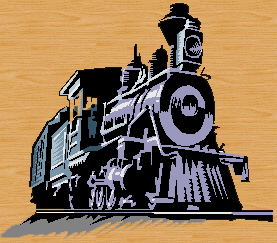
On April 6, 1853, the first train ran on Indian soil from what was then known as Boree Bunder (today, Chatrapati Shivaji Terminus) to Tannah (now Thane)-a distance of 34 kilometres
The event was marked by a 21 gun salute, the governor's band playing the British national anthem, three steam engines aptly named Sahib, Sindh and Sultan, and a sense of awe among those who witnessed the inaugural run, according to the Bombay Times and Journal of Commerce.
The project was the brainchild of C.T. Clarke, an engineer with Great Western Railway, England, who in 1843, proposed to the East India Company that a rail line be laid in India. Initially, an experimental line from Howrah to Bandooah, in the district of Bengal was selected. The plan ran into difficulties and intense lobbying from the Liverpool cotton cartel and a signature campaign by the local populace led to Bombay being selected as the starting point.
Work began in 1851 and was completed in record time: just 25 months. Over 10,000 workers toiled night and day to make this miracle happen at 20 percent less than the projected cost.
With the inaugural trip to Thane, India entered the industrial age. The run also laid to rest myths and superstitions that had gathered around the so called "fire carriages". According to the Overland Telegraph and Courier, "the natives salaamed the omnipotence of steam as it passed."
Villagers reasoned that the engine, which could move in either direction without any visible help, must surely be God. So in great deference they put the sacred red mark or tilaks on the smoke stacks of engines, left offerings of food and money on the foot-plates and placed flowers on the tracks. Even educated Indians were not too sure of the train. According to Bengal Hurkaru, a Bengali scholar having resolved to make a trip, duly consulted the stars with the help of an almanac, and fixed upon a Thursday as the "lucky day" for the journey.
"He fortified himself for the expedition by bathing three times in the river and repeating the name of his tutelary god 937 times. Midway, he got down and refused to proceed, saying that travelling too long in the car of fire would shorten his life. Seeing that it annihilates time and space and curtails the length of a journey, it could shorten the journey of human life too."
Mahatma Gandhi, too, had his reservations on the introduction of railways. "Railways accentuate the evil nature of man," he wrote in Hind Swaraj. "Bad men fulfil their evil designs with greater rapidity. Formerly people went to holy places with great difficulty. Generally, therefore, only real devotees visited such places. Now rogues visit them to practice roguery!"
From that state of initial resistance, the railways have become the economic life-line of India. Over 12,000 trains cover 63,028 kilometres, connecting 6,853 stations, moving 13 million people and more than 1.5 million tonnes of freight through a fleet of 7,566 locomotives, 42,570 coaches and 2,22,147 freight wagons every day.