THE TRUE STORY OF RUDOLPH
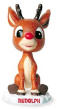
On a December night in Chicago many years ago, a little girl climbed onto
her father's lap and asked a question. It was a simple question, asked in
children's curiosity, yet it had a heart-rending effect on Robert May.
"Daddy," four-year-old Barbara May asked, "Why isn't my mommy
just like everybody else's mommy?"
Bob May stole a glance across his shabby two-room apartment. On a couch lay
his young wife, Evelyn, racked with cancer. For two years she had been bedridden.
For two years, all of Bob's small income and smaller savings had gone to pay
for treatments and medication.
The terrible ordeal had already shattered two adult lives. Now, Bob suddenly
realized the happiness of his growing daughter was also in jeopardy. As he
ran his fingers through Barbara's hair, he groped for some satisfactory answer
to her question.
Bob May knew only too well what it meant to be 'different'. As a child he
had been weak and delicate. With the innocent cruelty of children, his playmates
had continually goaded the stunted, skinny lad to tears. Later, at Dartsmouth,
from which he graduated in 1936, Bob May was so small that he was always being
mistaken for someone's little brother.
Nor was his adult life much happier. Unlike many of his classmates who floated
from college into plush jobs, Bob became a lowly copy writer for Montgomery
Ward, the big Chicago mail order house. Now at 33, Bob was deep in debt, depressed
and sad.
Although, he didn't know it at the time, the answer he gave the little child
on his lap was to bring him fame and fortune. It was also to bring joy to
countless thousands of children like his own Barbara. On that December night
in the shabby Chicago apartment, Bob cradled the little girl's head against
his shoulder and began to tell a story . . .
"Once upon a time, there was a reindeer named Rudolph, the only reindeer
in the world that had a big red nose. Naturally people called him "Rudolph,
the red-nosed reindeer."
As Bob went on to tell about Rudolph, he tried desperately to communicate
to Barbara the knowledge that, even though some creatures of God are strange
and different, they often enjoy the miraculous power to make others happy.
"Rudolph," Bob explained, "was terribly embarrassed by his
unique nose. Other reindeer laughed at him; his mother and father and sister
were mortified, too. Even Rudolph wallowed in self pity."
"Why was I born with such a terrible nose?" he cried.
"Well," continued Bob, "one Christmas eve, Santa Claus got
his team of husky reindeer - Dasher, Dancer, Prancer, and Vixen, and the others
-- ready for their yearly trip around the world. The entire reindeer community
assembled to cheer these great heroes on their way. But, a terrible fog engulfed
the earth that evening, and Santa knew that the mist was so thick that he
wouldn't be able to find a single chimney."
"Suddenly Rudolph appeared, his read nose glowing brighter than ever.
Santa sensed at once that here was the answer to his perplexing problem. He
led Rudolph to the front of the sleigh, fastened the harness and climbed in.
They were off! Rudolph guided Santa safely to every chimney that night. Rain,
and fog, snow and sleet -- nothing bothered Rudolph for his bright red nose
penetrated like a beacon."
"And, so it was that Rudolph became the most famous and beloved of all
the reindeer. The huge red nose he once hid in shame was now the envy of every
buck and doe in the reindeer world. Santa Claus told everyone that Rudolph
had saved the day, and from that Christmas on, Rudolph has been living serenely
and happy."
Little Barbara laughed with glee when her father had finished. Every night
she begged him to repeat the tale until finally Bob could rattle it off in
his sleep. Then, at Christmas time, he decided to make the story into a poem
like the 'Night Before Christmas' and prepare it in a booklet form with crude
illustrations, for Barbara's personal gift.
Night after night, Bob worked on the verses after Barbara had gone to bed,
for he was determined that his daughter should have a worthwhile gift, even
though he could not afford to buy one.
Then, as Bob was about to put the finishing touches on Rudolph, tragedy struck.
Evelyn May died. Bob, his hopes crushed, turned to Barbara as his chief comfort.
Yet, despite his grief, he sat at his desk in the quiet, now lonely apartment,
and worked on Rudolph with tears in his eyes.
Shortly after Barbara had cried with joy over his handmade gift on Christmas
morning, Bob was asked to an employee's holiday party at Montgomery Wards.
He didn't want to go, but his office associates insisted. When Bob finally
agreed, he took with him the poem and read it to the crowd. At first the noisy
throng listened in laughter and gaiety. Then, they became silent, and at the
end broke into spontaneous applause. That was in 1938.
By Christmas of 1947, some 6 million copies of the booklet had been given
away or sold, making Rudolph one of the most widely distributed books in the
world. The demand for Rudolph sponsored products increased so much in variety
and number that educators and historians predicted Rudolph would occupy a
permanent niche in the Christmas legend.
Through the years of unhappiness, the tragedy of his wife's death and his
ultimate success with Rudolph, Bob May has captured a sense of serenity. And
as each Christmas rolls around he recalled with thankfulness the night when
his daughter's questions inspired him to write the story.