A TASTE FOR CHRISTMAS
By Jug Suraiya
This article appeared in the Times of India on
December 25, 1987. Although it is 15 years old, I decided to include this
in our Christmas newsletter as it will revive fond memories for many of our
readers who still recall what Calcutta was like over the festive season.
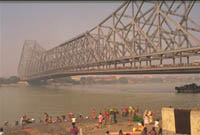
Photo by Huub Streng
Calcutta has a taste for Christmas. Like the mince
pies that its confectioners make so well, the city blends diverse flavours according
to a time-honoured recipe to confect what are locally known as borrow din-the
"big days" of the cold season, mellow with creamed butter dollops
of winter sunshine, fruity with friendly get-togethers and bitter sweet with
nostalgia.
Partly because of its colonial hangover, partly because it was, and to an extent
still is, something of a cosmopolitan cultural melting pot, and perhaps partly
because it has always espoused traditions not much in favour elsewhere, Calcutta
retains a Pickwickian zest for Christmas. The dazzling illuminations, the sumptuous
dalis presented to the burra sahibs by those who would be wished well by them,
and the wandering bands of carol singers who mazed a melody as uncertain as
a murky and potholed Park Circus gulli, may have been consigned to a foggy past.
But despite the diversions it has had to take, Christmas is still alive and
well and celebrated in Calcutta; an immovable feast that reduced circumstances,
Metro diggings and the deeper excavations of time have failed to dislodge.
The mainstay of Calcutta's Christmas is the Anglo Indian household, to which
an invitation must be inveigled if one wants the true savour of the season.
Come the first week of December and shopping forays are launched from the back
alleys of Wellesley and Eliot Road, Park Lane and Ripon street to buy the ingredients
for a festal reunion when aunts and cousins and friends and in-laws will descend
from up-country railway colonies-or the more distant environs of Australian
or Canadian suburbia-in an annual rite of passage.
Little old ladies in clattering rickshaws converge on the New Market (over 110
years old and gutted by fire, but still going strong) to haggle with salesmen
who sit amidst peaks of dried fruits whose towering summits graphically represent
the ascent of soaring prices. Grudging bargains are struck for candied peel
and preserved pumpkin, sugared cherries and wrinkled raisins. Better forget
the almonds this year, at Rs.140 a kilo for the cheapest variety, and make do
with walnuts and cashews, expensive enough as they are.
Despite such makeshift substitutions, the jealously guarded recipe that each
household has works its alchemy as the ingredients are soaked in rum and sun
and mixed into the batter which is dispatched to the clay ovens of the local
baker, on whom a sharp eye must be kept lest he winkle out from the uncooked
mixture a particularly tempting cherry or plump sultana.
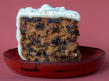
Appetizing aromas wreathe the back lanes like mist and the cakes emerge, golden
brown and faintly hissing, to be cooled and enclosed in greaseproof paper and
left to mature till the big day when according to yearly custom they will be
unwrapped and exclaimed upon an unanimously declared incomparably better than
the one that Auntie Mabel, bless her, had sent last year from Marks and Sparks,
or was it Sparks and Marks.
Those not fortunate enough to have access to a home-made cake (or even one from
Sparks and Marks) can do fairly well for themselves by getting one from Nahoum's
in the New Market considered by many to do the best commercially made, rich
fruit cakes in the city. For plum puddings, however, connoisseurs go next door
to M.X. D'Gama's or Maxo's as it is popularly known. The one complaint that
a purist might make about Maxo's plum puds is that they do not have embedded
in their rich,gooey interiors the local equivalent of sixpence bits which genial
hosts delight in fishing out for favoured guests. Provided one can stand the
prices, Flury's on Park Street remains unbeatable for mince pies and other seasonal
specialties like chocolate cones, Yule logs and nougatines.
Whether making a cake or buying one off the shelf, those in the know do their
shopping early. Not only does most Christmas confectionery improve with keeping
and the addition of a few judicious tablespoons of rum or brandy, but also advance
buying helps one avoid the frantic rush that builds up closer to the big day
when the narrow lanes of the Market are clogged with a surging tide of customers
determined, in this season at least, to follow the royalist prescription of
eating cake in the absence of bread.
With the eclectic gusto that he displays for other exotic items of mental and
culinary consumption, the Bengali has made at least this aspect of Christmas
as much a part of indigenous gastronomic tradition as nolen gurer sandesh and
often a heated debate can be generated by such finer points of doctrine as to
whether crystallized ginger in a plum cake is an ideologically sound formulation
or a revisionist aberration.
But if cake is the end all of Calcutta's Christmas fare, it is by no means the
be all. Even as the mixed fruit is maturing in glass jars on shelves, safely
out of the reach of marauding young hands, the meat shops in several of the
city's markets are busy preparing salt beef, pickled in brine, lime juice and
saltpetre. Though clubs and the larger restaurants continue to serve the traditional
British Christmas dinner of turkey with all the trimmings, a more authentic
local alternative is the Anglo-Indian specialty known as haas and baas or duck
with bamboo shoots, and poultry shops are loud with the quack and flutter of
the birds.
Although available in a variety of commercial establishments, a Calcutta Christmas
is best consumed in someone's home. Despite hard times, a number of families,
not all of them Christian, keep an open house all day, with guests dropping
in to exchange greetings, eat a slice of cake, drink a glass of sweet home-made
raisin wine (available in a New Market confectionery in a seasonal indulgence
to which the excise department seems to turn a benevolently blind eye), and
swap reminiscences of seasons past and friends remembered, while children scamper,
for once un-scolded, around tables crowded with plates and presents, and the
afternoon drowsily curls up on itself like the cat by the rocking chair, too
replete with tidbits even to dream of chasing mice.
In keeping with the democratic trend of the vernacularisation of Christianity,
in recent times Calcutta has begun to sprout Christmas pandals, miniature look-alikes
of the elaborate structures put up during the Pujas. If the Holy Family has
thus been co-opted into the popular Hindu pantheon, orthodox Christmas fare
has also undergone reincarnation, the better to suit local tastes.
Thus a number of dhabas advertise Christmas, or at least cold weather specialties
like paya curry and mataan ishtu which the canny linguist might correctly interpret
to mean mutton stew, Delhi durbar-style. In the last remaining vestiges of the
old Chinatown in north Calcutta, Chinese grocers as wizened as their wares purvey
such recherché delicacies as dried pork or "ding-ding", sweet
preserved olives, and sweet-and-sour sausages tied in bunches with red twine.
North Indian restaurants feature special "Xmas" menus that include
makke ke roti and sarso ka saag and hot gajar halwa optionally topped with a
scoop of vanilla ice-cream.
Apart from selling hot cakes like hot cakes, Bengali establishments do a brisk
business in patties and that great Calcutta favourite, the kobiraji cutlet,
so called not because it is made by a practitioner of ayurvedic medicine but
because the light egg batter that enfolds it has given rise to the colloquial
corruption kobiraj for "covered".
Even the hardiest digestion finally must quail before the Epicurean assault
of a Calcutta Christmas. Like spectres of dyspepsia, the unsold confections
haunt the no longer lit up glass cases in the New Market. As in the case of
Marley's ghost in Dickens's story, however, these contribute an apposite ending
to the Christmas tale, in that they are sold at cost to charitable institutions
who organize, for those who can't afford them, festivities which, although admittedly
late, are better than never. Embarrassingly sentimental and something of a cliché?
But of course. At Christmas, or any other time, Calcutta seldom pretends to
be otherwise.
Next Page
Back
to Table of Contents