 |
| Buffelgrass Cenchrus ciliaris syn. Pennisetum ciliare |
| Family: Poaceae Origin: native to Africa and parts of Middle East, introduced around 1940 in Texas as a forage Longevity: Warm season perennial Growth Habit: Bunch Planting Rate: 1 1/4 lb dehulled (row); 2 lb dehulled, 3-5 lb burr (broadcast) Soil type: adapted to light sand and clay soils |
|
 |
 |
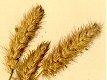 |
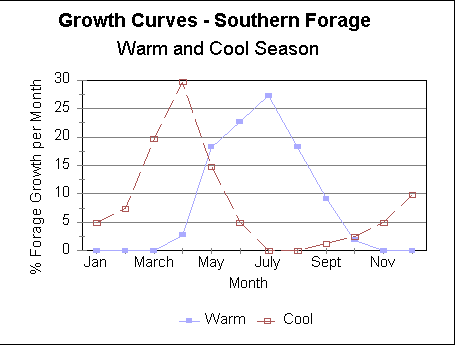
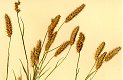
| Description Buffelgrass (Cenchrus ciliaris) is a warm season perennial bunchgrass characterized by purple, gray, or yellowish-brown bristly seedheads with long stems rising from a knotty base. It grows from one to four feet tall and has long, narrow, bluish-green leaves that range from one to four inches long. Its spikelets can be clustered or solitary and the bristles on the spikelets can be fused or separated. One can tell the difference between Cenchrus and Pennisetum, because the bristles on Pennisetum are separate and on Cenchrus they are fused. This bunchgrass has a dense and long root system that can grow to eight feet deep. Its seeds are spread by wind and animals. Buffelgrass is similar in appearance to millet; in fact, the genus name Cenchrus comes from the Greek word "kegchros" which means millet. Habitat C. cenchrus grows well in places where annual rainfall ranges from 12 to 22 inches, like the semi-arid conditions of the Southwest United States. It is drought tolerant and can survive in regions in which the temperature is no lower than 41 F. Buffelgrass is found mostly in the Sonoran Desert. Problems This is a highly invasive forage that is attracted to fire. It causes problems to the ecosystem because it competes with other plants for space and nutrients. Once it burns, it grows back even stronger while the other plants in that area die off. This has an effect on the animals in that area that need those other plants to survive. People have been making efforts to get rid of buffelgrass. Utilization Buffelgrass is of high economic value to livestock, especially in Texas for cattle, but is low for wildlife. It responds to fertilizer and has good seedling vigor. It withstands heavy grazing and is used for range reseeding, pasture, hay production, revegetation, erosion control, and soil stabilization. It also is fast recovering from drought and heavy grazing. Growth Buffelgrass rapidly grows from early spring through late summer and continues to grow during the hottest part of the summer. Below is a growth curve of warm and cool season grasses. The curve for buffelgrass is shown in blue. |
| Images |
| References Esque, Todd & Schwalbe, Cecil. Non-native grasses and fire create double jeopardy. People, Land, and Water. July/August 2000 Rutman, Sue. At what cost? Deciding whether to control exotic plants. Natural Resource Year in Review. 1998 Links Texas A&M Wildland Invasive Species Program Pogue Seed Company |
 |
| Email me @ [email protected] |