 |
CRITICAL
THINKING & TRANSFER OF KNOWLEDGE & SKILLS
Chow
Teck Seng (aka Zhou Decheng, 1999), NIE Assignment
Introduction:
This article briefly discusses the correlation
between critical thinking and the transfer of knowledge and skills, and the two
different aspects of their combination, in making up the coherent learning
process. The two aspects are:
a)
Critical
thinking as a skill to be transferred in different learning experiences;
b)
The role of “Critical
Thinking” as a vehicle in maximizing transfer and ensuring a positive transfer
of knowledge and skills
In the second part of the article, two strategies,
which demonstrate how critical thinking can enhance the transfer of knowledge
and skills in the learning process of Chinese language, are addressed.
1) Critical thinking as the
skill to be transferred in a learning experience
Very often, “critical thinking” might just be referred as “good
thinking skills”. What
is good thinking? Interpretation varies from people to people. Some
psychologists associate thinking with problem solving and creativity, others
talk about evaluating evidence or making judgements (Woolfolk, 1995). Baron has
seen good thinking as “thinking that
achieves its goal”(1995).Woodlfolk have identified critical thinking as
one of the major thinking skill in learning. Together, both critical and
creative thinking are important and inter-dependent in the holistic process of
good thinking.
From the word “critical”,
“people might assume that critical thinking is destructive, arrogant,
and hurtful; it would seem to be a way to build up one’s ego by ridiculing
others. But the root word behind
‘critic’, the Greek KRITHS, has neither positive nor negative connotations;
it means simply ‘judge’, one who evaluates, distinguishes, decides,
determines if something is right or wrong.”[1]
Some might wonder, if
critical thinking is an in-born intuitional ability or a skill that can be
taught or learnt? I believe that these two perceptions do not contradict each
other. As teachers, the belief that all learners can think is significant. Yet,
this ability to think might not always be employed as a habitual skill to
acquire new knowledge—the ability is not transferred in every future learning
situation. Here the transfer of critical thinking can be understood as “ the
process that makes possible the giving of previously learned (ie critical
thinking) responses in new situations”(Gage, 1975). “The
role of an educator wishing to develop critical thinking skills in learners must
therefore be that of a helper, facilitator and motivator. The educator’s role
is to help learn, not to teach.” [2]
Therefore a teacher can nurture good thinking skills in pupils through a
non-judgmental environment, stimulating activities, higher-order thinking
questions and positive feedback in their various learning experiences.
We understand that the
transfer of critical thinking skills would be different in deviant learning
applications, but it can be generalized as a set of systematic thinking
sub-skills, just as it is defined as the sets of skills needed to solve a
problem: “In the problem-solving
process, the person focuses on the
problem. He then selects relevant
information, and he organizes, analyses
and integrates the data collected. He then generates various alternatives, considers the pros and cons of the
alternatives in order to evaluate the
most appropriate alternative solution.”(“Towards Thinking Schools”, An
MOE document)
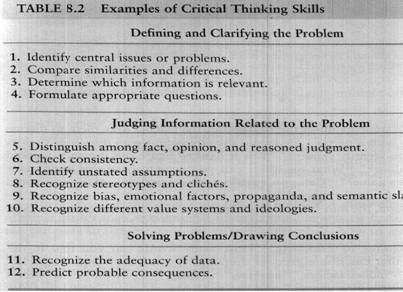
Although psychologists have not been able to
agree on the skills that constitute critical thinking, but below is an
representative list of critical thinking skills. (P. Kneedler, 1985):
Thus, critical thinking can
be viewed in terms of arguments involved in developing and justifying beliefs. Or it can be
analyzed into component cognitive processes, some of which is learnable. These
critical thinking skills can include: Focusing, information gathering,
remembering, organizing, analyzing, generating, integrating and evaluating.
Critical thinking can be learnt in 2 ways. First, to foster metacognition,
ie “thinking about thinking”. Just as the “Mystery of the Dead Mouse”
experiment that he had done (Swartz, Robert J, 1990), he noted that “ there
is more than just thinking about why the mouse died to this lesson” and “ we
want students to integrate the forms of thinking
that we help them use in the classroom into their ways of thinking in
general. When this happens, real learning takes place.”(p 431)
“Awareness” in the thinking process that they are undergoing is important.
Next, to provide more practices or “examples” for the learners to apply
critical thinking. The practices aimed at the learning of both the “content”
and “good thinking”. Swartz have named this as “conceptual –infusion
approach” to teaching for critical thinking (p 415). He said that “for
the teaching of thinking to be successful, transfer must be accomplished. The
more students become aware of contexts for the use of specific thinking skills
and activities, and the more they use them in new contexts, the more transfer is
facilitated”(p
437).
2)
The role of “Critical
Thinking” as a vehicle in maximizing transfer and ensuring a positive transfer
of knowledge and skills
Now we take a slightly
different perspective in analyzing the correlation between critical
thinking and the transfer of knowledge and skills, in the process of learning.
Generally there are 2 kinds of transfer. One of them
is low-road transfer, which “involves
the spontaneous, automatic transfer of highly-practiced skills, with little need for reflective thinking”. One example
is reading skills. High-road transfer, on the other hand, involves “
constantly applying abstract knowledge learned in one situation.” (Salmon G &
perkins D, 1989. P 118). One example is the learner’s attempt to apply the
knowledge on “ characterization” that he gained during literature lessons in
a future composition.
Now, what role does “critical thinking” play in
the transfer of knowledge and skills? In the evolution of transfer theories, we
witness the “theory of identical elements” replacing “the theory of
formal-discipline”. The doctrine of identical elements held that transfer
could occur from one learning to another as long as they had elements in common.
(Thorndike, 1913) But this theory actually focused on mainly explaining low-road
transfer of highly practiced skills and not all learnings. The introduction of
critical thinking in this type of transfer would normally associate with
moral reasoning. In 1908, Judd proposed the theory of generalization as an
explanation of transfer. In an experiment done by Hendrickson and Schroeder
(Garrison, p 201), 3 groups of boys are tasked to throw darts in water----Group
A received explanation of refraction, group B received explanation with extra
information that the changing depth of water changes the amount of refraction
and group C no explanation. The amount of transfer varies in the following
manner: B>A>C. It proves that generalization is a better high-road
transfer theory, requiring generalization as a form of critical thinking
(synthesis) to maximize transfer.
According to the transposition theory, which can be
seen as an extension to the generalization theory, transfer will take place to
the extent that the learner recognizes significant relations in two situational
patterns. It is at this point that the theory of identical elements tends to
fuse with the theory of generalization, based upon subjectively observed identical patterns. The ability to observe
identical patterns requires critical thinking skills such as focusing,
analyzing, generalizing and even evaluating as vehicles for knowledge transfer.
Other interpretations of transfer theories, such as the ability of
learners to generalize, intelligence of the children and the attitude/ mental
set of the learner all have close relationships with the ability of critical
thinking and they have important influence upon transfer. The lack of critical
thinking in the transferring process would often lead to a zero transfer or even
a negative transfer. Negative transfer, meaning that previous learning have
somehow interferes with the later learning. The reason might most probably be
the absence of critical thinking procedures which leads to a wrong application
of learned knowledge, or the lack of critical thinking in the form of moral
reasoning, which leads to inappropriate actions.
In order to promote critical thinking as a mental catalyst to maximize
positive transfer, the arguments held by constructivists and social-
constructivists on learning processes, have provide an insight. Through deep
dialogues and discussions, self-constructed and shared-negotiated knowledge can
be meaningfully obtained, through constructive critical learning. Learning takes
place fastest when there are clear goals and rewards, time to assimilate and
learners are free to risk, experiment and practice.
Critical thinking is the shared language and the discussions avenues for
knowledge transfer.
It must also be emphasized that the above-mentioned two viewpoints are closely-related, with only a difference in focus.
In this part of my paper, I
would further illustrate how to go about developing students’ critical thinking skills with respect to the
transfer of knowledge and skills, from the point of view of a Chinese Language
teacher. The 2 strategies are as follows:
In
the preparation of language lessons, teachers can pre-design questions, in
accordance to the different cognitive levels, for the pupils to answer in
classroom.
For
example, the teaching procedures of a Chinese reading comprehension lesson “
The Kite”(see Annex 1), can be summarized as below:
Subject:
Chinese
Level/
Stream: Sec 2 (express)
Topic:
Reading Comprehension
Passage:
“The Kite” by Lu Xun
Teaching
goals: Through guided reading,
pupils can enhance their reading and comprehension skills and are able to answer
the pre-designed questions of different cognitive levels. In doing so, it is
hoped that desirable critical skills can be developed.
Some
of the questions would be:
5.3: Why do you think that the
author want to emphasize on the sickliness of his brother in the writing?
(Cognitive level: Interpretation)
5.4: Do you think what his
brother had done is justified? (Cognitive level: analysis and evaluation)
During questioning, we can use the WRAITEC model to help us obtain more
critical and organized answers from the pupils. This model can help learners to
think in different points of view:
1.What
(What is the concept that you say?)
2.Reason
(What is your reason in saying so, are there any evidences to support your
answer?)
3.
Assuming (when you make this claim, do you make any assumption or
hypothesis?)
4.Inferences
(What are the other possible inferences that you can make?)
5. True
(Is your stand truthful? How do you evaluate?)
6. Example
(Any examples to support your stand?)
7.Counter-example
(Is your stand sound? Are there any counter-examples?)
This
would help the students to develop awareness of their thinking processes.
Teachers can also design a composition (see Annex1 Qn 13) topic closely-related
to this passage, so that there is an immediate practice for the transfer of
critical thinking skills from reading/ answering to writing. Future questions of
reading comprehension lessons would be designed in similar cognitive levels, so
that a “thinking culture” can be created in the classroom.
Webboard, as a form of computer conferencing and tele-communication, can
help overcome time and distance constrains. This is where students, including
teachers, negotiate, make critical distinctions, build trust and share a special
language.
For
example:
Subject:
Chinese
Level/stream:
Sec 2/ Express
Topic: discussion/ debate on the
evaluation of the controversial history character Emporor Qin (秦始皇)
Physical settings: Home/ Computer labs
Teaching goals:
Through critical discussion, the learners are able to develop the ability to
evaluate historic figures. In doing so, it is also hoped that they can learn a
set of general critical thinking skills and exercise it in carefully composed
written sentences, paragraphs and essays, with a focus on the style of an
argumentative language.
The teacher can divide the class into two and each
group would take different stands. They have to post at least 2 messages, of
which one is in reply to others’ comments, up the webboard as homework. During
lessons, the teacher would double-remind them to portray their answers to the
four ideals of clarity, completeness, coherence and charity (fairmindedness).
This discussion or debate can be held before or after a classroom lesson on
Emperor Qin. A successful discussion would witness a positive transfer of
knowledge guided by critical thinking process.
Conclusion:
In the conclusion, I attempt to re-define transfer:
Is it “knowledge or skills” that are transferred? It is an interesting
question. On the other side, it can also be seen that during a learning process
or a new problem-solving situation, new knowledge is created based on the old
knowledge (rather than a transfer): It is the old information and the new
context that supply the raw materials. Knowledge is closely related to
intelligent action. It is something we, through critical
thinking processes, make and keep within ourselves.
References:
1.
Davis, Andrew (1998).
“Transfer, Abilities and Rules (chapter 6)” in Journal
of Philosopy of Education- Special Issue: The limits of Educational
Assessment, Vol. 32 Issue
2.
Francis
S. Bennett (1997). Critical Thinking. http://pr.erau.edu/~bennett/cteval.html
3.
Frandsen, Arden N.
(1961). Educational
Psychology.
4.
Gage, N.L. &
Berliner, David C.(1975). Educational
Psychology.
5.
Garry, Ralph (1965). The
Psychology of Learning.
6.
Garrison, Karl C.,
7.
Goh Chok Tong, “
8.
Goodwin, W.L. &
Klansmeier, H. J. (1975). Facilitating
Student Learning.
9.
Grant, Grace E., (1988). Teaching Critical
Thinking.
10.
Skinner, B.F.,1968.
“Teaching Thinking”(Chapter 6), The
Technology of Teaching.
11.
Swartz , Robert J.,
1991. Structured Teaching Critical
Thinking and Reasoning in Standard Subject Area Instruction, in Informal Reasoning and Education (Ed. by Voss, James F.).
12.
Woolfolk, Anita
E.(1995).Educational Psychology(6th
Edition).