principle suggests that what we have come to perceive as solid matter is in actuality both solid and non-solid at the same time. The determining factor in what will ultimately become substance as we know it is the participation of the observer.
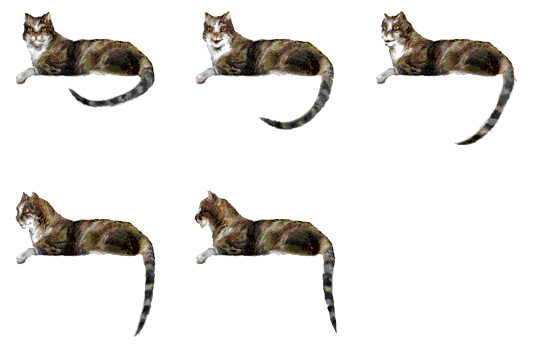
This concept has become familiar in what is now known as the experiment called Schrödinger's cat. Physicist Eric Schrödinger demonstrated the apparent conflict between, what quantum theory tells us is true about the nature and behavior of matter on the microscopic level, and what we observe to be true on the macroscopic level.
In his theoretical experiment a living cat is placed into a steel chamber, along with a device containing a vial of hydrocyanic acid. There is, in the chamber, a very small amount of a radioactive substance. If even a single atom of the substance decays during the test period, a relay mechanism will trip a hammer. The hammer in turn will break the vial releasing the acid which will kill the cat.
Since the steel chamber is completely enclosed, the observer cannot know whether or not an atom of the substance has decayed, and consequently, cannot know whether the vial has been broken, the hydrocyanic acid released, and the cat killed. Since we cannot know, the cat is both dead and alive according to quantum law.It is only when we break open the chamber and learn the condition of the cat that the superposition is lost, and the cat becomes one or the other (dead or alive).
Of course, in the field of scientific research only observable phenomena are considered to be legitimate sources of information. Human awareness or consciousness is not a scientifically measurable state and is often left out of the final equation in determining what makes physical matter what it is.
However, in an observable universe what is it precisely that constitutes the act of observation? What force is it that breathes life into our senses so we may perceive the world around us? When the chamber is opened, and the cat is finally observed, what is it that determines the choice that is made in bringing the end result?
In the concept of an observable universe, by virtue of my participation as observer, I am both the creator of what it is I desire and the obstacle to obtaining it. I become the obstacle in the final choice I make in receiving what I have created by using whatever thoughts I hold as my beliefs. Much like making the choice as to whether the cat is alive or dead when we look into the chamber. This is why there can be no definitive formula to creating what we desire to have. There is no other person who would know what thoughts you hold within your framework of beliefs from which you make your choices.
While messages of positive thinking are extremely helpful in learning to succeed, sometimes simply trying to convince ourselves we can do it is just not enough. There may be times when it is more beneficial to expose the thoughts we hold which prevent us from obtaining our goal, and then learn to work around them.
I had to do some deep excavation into my own thoughts to uncover why I would fail. What I discovered reinforced the fact that it really was me that was the obstacle to getting what I wanted. I realized I had been reluctant to make a commitment to purchasing a computer. My income is very modest and I had twinges of guilt over spending the money. I also had misgivings about buying something of such importance that had been previously owned.
I confronted myself with the basic question – did I really want a new computer? I decided I did. I made a list of everything I really
Return to Index